Ng Madelena Y, Halpern Jodi, Shane Olivia, Teng Tina, Nguyễn Michael, Alt Casey Ryan, Leite Anaïs Barthe, Moss-Pultz Sean, Lyles Courtney R, Cheshire Coye
School of Public Health, University of California, Berkeley, Berkeley, CA, United States.
Department of Medicine (Biomedical Informatics), Stanford University, Stanford, CA, United States.
JMIR Mhealth Uhealth. 2025 Mar 25;13:e65747. doi: 10.2196/65747.
Blockchain technology has capabilities that can transform how sensitive personal health data are safeguarded, shared, and accessed in digital health research. Women's health data are considered especially sensitive, given the privacy and safety risks associated with their unauthorized disclosure. These risks may affect research participation. Using a privacy-by-design approach, we developed 2 app-based women's health research study prototypes for user evaluation and assessed how blockchain may impact participation.
This study aims to seek the perspectives of women to understand whether applications of blockchain technology in app-based digital research would affect their decision to participate and contribute sensitive personal health data.
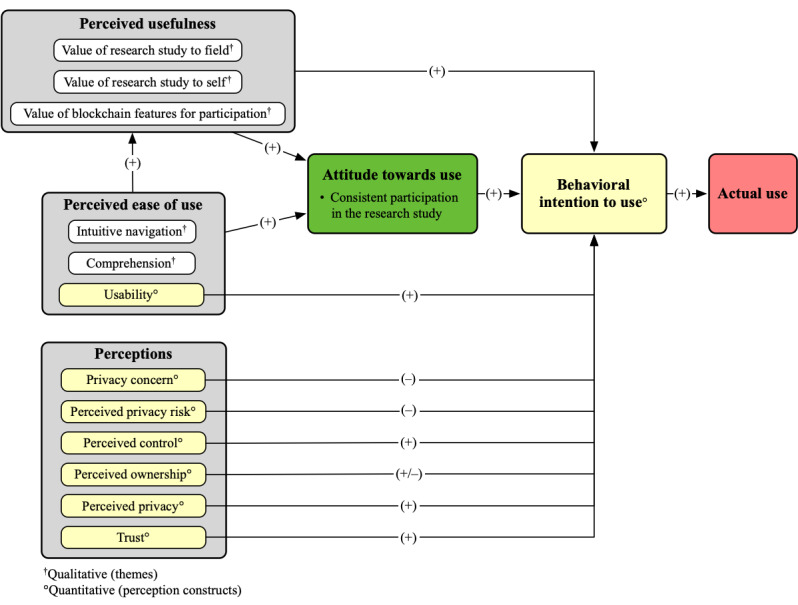
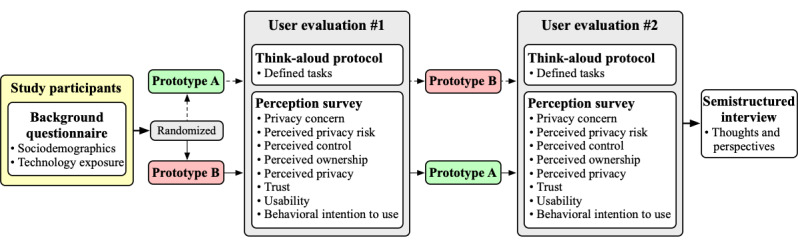
A convergent, mixed methods, experimental design was used to evaluate participant perceptions and attitudes toward using 2 app-based women's health research study prototypes with blockchain features. Prototype A was based on the status quo ResearchKit framework and had extensive electronic informed consent, while prototype B minimized study onboarding requirements and had no informed consent; the mechanisms of how the contributed data flowed and were made pseudonymous were the same. User evaluations were carried out in February and March 2021 and consisted of a think-aloud protocol, a perception survey, and a semistructured interview. Findings were mapped to the technology acceptance model to guide interpretation.
We recruited 16 representative female participants from 175 respondents. User evaluations revealed that while participants considered prototype B easier to use on intuitive navigation (theme 1) of specified tasks and comprehension (theme 2) of research procedures, prototype A trended toward being perceived more favorably than prototype B across most perception survey constructs, with an overall lower level of privacy concern (mean [SD]: 2.22 [1.10] vs 2.95 [1.29]) and perceived privacy risk (2.92 [1.46] vs 3.64 [1.73]) and higher level of perceived privacy (5.21 [1.26] vs 4.79 [1.47]), trust (5.46 [1.19] vs 4.76 [1.27]), and usability (67.81 [21.77] vs 64.84 [23.69]). Prototype B was perceived more favorably than prototype A with perceived control (4.92 [1.32] vs 4.89 [1.29]) and perceived ownership (5.18 [0.59] vs 5.01 [0.96]). These constructs, except for perceived ownership, were significantly correlated with behavioral intention to use the app (P<.05). Participants perceived the usefulness of these prototypes in relation to the value of research study to women's health field (theme 3), the value of research study to self (theme 4), and the value of blockchain features for participation (theme 5).
This study provides nuanced insights into how blockchain applications in app-based research remain secondary in value to participants' expectations of health research, and hence their intention to participate and contribute data. However, with impending data privacy and security concerns, it remains prudent to understand how to best integrate blockchain technology in digital health research infrastructure.
区块链技术具有变革数字健康研究中敏感个人健康数据保护、共享和访问方式的能力。鉴于女性健康数据未经授权披露会带来隐私和安全风险,其被视为特别敏感的数据。这些风险可能会影响研究参与度。我们采用设计时考虑隐私的方法,开发了两款基于应用程序的女性健康研究原型以供用户评估,并评估区块链可能如何影响参与度。
本研究旨在探寻女性的观点,以了解区块链技术在基于应用程序的数字研究中的应用是否会影响她们参与研究并提供敏感个人健康数据的决定。
采用收敛性混合方法实验设计,以评估参与者对两款具有区块链功能的基于应用程序的女性健康研究原型的看法和态度。原型A基于现状ResearchKit框架,有广泛的电子知情同意书,而原型B尽量减少研究入门要求且没有知情同意书;所提供数据的流动和匿名化机制相同。2021年2月和3月进行了用户评估,包括出声思维协议、认知调查和半结构化访谈。研究结果映射到技术接受模型以指导解释。
我们从175名受访者中招募了16名有代表性的女性参与者。用户评估显示,虽然参与者认为原型B在指定任务的直观导航(主题1)和研究程序的理解(主题2)方面更易于使用,但在大多数认知调查指标上,原型A比原型B更受青睐,总体隐私担忧水平较低(均值[标准差]:2.22[1.10]对2.95[1.29]),感知隐私风险较低(2.92[1.46]对3.64[1.73]),感知隐私水平较高(5.21[1.26]对4.79[1.47])、信任度较高(5.46[1.19]对4.76[1.27])和可用性较高(67.81[21.77]对64.84[23.69])。在感知控制(4.92[1.32]对4.89[1.29])和感知所有权(5.18[0.59]对5.01[0.96])方面,原型B比原型A更受青睐。除感知所有权外,这些指标与使用该应用程序的行为意向显著相关(P<0.05)。参与者认为这些原型在对女性健康领域研究的价值(主题3)、对自身研究的价值(主题4)以及区块链功能对参与的价值(主题5)方面有用。
本研究提供了细致入微的见解,说明基于应用程序的研究中的区块链应用在对参与者对健康研究的期望以及因此对他们参与和提供数据的意向方面,其价值仍居次要地位。然而,鉴于迫在眉睫的数据隐私和安全问题,了解如何在数字健康研究基础设施中最佳地整合区块链技术仍然是审慎之举。