Milanova Valentina, Lazarova Iva, Mihaylova Kalina, Gomes Michelle, Georgieva Teodora, Multmeier Jan
Anne's Day Ltd, London, United Kingdom.
TotalEffects GmbH, Oranienburg, Germany.
BMC Womens Health. 2025 Mar 26;25(1):141. doi: 10.1186/s12905-025-03652-z.
Cervical cancer remains a significant health concern, particularly in low-income and middle-income countries (LMICs). This study aims to compare the efficacy and suitability of a self-collected tampon for the detection of human papillomavirus (HPV) and sexually transmitted infections (STIs) using qualitative TMA-based assays (Transcription Mediated Amplification; APTIMA® HPV, APTIMA® Combo 2 (CT/NG; AC2 from now on) and APTIMA®Bacterial Vaginosis (BV from now on). Additionally, we assess the acceptability of tampons as a self-collection tool.
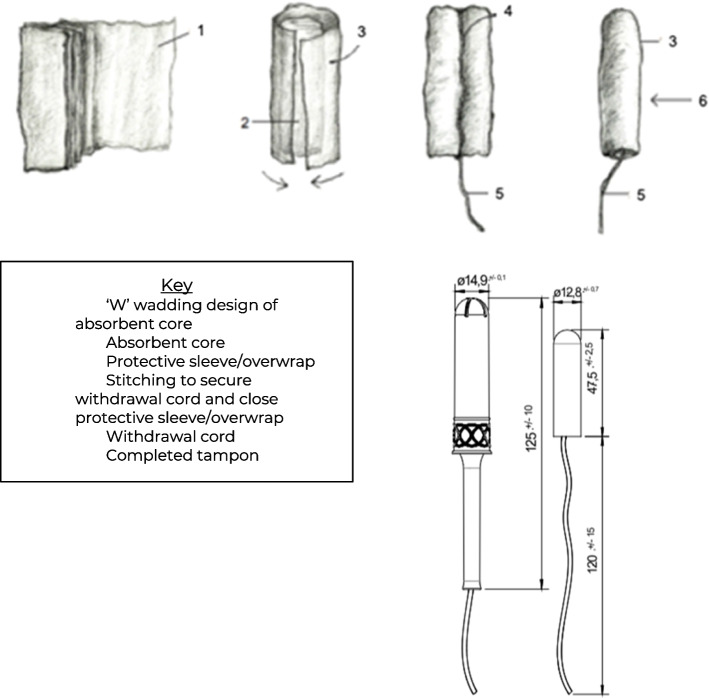
A cohort of 75 female participants aged 18-54 years was recruited through female-focused social networks. Participants provided informed consent and underwent both Health Care Workers (HCW-collected) and self-collected sample collection using the Daye Diagnostic Tampon. Samples were stored in ThinPrep Vials (TP Vial) or Aptima® Multitest Swab Collection Kit (APTIMA®) solutions. HPV and STI testing were performed using TMA-based assay on the fully automated Panther® Platform. Acceptability was assessed through a questionnaire with Likert-scale responses.
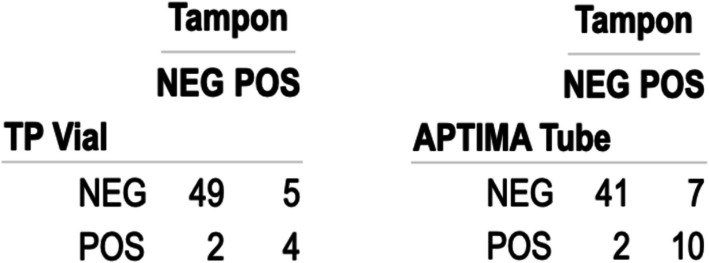
The study involved 60 participants who completed the study (80% of recruited participants). The self-collected tampons showed sensitivity and specificity of 66.67% and 90.74% (when rinsed in TP Vial) and 83.33% and 85.42% (when rinsed in APTIMA®) for HPV detection, respectively. For bacterial vaginosis (BV) detection, the tampons exhibited sensitivity and specificity of 100.0% and 96.43% (TP Vial) and 88.89% and 98.04% (APTIMA), respectively. For detection of chlamydia and gonorrhoea (AC2), the sensitivity and specificity were 100.00% and 100.0% (TP Vial) and 100.00% and 98.31% (APTIMA), respectively. Participants expressed a preference for tampon self-collection over HCW-collected swabs (90%).
Self-collected tampons demonstrated promising diagnostic accuracy to HCW-collected swabs for HPV and STI detection. The tampon self-collection method was well-accepted and preferred by participants, suggesting its potential as an alternative screening tool, particularly in low-resource settings. Further research with larger and more diverse populations is recommended to validate these findings and inform tampon-based self-collection programs for cervical cancer screening. Randomised controlled trials and comparisons with gold standard methods would enhance validation.
宫颈癌仍然是一个重大的健康问题,在低收入和中等收入国家(LMICs)尤为如此。本研究旨在比较使用基于转录介导扩增的定性检测方法(转录介导扩增;APTIMA®人乳头瘤病毒检测、APTIMA®联合检测2(沙眼衣原体/淋病奈瑟菌;以下简称AC2)和APTIMA®细菌性阴道病检测(以下简称BV))时,自行采集的棉塞在检测人乳头瘤病毒(HPV)和性传播感染(STIs)方面的有效性和适用性。此外,我们评估棉塞作为自行采集工具的可接受性。
通过以女性为重点的社交网络招募了75名年龄在18 - 54岁之间的女性参与者。参与者提供了知情同意书,并使用大业诊断棉塞进行了医护人员采集(HCW采集)和自行采集样本。样本储存在ThinPrep小瓶(TP小瓶)或Aptima®多重检测拭子采集试剂盒(APTIMA®)溶液中。使用基于转录介导扩增的检测方法在全自动Panther®平台上进行HPV和性传播感染检测。通过具有李克特量表反应的问卷评估可接受性。
该研究纳入了60名完成研究的参与者(占招募参与者的80%)。自行采集的棉塞在检测HPV时,当在TP小瓶中冲洗时,敏感性和特异性分别为66.67%和90.74%;当在APTIMA®中冲洗时,敏感性和特异性分别为83.33%和85.42%。对于细菌性阴道病(BV)检测,棉塞在TP小瓶中的敏感性和特异性分别为100.0%和96.43%,在APTIMA®中的敏感性和特异性分别为88.89%和98.04%。对于衣原体和淋病(AC2)检测,敏感性和特异性在TP小瓶中分别为100.00%和100.0%,在APTIMA®中分别为100.00%和98.31%。参与者表示比起医护人员采集的拭子,更喜欢自行采集棉塞(90%)。
自行采集的棉塞在检测HPV和性传播感染方面,与医护人员采集的拭子相比,显示出有前景的诊断准确性。棉塞自行采集方法被参与者很好地接受且更受青睐,表明其作为一种替代筛查工具的潜力,特别是在资源匮乏的环境中。建议对更大规模和更多样化的人群进行进一步研究,以验证这些发现,并为基于棉塞的宫颈癌筛查自行采集项目提供信息。随机对照试验以及与金标准方法的比较将加强验证。