Yu Shi Nae, Hong Sun In, Park Jung Wan, Jeon Min Hyok, Cho Oh Hyun
Division of Infectious Diseases, Department of Internal Medicine, Soonchunhyang University Cheonan Hospital, Soonchunhyang University College of Medicine, 31, Suncheonhyang 6-gil, Dongnam-gu, Cheonan 31151, Republic of Korea.
J Fungi (Basel). 2025 Mar 12;11(3):217. doi: 10.3390/jof11030217.
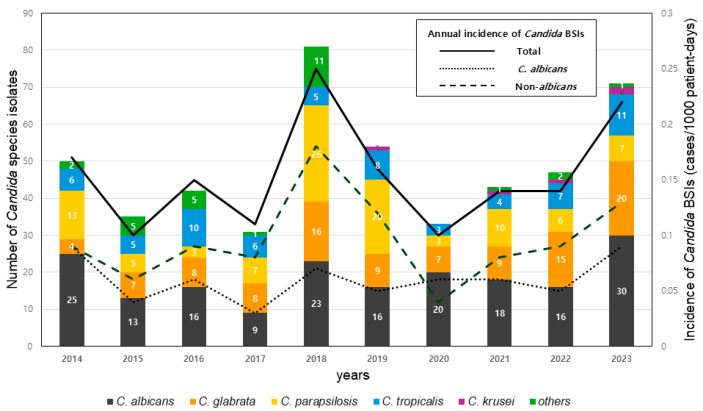
species are major pathogens of bloodstream infections (BSIs) in hospitalized patients, with high mortality. This study examined species distribution, clinical characteristics, and the mortality of patients with BSIs. Adult patients (≥16 years) with BSIs at a teaching hospital (2014-2023) were retrospectively reviewed. Over 10 years, 487 isolates were obtained from 462 patients. was the most frequent (38.2%), followed by (21.1%), (20.5%), and (13.3%). The annual incidence of BSIs remained stable ( = 0.525). However, non- species BSIs increased 1.61-fold compared to (95% CI: 1.19-2.19, = 0.002). Fluconazole-non-susceptible isolates increased after 2021 ( = 0.040). The overall 30-day mortality was 40.6%. In the multivariate analysis, a high Charlson comorbidity index (aHR: 1.20, 95% CI: 1.07-1.35, = 0.001) and high SOFA score (aHR: 1.12, 95% CI: 1.02-1.23, = 0.022) were the strongest predictors of 30-day mortality. Meanwhile, BSIs (aHR: 0.46, 95% CI: 0.22-0.99, = 0.047) and central venous catheter removal at any time (aHR: 0.22, 95% CI: 0.13-0.37, < 0.001) were associated with reduced 30-day mortality. The mortality of patients with BSIs was mainly determined by disease severity, while catheter removal was associated with improved survival.
某些菌种是住院患者血流感染(BSIs)的主要病原体,死亡率很高。本研究调查了血流感染患者的菌种分布、临床特征及死亡率。对一家教学医院(2014 - 2023年)的成年(≥16岁)血流感染患者进行了回顾性分析。在10多年间,从462例患者中分离出487株菌株。某菌种最为常见(38.2%),其次是另一菌种(21.1%)、又一菌种(20.5%)和再一菌种(13.3%)。血流感染的年发病率保持稳定(P = 0.525)。然而,非该常见菌种的血流感染与该常见菌种相比增加了1.61倍(95%置信区间:1.19 - 2.19,P = 0.002)。2021年后,对氟康唑不敏感的菌株有所增加(P = 0.040)。总体30天死亡率为40.6%。在多因素分析中,高Charlson合并症指数(校正风险比:1.20,95%置信区间:1.07 - 1.35,P = 0.001)和高序贯器官衰竭评估(SOFA)评分(校正风险比:1.12,95%置信区间:1.02 - 1.23,P = 0.022)是30天死亡率的最强预测因素。同时,该特定菌种的血流感染(校正风险比:0.46,95%置信区间:0.22 - 0.99,P = 0.047)以及随时拔除中心静脉导管(校正风险比:0.22,95%置信区间:0.13 - 0.37,P < 0.001)与30天死亡率降低相关。血流感染患者的死亡率主要由疾病严重程度决定,而拔除导管与生存率提高相关。