Montilla Alejandro, Zabala Alazne, Calvo Ibai, Bosch-Juan Marina, Tomé-Velasco Irene, Mata Paloma, Koster Mirjam, Sierra Amanda, Kooistra Susanne M, Soria Federico N, Eggen Bart J L, Fresnedo Olatz, Fernández José Andrés, Tepavcevic Vanja, Matute Carlos, Domercq María
Achucarro Basque Center for Neuroscience, E-48940, Leioa, Spain.
Department of Neuroscience, University of the Basque Country UPV/EHU, E-48940, Leioa, Spain.
Cell Mol Life Sci. 2025 Mar 26;82(1):131. doi: 10.1007/s00018-025-05648-2.
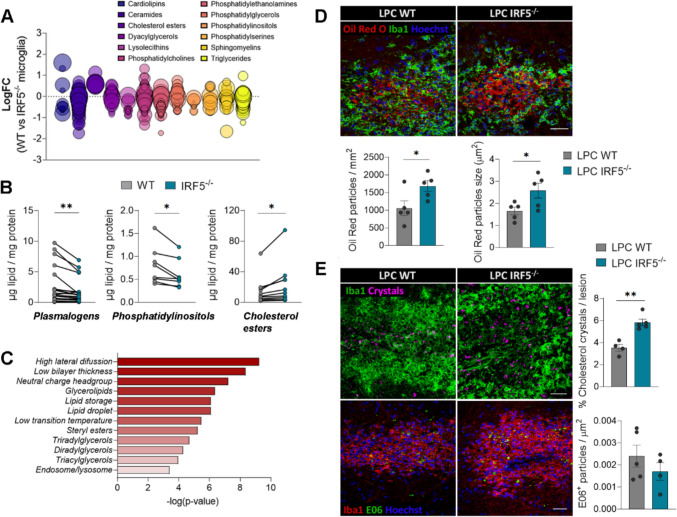
Interferon regulatory factor 5 (IRF5) is a transcription factor that plays a role in orchestrating innate immune responses, particularly in response to viral infections. Notably, IRF5 has been identified as a microglia risk gene linked to multiple sclerosis (MS), but its specific role in MS pathogenesis remains unclear. Through the use of Irf5 mice, our study uncovers a non-canonical function of IRF5 in MS recovery. Irf5 mice exhibited increased damage in an experimental autoimmune encephalomyelitis (EAE) model and demonstrated impaired oligodendrocyte recruitment into the lesion core following lysolecithin-induced demyelination. Transcriptomic and lipidomic analyses revealed that IRF5 has a role in microglia-mediated myelin phagocytosis, lipid metabolism, and cholesterol homeostasis. Indeed, Irf5 microglia phagocytose myelin, but myelin debris is not adequately degraded, leading to an accumulation of lipid droplets, cholesterol esters, and cholesterol crystals within demyelinating lesions. This abnormal buildup can hinder remyelination processes. Importantly, treatments that promote cholesterol transport were found to reduce lipid droplet accumulation and mitigate the exacerbated damage in Irf5 mice with EAE. Altogether, our study identified the antiviral transcription factor IRF5 as a key transcriptional regulator of lipid degradation and cholesterol homeostasis and suggest that loss of IRF5 function leads to pathogenic lipid accumulation in microglia, thereby obstructing remyelination. These data and the fact that Irf5 polymorphisms are significantly associated with MS, highlight IRF5 as a potential therapeutic target to promote regenerative responses.
干扰素调节因子5(IRF5)是一种转录因子,在协调先天免疫反应中发挥作用,尤其是在应对病毒感染时。值得注意的是,IRF5已被确定为与多发性硬化症(MS)相关的小胶质细胞风险基因,但其在MS发病机制中的具体作用仍不清楚。通过使用Irf5基因敲除小鼠,我们的研究揭示了IRF5在MS恢复中的非经典功能。Irf5基因敲除小鼠在实验性自身免疫性脑脊髓炎(EAE)模型中表现出更严重的损伤,并且在溶血卵磷脂诱导的脱髓鞘后,少突胶质细胞向损伤核心的募集受损。转录组学和脂质组学分析表明,IRF5在小胶质细胞介导的髓鞘吞噬、脂质代谢和胆固醇稳态中发挥作用。事实上,Irf5基因敲除的小胶质细胞吞噬髓鞘,但髓鞘碎片没有得到充分降解,导致脱髓鞘病变内脂滴、胆固醇酯和胆固醇晶体的积累。这种异常积累会阻碍髓鞘再生过程。重要的是,发现促进胆固醇转运的治疗方法可以减少脂滴积累,并减轻EAE模型中Irf5基因敲除小鼠的加重损伤。总之,我们的研究确定抗病毒转录因子IRF5是脂质降解和胆固醇稳态的关键转录调节因子,并表明IRF5功能丧失导致小胶质细胞中致病性脂质积累,从而阻碍髓鞘再生。这些数据以及Irf5基因多态性与MS显著相关的事实,突出了IRF5作为促进再生反应的潜在治疗靶点。