Karakasis Paschalis, Theofilis Panagiotis, Lefkou Eleftheria, Antoniadis Antonios P, Patoulias Dimitrios, Korantzopoulos Panagiotis, Fragakis Nikolaos
Second Department of Cardiology, Hippokration General Hospital, Medical School, Aristotle University of Thessaloniki, Konstantinoupoleos 49, 54642 Thessaloniki, Greece.
First Cardiology Department, School of Medicine, Hippokration General Hospital, National and Kapodistrian University of Athens, 11527 Athens, Greece.
Int J Mol Sci. 2025 Mar 18;26(6):2739. doi: 10.3390/ijms26062739.
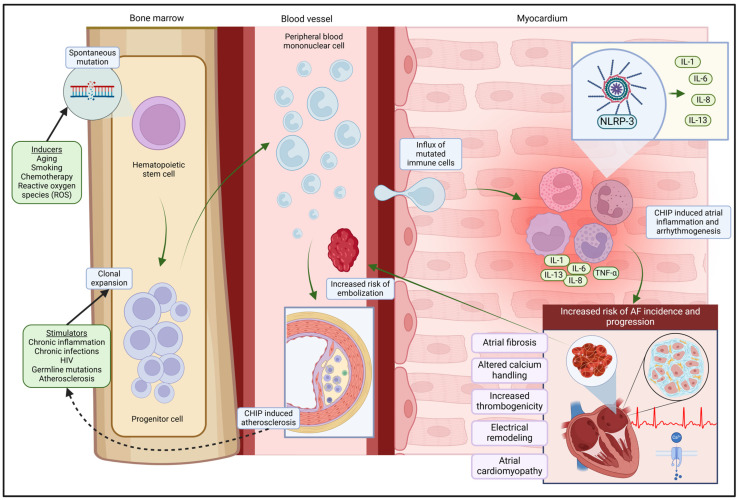
Clonal hematopoiesis of indeterminate potential (CHIP) has emerged as a novel risk factor for cardiovascular diseases. CHIP is characterized by the expansion of hematopoietic stem cell clones harboring somatic mutations in genes such as TET2, DNMT3A, and ASXL1, which are implicated in inflammation, atrial remodeling, and hypercoagulability. These mutations foster a pro-inflammatory and pro-thrombotic environment conducive to arrhythmogenesis, thereby linking CHIP to the development and progression of atrial fibrillation (AF). Mechanistic insights indicate that CHIP contributes to atrial fibrosis, disrupts calcium signaling, and exacerbates oxidative stress, all of which heighten susceptibility to AF. Clinical studies, including epidemiological and Mendelian randomization analyses, further support the association between CHIP and an increased risk of both incident and progressive AF, with specific mutations such as TET2 and ASXL1 identified as significant contributors. Additionally, CHIP has been linked to adverse outcomes in AF, including elevated rates of heart failure, thromboembolism, and mortality. Understanding CHIP's role in AF pathophysiology offers opportunities for the development of precision medicine approaches, providing novel avenues for early intervention and targeted AF treatment. This review synthesizes current mechanistic and clinical evidence on the role of CHIP in AF, emphasizes its potential as a biomarker for risk stratification, and explores emerging therapeutic strategies targeting CHIP-associated pathways.
不确定潜能的克隆性造血(CHIP)已成为心血管疾病的一种新的危险因素。CHIP的特征是造血干细胞克隆的扩增,这些克隆在TET2、DNMT3A和ASXL1等基因中存在体细胞突变,这些基因与炎症、心房重塑和高凝状态有关。这些突变促进了有利于心律失常发生的促炎和促血栓形成环境,从而将CHIP与心房颤动(AF)的发生和发展联系起来。机制研究表明,CHIP会导致心房纤维化、破坏钙信号并加剧氧化应激,所有这些都会增加对AF的易感性。包括流行病学和孟德尔随机化分析在内的临床研究进一步支持了CHIP与新发和进展性AF风险增加之间的关联,其中TET2和ASXL1等特定突变被确定为重要因素。此外,CHIP还与AF的不良结局有关,包括心力衰竭、血栓栓塞和死亡率升高。了解CHIP在AF病理生理学中的作用为精准医学方法的发展提供了机会,为早期干预和靶向AF治疗提供了新途径。本综述综合了关于CHIP在AF中作用的当前机制和临床证据,强调其作为风险分层生物标志物的潜力,并探索针对CHIP相关途径的新兴治疗策略。