Minacori Marco, Fiorini Sara, Perugini Monia, Iannetta Annamaria, Meschiari Giorgia, Chichiarelli Silvia, Altieri Fabio, Natali Pier Giorgio, Eufemi Margherita
Department of Biochemical Science "A. Rossi Fanelli", Faculty of Pharmacy and Medicine, Sapienza University of Rome, P.le Aldo Moro 5, 00185 Rome, Italy.
Department of Bioscience and Agro-Food and Environmental Technology, University of Teramo, Campus "Aurelio Saliceti", Via R. Balzarini 1, 64100 Teramo, Italy.
Int J Mol Sci. 2025 Mar 18;26(6):2744. doi: 10.3390/ijms26062744.
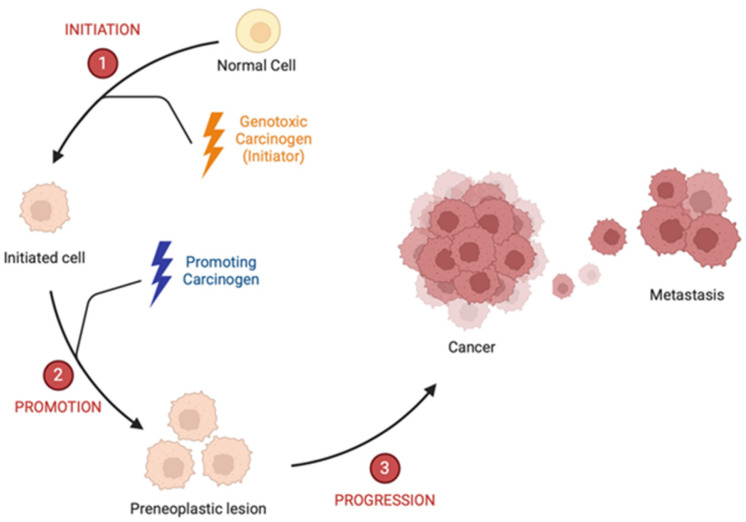
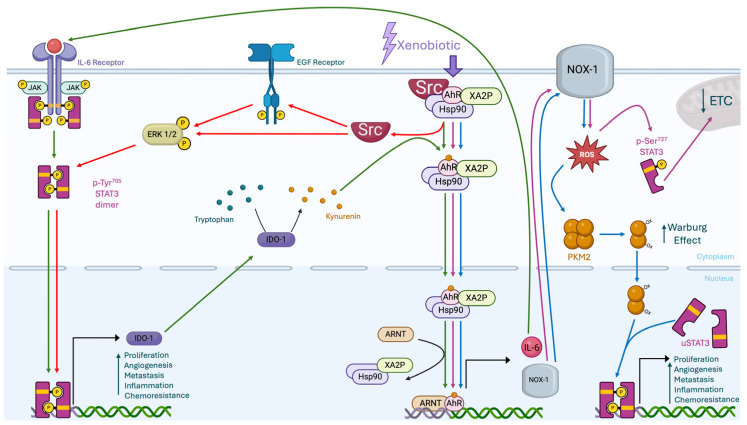
Human chemical carcinogenesis is a multistage process where chemicals or their metabolites cause irreversible changes in normal cell physiology, eventually leading to uncontrolled proliferation, transforming a normal cell into a cancerous one. Signal transducer and activator of transcription 3 (STAT3) is a cytoplasmic transcription factor that regulates cell proliferation, differentiation, apoptosis, angiogenesis, inflammation, and immune responses. Its aberrant activation triggers tumor progression by promoting the expression of oncogenic genes; thus, STAT3 is classified as an oncoprotein. The aryl hydrocarbon receptor (AhR) is a ligand-activated transcription factor that responds to a wide variety of chemicals, including carcinogens like dioxins, inducing genes associated with detoxification, proliferation, and immune regulation. Recent reports show that AhR plays a critical role in cancer development and maintenance. AhR may interact with signaling pathways, like the STAT3 pathway, which mediates the carcinogenic effects of several pollutants. Various chemical agents, such as industrial waste and hydrocarbon compounds, can alter the expression or signaling activity of AhR and STAT3 pathways, leading to different types of cancers. Understanding the complex STAT3-AhR network in the regulation of chemical carcinogenesis could open new avenues for cancer prevention or treatment, particularly in personalized medicine, aiming to improve life expectancy and achieving a complete cure.
人类化学致癌作用是一个多阶段过程,在此过程中,化学物质或其代谢产物会导致正常细胞生理发生不可逆变化,最终导致不受控制的增殖,将正常细胞转变为癌细胞。信号转导和转录激活因子3(STAT3)是一种细胞质转录因子,可调节细胞增殖、分化、凋亡、血管生成、炎症和免疫反应。其异常激活通过促进致癌基因的表达来触发肿瘤进展;因此,STAT3被归类为一种癌蛋白。芳烃受体(AhR)是一种配体激活的转录因子,可对多种化学物质作出反应,包括二恶英等致癌物,诱导与解毒、增殖和免疫调节相关的基因。最近的报告表明,AhR在癌症发展和维持中起关键作用。AhR可能与信号通路相互作用,如STAT3通路,该通路介导几种污染物的致癌作用。各种化学物质,如工业废物和碳氢化合物,可改变AhR和STAT3通路的表达或信号活性,导致不同类型的癌症。了解化学致癌作用调控中复杂的STAT3-AhR网络可能为癌症预防或治疗开辟新途径,特别是在个性化医学中,旨在提高预期寿命并实现完全治愈。