Dam Sharmistha, Tscherne Alina, Engels Leoni, Sutter Gerd, Osterhaus Albert D M E, Rimmelzwaan Guus F
Research Center for Emerging Infections and Zoonoses, University of Veterinary Medicine, Hannover, Germany.
Division of Virology, Department of Veterinary Sciences, Ludwig Maximilians University Munich (LMU Munich), Oberschleißheim, Germany.
Sci Rep. 2025 Mar 27;15(1):10586. doi: 10.1038/s41598-025-95479-9.
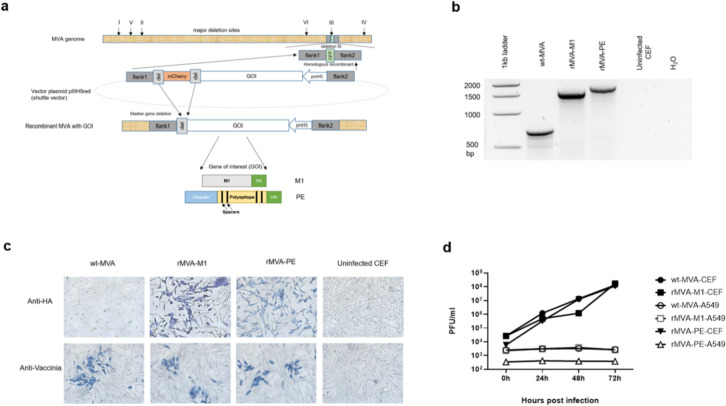
The availability of influenza vaccines that can induce broadly protective immune responses is highly desirable and could also mitigate the impact of future influenza pandemics. Ideally, these vaccines also induce virus-specific CD8 + T cells, which have been identified as an independent correlate of protection. In the present study, we explored the use of an artificial immunogen that comprises of twenty highly conserved influenza virus CD8 + T cell epitopes with an HLA coverage of 99.5% of the world population. The highly attenuated viral vector Modified Vaccinia virus Ankara (MVA) was used to deliver the artificial poly-epitope sequence (rMVA-PE) and by using T cell lines raised against individual epitopes, we confirmed that the epitopes are liberated from the artificial immunogen. For efficient antigen processing and presentation, the epitopes were separated by spacer sequences. Stimulation of peripheral blood mononuclear cells of HLA-typed blood donors with rMVA-PE resulted in the activation of influenza virus-specific T cell responses. Furthermore, immunization of humanized HLA-A2.1-/HLA-DR1-transgenic H-2 class I-/class II-knockout mice (HLA-A*02:01) with rMVA-PE induced influenza virus-specific CD8 + T cell responses. Thus, rMVA-PE proved to be immunogenic both in vitro and in vivo and constitutes a promising vaccine candidate for the induction of cross-reactive CD8 + T cell responses that could afford protection against antigenically distinct influenza A viruses (IAV) of various subtypes and species, and is currently considered for further clinical testing.
能够诱导广泛保护性免疫反应的流感疫苗非常理想,也可以减轻未来流感大流行的影响。理想情况下,这些疫苗还能诱导病毒特异性CD8 + T细胞,该细胞已被确定为保护的独立相关因素。在本研究中,我们探索了一种人工免疫原的用途,该免疫原由二十个高度保守的流感病毒CD8 + T细胞表位组成,HLA覆盖全球99.5%的人口。高度减毒的病毒载体安卡拉痘苗病毒(MVA)用于递送人工多表位序列(rMVA-PE),通过使用针对单个表位产生的T细胞系,我们证实这些表位从人工免疫原中释放出来。为了实现有效的抗原加工和呈递,表位由间隔序列隔开。用rMVA-PE刺激HLA分型献血者的外周血单核细胞,可激活流感病毒特异性T细胞反应。此外,用rMVA-PE免疫人源化HLA-A2.1-/HLA-DR1转基因H-2 I类/II类敲除小鼠(HLA-A*02:01)可诱导流感病毒特异性CD8 + T细胞反应。因此,rMVA-PE在体外和体内均具有免疫原性,是一种有前景的疫苗候选物,可诱导交叉反应性CD8 + T细胞反应,从而提供针对各种亚型和物种的抗原性不同的甲型流感病毒(IAV)的保护,目前正在考虑进行进一步的临床试验。