Xu Yadong, Liu Xiaoan, Yang Aimei, Hao Ziyi, Li Xuening, Li Dan, Yu Xiaoping, Ye Xinping
College of Life Sciences, Shaanxi Normal University, Xi'an 710119, China.
Research Center for UAV Remote Sensing, Shaanxi Normal University, Xi'an 710062, China.
Animals (Basel). 2025 Mar 12;15(6):801. doi: 10.3390/ani15060801.
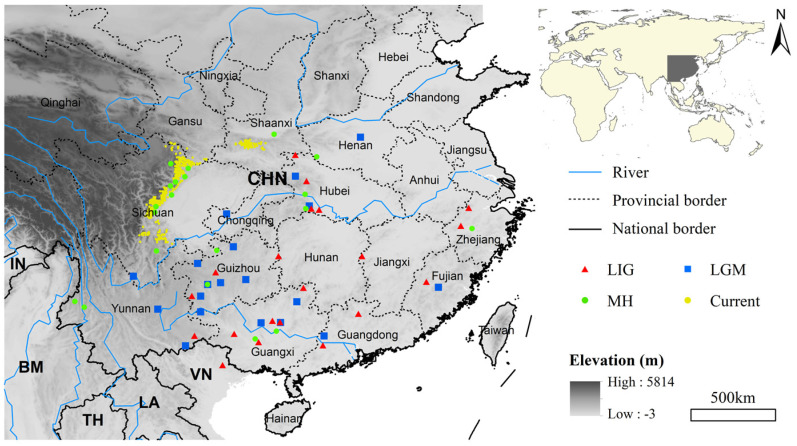
Understanding the response of species to past climate change provides great opportunities to know their adaptive capacity for resilience under future climate change. Since the Late Pleistocene, dramatic climate fluctuations have significantly impacted the distribution of giant pandas (). However, how the spatial distribution and climatic niche of giant pandas shifted in response to past climate change remain poorly understood. Based on the known distribution records (fossil and present day) and the most updated climate projections for the Last Interglacial (LIG; ~120 ka), Last Glacial Maximum (LGM; ~22 ka), Mid-Holocene (MH; ~6 ka), and the present day, we predicted and compared the distribution and climatic niche of giant pandas. The results show that giant pandas have undergone a considerable range contraction (a 28.27% reduction) followed by a marked range expansion (a 75.8% increase) during the LIG-LGM-MH period, while its climatic niche remained relatively stable. However, from the MH to the current, both the distribution area and climatic niche of giant pandas have undergone significant changes. Our findings suggest that the giant panda may adjust its distribution to track stable climatic niches in response to future climate change. Future conservation planning should designate accessible areas for giant pandas and adjust priority conservation areas as needed.
了解物种对过去气候变化的响应,为认识它们在未来气候变化下的适应恢复能力提供了绝佳机会。自晚更新世以来,剧烈的气候波动对大熊猫的分布产生了重大影响。然而,大熊猫的空间分布和气候生态位如何随着过去的气候变化而变化,目前仍知之甚少。基于已知的分布记录(化石和现代)以及末次间冰期(LIG;约12万年)、末次盛冰期(LGM;约2.2万年)、全新世中期(MH;约6千年)和现代的最新气候预测,我们对大熊猫的分布和气候生态位进行了预测和比较。结果表明,在LIG-LGM-MH时期,大熊猫经历了相当程度的分布范围收缩(减少了28.27%),随后是显著的分布范围扩张(增加了75.8%),而其气候生态位保持相对稳定。然而,从全新世中期到现在,大熊猫的分布面积和气候生态位都发生了显著变化。我们的研究结果表明,大熊猫可能会调整其分布以追踪稳定的气候生态位,以应对未来的气候变化。未来的保护规划应为大熊猫指定可达区域,并根据需要调整优先保护区域。