Gao Fei, Li Huikai, Feng Xiuxue, Chen Qianqian, Du Chen, Cheng Bingqian, Han Ke, Chai Ningli, Linghu Enqiang
Department of Gastroenterology, the First Medical Center of Chinese PLA General Hospital, Beijing 100853, China.
Government Offices Administration of the Central Military Commission, Beijing 100034, China.
Endosc Ultrasound. 2025 Jan-Feb;14(1):4-12. doi: 10.1097/eus.0000000000000105. Epub 2025 Mar 3.
To explore the safety and efficacy of injections of 1%, 2%, or 3% lauromacrogol during EUS-guided lauromacrogol ablation (EUS-LA) for the treatment of pancreatic cystic neoplasms (PCNs) and to determine the optimal concentration of lauromacrogol for use in EUS-LA therapeutic regimens.
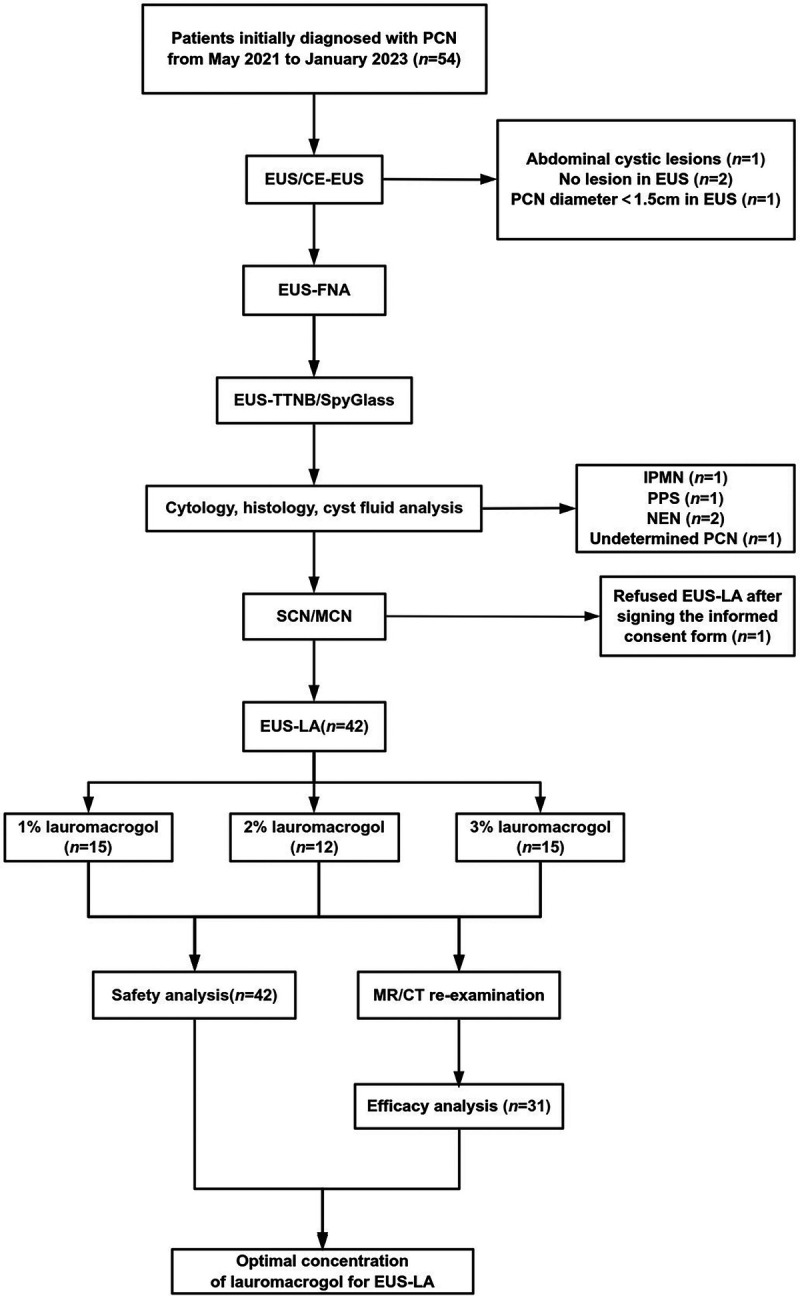
From May 2021 to January 2023, patients who met the indications for EUS-LA were randomly divided into 3 groups: A, B, and C; the patients in these groups were injected with 1%, 2%, and 3% lauromacrogol during EUS-LA, respectively. Safety was evaluated based on the incidence of postoperative complications. Efficacy was comprehensively evaluated by assessing the ablation rate and ablation effect.
Forty-two patients underwent EUS-LA, and 31 patients completed at least 1 postoperative re-examination. No acute pancreatitis was observed in the 1% and 2% lauromacrogol groups, and 1 case of acute pancreatitis occurred in the 3% lauromacrogol group. The total complication rate was 2.4%. The median ablation rates of the groups were 94.1%, 82.0%, and 100.0%, respectively. There were statistically significant differences in the EUS-LA ablation rate between the 1% and 3% lauromacrogol groups and between the 2% and 3% lauromacrogol groups. There was a statistically significant difference in complete disappearance between the 1% and 3% lauromacrogol groups as well as between the 2% and 3% lauromacrogol groups.
The short-term outcomes showed that injections of 1%, 2%, and 3% lauromacrogol were safe for use in EUS-LA, and injection of 3% lauromacrogol was the most effective for EUS-LA.
探讨在超声内镜引导下聚桂醇消融术(EUS-LA)治疗胰腺囊性肿瘤(PCNs)过程中,注射1%、2%或3%聚桂醇的安全性和有效性,并确定EUS-LA治疗方案中聚桂醇的最佳浓度。
2021年5月至2023年1月,将符合EUS-LA适应证的患者随机分为A、B、C三组;在EUS-LA过程中,分别向这些组的患者注射1%、2%和3%的聚桂醇。根据术后并发症发生率评估安全性。通过评估消融率和消融效果综合评价疗效。
42例患者接受了EUS-LA,31例患者完成了至少1次术后复查。1%和2%聚桂醇组未观察到急性胰腺炎,3%聚桂醇组发生1例急性胰腺炎。总并发症发生率为2.4%。三组的中位消融率分别为94.1%、82.0%和100.0%。1%与3%聚桂醇组之间以及2%与3%聚桂醇组之间的EUS-LA消融率存在统计学显著差异。1%与3%聚桂醇组之间以及2%与3%聚桂醇组之间在完全消失方面存在统计学显著差异。
短期结果表明,在EUS-LA中注射1%、2%和3%的聚桂醇是安全的,注射3%聚桂醇对EUS-LA最有效。