Tang Qiaolin, Meng Xiangzhu, Tu Xiaowen, Zhang Jian
Department of Cardiology, Jiangxi Province Hospital of Integrated Chinese and Western Medicine, Nanchang, China.
Clin Appl Thromb Hemost. 2025 Jan-Dec;31:10760296251328011. doi: 10.1177/10760296251328011. Epub 2025 Mar 28.
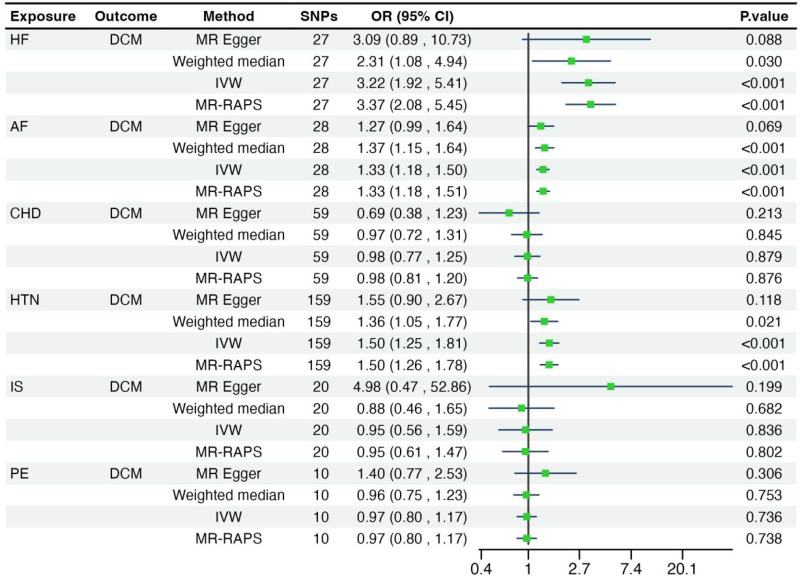
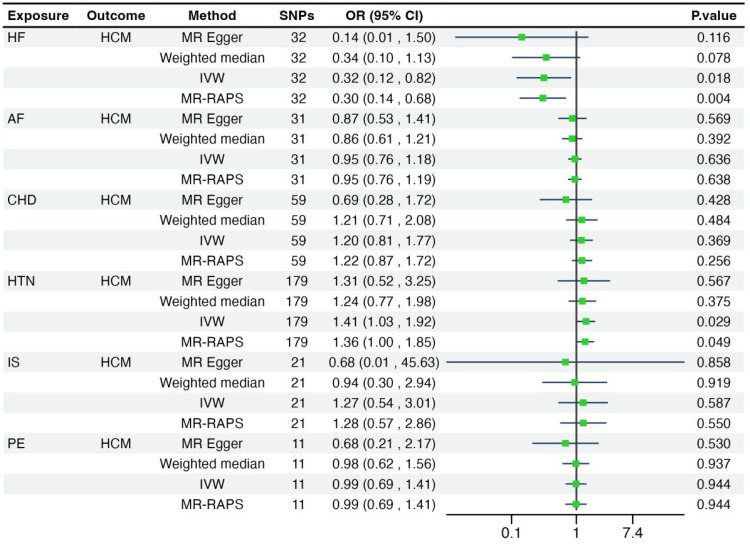
Cardiomyopathies are commonly believed to have genetic origins; however, the connection between cardiomyopathies and cardiovascular diseases remains uncertain. Thus, we employed a Mendelian randomization (MR) approach to investigate the potential causal effects of specific cardiovascular disease subtypes on dilated and hypertrophic cardiomyopathies, focusing primarily on a European population. Summary-level data for cardiomyopathies and other cardiovascular diseases were obtained from public genome-wide association studies. Random-effects inverse-variance weighting was used as the primary analysis, whereas sensitivity analyses, including weighted median, MR-Egger, and multivariable MR methods, were also conducted. A genetic predisposition to atrial fibrillation [odds ratio (OR): 1.33; 95% confidence interval (CI): 1.18-1.50; P < 0.001], heart failure (OR: 3.22; 95% CI: 1.92-5.41; P < 0.001), and hypertension (OR: 1.50; 95% CI: 1.25-1.81; P < 0.001) were causally linked to an increased risk of developing dilated cardiomyopathy. However, there was no direct causal connection between genetically predicted coronary heart disease, pulmonary embolism, or ischemic stroke and the risk of developing dilated cardiomyopathy. In contrast, no significant associations were found between genetically predicted CVD subtypes and the risk of developing hypertrophic cardiomyopathy. Genetically predicted heart failure is significantly associated with the risk of developing dilated cardiomyopathy, underscoring the importance of effective heart failure management for risk prevention. Moreover, individuals with hypertension and atrial fibrillation might have an increased predisposition to dilated cardiomyopathy, highlighting crucial implications for management.
心肌病通常被认为有遗传起源;然而,心肌病与心血管疾病之间的联系仍不明确。因此,我们采用孟德尔随机化(MR)方法来研究特定心血管疾病亚型对扩张型和肥厚型心肌病的潜在因果效应,主要聚焦于欧洲人群。心肌病和其他心血管疾病的汇总数据来自公开的全基因组关联研究。随机效应逆方差加权法用作主要分析方法,同时还进行了敏感性分析,包括加权中位数、MR-Egger和多变量MR方法。房颤的遗传易感性[比值比(OR):1.33;95%置信区间(CI):1.18 - 1.50;P < 0.001]、心力衰竭(OR:3.22;95% CI:1.92 - 5.41;P < 0.001)和高血压(OR:1.50;95% CI:1.25 - 1.81;P < 0.001)与扩张型心肌病发病风险增加存在因果关联。然而,遗传预测的冠心病、肺栓塞或缺血性中风与扩张型心肌病发病风险之间没有直接因果联系。相比之下,在遗传预测的心血管疾病亚型与肥厚型心肌病发病风险之间未发现显著关联。遗传预测的心力衰竭与扩张型心肌病发病风险显著相关,这凸显了有效管理心力衰竭对预防风险的重要性。此外,高血压和房颤患者可能更易患扩张型心肌病,这对治疗具有关键意义。