
机器学习在帕金森病认知障碍中的作用:系统评价与荟萃分析
The Role of Machine Learning in Cognitive Impairment in Parkinson Disease: Systematic Review and Meta-Analysis.
作者信息
Wu Yanyun, Cheng Yangfan, Xiao Yi, Shang Huifang, Ou Ruwei
机构信息
Department of Neurology, West China Hospital of Sichuan University, Chengdu, China.
出版信息
J Med Internet Res. 2025 Mar 14;27:e59649. doi: 10.2196/59649.
BACKGROUND
Parkinson disease (PD) is a common neurodegenerative disease characterized by both motor and nonmotor symptoms. Cognitive impairment often occurs early in the disease and can persist throughout its progression, severely impacting patients' quality of life. The utilization of machine learning (ML) has recently shown promise in identifying cognitive impairment in patients with PD.
OBJECTIVE
This study aims to summarize different ML models applied to cognitive impairment in patients with PD and to identify determinants for improving diagnosis and predictive power for early detection of cognitive impairment.
METHODS
PubMed, Cochrane, Embase, and Web of Science were searched for relevant articles on March 2, 2024. The risk of bias was assessed using the Quality Assessment of Diagnostic Accuracy Studies-2 (QUADAS-2). Bivariate meta-analysis was used to estimate pooled sensitivity and specificity results, presented as odds ratio (OR) and 95% CI. A summary receiver operator characteristic (SROC) curve was used.
RESULTS
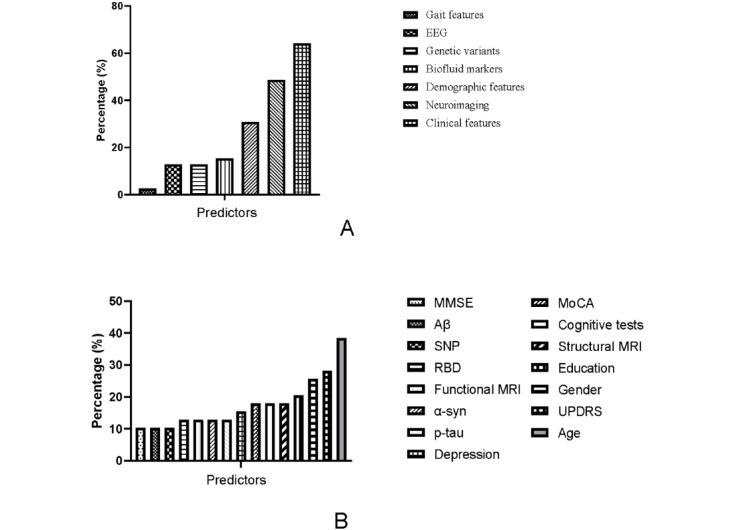
A total of 38 articles met the criteria, involving 8564 patients with PD and 1134 healthy controls. Overall, 120 models reported sensitivity and specificity, with mean values of 71.07% (SD 13.72%) and 77.01% (SD 14.31%), respectively. Predictors commonly used in ML models included clinical features, neuroimaging features, and other variables. No significant heterogeneity was observed in the bivariate meta-analysis, which included 12 studies. Using sensitivity as the metric, the combined sensitivity and specificity were 0.76 (95% CI 0.67-0.83) and 0.83 (95% CI 0.76-0.88), respectively. When specificity was used, the combined values were 0.77 (95% CI 0.65-0.86) and 0.76 (95% CI 0.63-0.85), respectively. The area under the curves of the SROC were 0.87 (95% CI 0.83-0.89) and 0.83 (95% CI 0.80-0.86) respectively.
CONCLUSIONS
Our findings provide a comprehensive summary of various ML models and demonstrate the effectiveness of ML as a tool for diagnosing and predicting cognitive impairment in patients with PD.
TRIAL REGISTRATION
PROSPERO CRD42023480196; https://www.crd.york.ac.uk/PROSPERO/view/CRD42023480196.
背景
帕金森病(PD)是一种常见的神经退行性疾病,具有运动和非运动症状。认知障碍常在疾病早期出现,并可在疾病进展过程中持续存在,严重影响患者的生活质量。机器学习(ML)的应用最近在识别帕金森病患者的认知障碍方面显示出前景。
目的
本研究旨在总结应用于帕金森病患者认知障碍的不同机器学习模型,并确定改善诊断和早期检测认知障碍预测能力的决定因素。
方法
于2024年3月2日在PubMed、Cochrane、Embase和Web of Science上检索相关文章。使用诊断准确性研究质量评估-2(QUADAS-2)评估偏倚风险。采用双变量荟萃分析来估计合并的敏感性和特异性结果,以比值比(OR)和95%置信区间(CI)表示。使用汇总受试者工作特征(SROC)曲线。
结果
共有38篇文章符合标准,涉及8564例帕金森病患者和1134例健康对照。总体而言,120个模型报告了敏感性和特异性,平均值分别为71.07%(标准差13.72%)和77.01%(标准差14.31%)。机器学习模型中常用的预测因素包括临床特征、神经影像学特征和其他变量。在包括12项研究的双变量荟萃分析中未观察到显著异质性。以敏感性为指标,合并的敏感性和特异性分别为0.76(95%CI 0.67 - 0.83)和0.83(95%CI 0.76 - 0.88)。当以特异性为指标时,合并值分别为0.77(95%CI 0.65 - 0.86)和0.76(95%CI 0.63 - 0.85)。SROC曲线下面积分别为0.87(95%CI 0.83 - 0.89)和0.83(95%CI 0.80 - 0.86)。
结论
我们的研究结果对各种机器学习模型进行了全面总结,并证明了机器学习作为诊断和预测帕金森病患者认知障碍工具的有效性。
试验注册
PROSPERO CRD42023480196;https://www.crd.york.ac.uk/PROSPERO/view/CRD42023480196。



 Zotero 插件