Harris Cheryl, Giguère Lauriane, Chu Alanna, Lamarche Jani, Langmuir Tori, Menelas Kerry, Rutkowski Nicole, Sehabi Ghizlène, Lebel Sophie
Neuroscience Program, The Ottawa Hospital Research Institute, The Ottawa Hospital, Ottawa, Canada.
School of Psychology, Faculty of Social Sciences, University of Ottawa, Ottawa, Canada.
Psychooncology. 2025 Apr;34(4):e70140. doi: 10.1002/pon.70140.
New treatments are contributing to individuals living longer with advanced, metastatic, or incurable (AMI) cancers. The impact of these treatments is unpredictable, resulting in considerable uncertainty for these patients. Currently, there are no interventions that effectively address uncertainty in AMI cancers. To fill this gap, we designed the Adapting to life with Cancer Cognitive ExisteNtial Therapy (ACCENT) intervention.
To evaluate the feasibility, acceptability, and preliminary efficacy of ACCENT in AMI cancers.
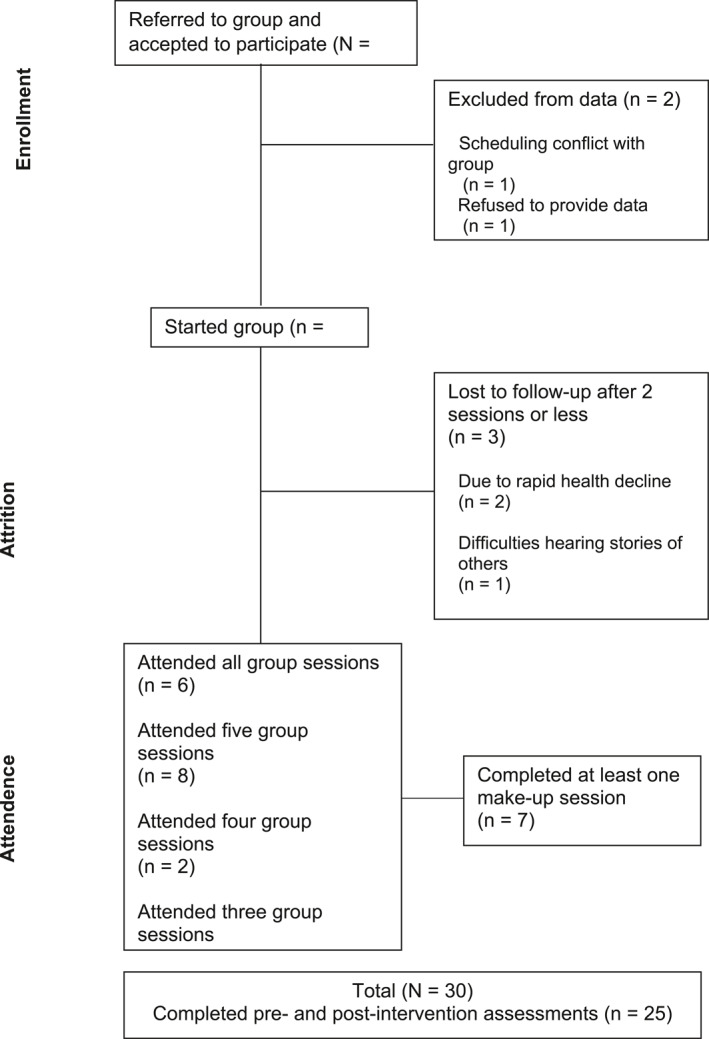
ACCENT was delivered online for 6 consecutive weekly sessions of 1.5 hours to five groups of six to seven patients. Thirty-two patients were interested in participating, but 2 did not complete the assessments pre- or post-intervention. A pragmatic feasibility study was conducted using data collected in routine clinical practice. Participants completed the Intolerance of Uncertainty Scale-Short Form, the Generalized Anxiety Disorder scale, and the Impact of Events Scale before and after the intervention. Post-intervention, participants answered open-ended questions to assess acceptability, rated their perceptions of improvement and usefulness, and completed the Satisfaction with Therapy and Therapist Scale.
ACCENT appears feasible with participants completing the intervention and all assessments between January 2022 and November 2023. It appears acceptable with an attrition rate of 12.5%, and a high degree of attendance and satisfaction. There was a non-significant decrease in intolerance of uncertainty, and a significant decrease in anxiety, and cancer-specific distress post-intervention.
A randomized controlled pilot study is warranted to further evaluate ACCENT in patients with AMI cancers.
新的治疗方法有助于晚期、转移性或无法治愈(AMI)癌症患者延长生存期。这些治疗方法的效果难以预测,给这些患者带来了很大的不确定性。目前,尚无有效解决AMI癌症不确定性的干预措施。为填补这一空白,我们设计了“适应癌症认知存在疗法(ACCENT)”干预措施。
评估ACCENT对AMI癌症患者的可行性、可接受性和初步疗效。
ACCENT通过网络进行,连续6周,每周1次,每次1.5小时,分为5组,每组6至7名患者。32名患者表示有兴趣参与,但2名患者未完成干预前后的评估。本研究采用常规临床实践中收集的数据进行务实的可行性研究。参与者在干预前后完成了不确定性不耐受量表简版、广泛性焦虑障碍量表和事件影响量表。干预后,参与者回答开放式问题以评估可接受性,对自身改善和有用性进行评分,并完成治疗和治疗师满意度量表。
在2022年1月至2023年11月期间,参与者完成了干预和所有评估,表明ACCENT似乎可行。其可接受性较好,损耗率为12.5%,出勤率和满意度较高。干预后,不确定性不耐受有非显著下降,焦虑和癌症特异性痛苦有显著下降。
有必要开展一项随机对照试验性研究,以进一步评估ACCENT对AMI癌症患者的疗效。