Perdomo-Celis Federico, Passaes Caroline, Monceaux Valérie, Lambotte Olivier, Costagliola Dominique, Chevalier Mathieu F, Weiss Laurence, Sáez-Cirión Asier
Institut Pasteur, Université Paris Cité, Viral Reservoirs and Immune Control Unit, Paris, 75015, France; Institut Pasteur, Université Paris Cité, HIV Inflammation and Persistance Unit, Paris, 75015, France; Instituto de Genética Humana, Facultad de Medicina, Pontificia Universidad Javeriana, Bogotá, Colombia.
Institut Pasteur, Université Paris Cité, Viral Reservoirs and Immune Control Unit, Paris, 75015, France; Institut Pasteur, Université Paris Cité, HIV Inflammation and Persistance Unit, Paris, 75015, France.
EBioMedicine. 2025 Apr;114:105672. doi: 10.1016/j.ebiom.2025.105672. Epub 2025 Mar 29.
Virus-specific CD8 T cells play a major role in the natural control of HIV infection, linked to memory-like features such as high survival capacity and polyfunctionality. However, virus-specific CD8 T cells from HIV non-controllers exhibit an effector-like and exhausted profile, with limited antiviral potential. Metabolic reprogramming of cells from non-controllers could reinvigorate their functional capacities. Considering the implication of the cholesterol pathway in the induction of T cell exhaustion, here we evaluated the impact of rosuvastatin, an inhibitor of cholesterol synthesis, on the functionality and memory profile of HIV-specific CD8 T cells from people on antiretroviral treatment.
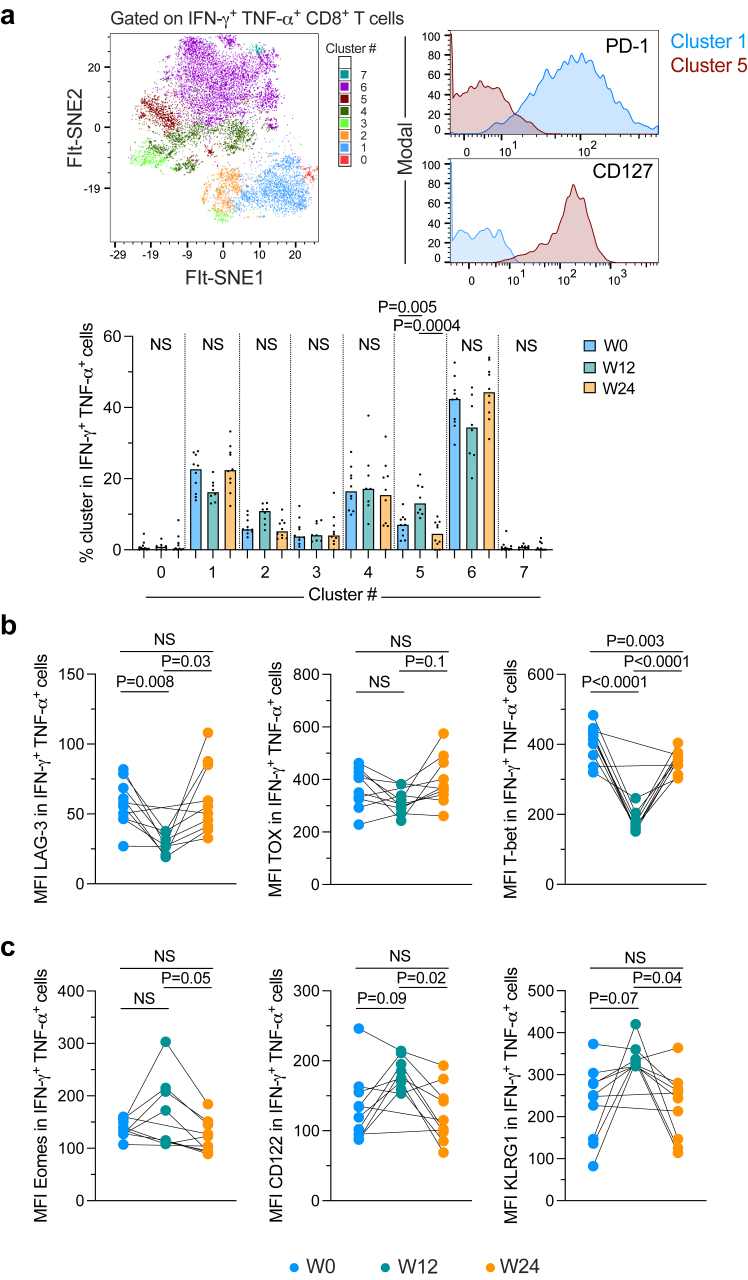
We analysed samples from 10 individuals with HIV-1 on ART who participated in the IMEA 043-CESAR trial and received rosuvastatin for 12 weeks. We explored whether rosuvastatin treatment was accompanied by changes in the memory potential of CD8 T cells. We evaluated the phenotype and functionality of total and HIV-specific CD8 T cells before, during, and after treatment with rosuvastatin. A mixed effects model was used for repeated measures and corrected for multiple comparisons.
Total and HIV-specific CD8 T cell survival and functionality were enhanced in individuals who received a 12-week course of rosuvastatin, with a consistent increase in polyfunctional IFN-γ TNF-α cells. The superior CD8 T cell functionality after rosuvastatin treatment was associated with intrinsic metabolic changes, including the decrease of fatty acid uptake, as well as a reduction in effector/exhaustion markers. Changes in the characteristics of CD8 T cells coincided with the duration of rosuvastatin administration, and most effects waned after the cessation of the treatment.
CD8 T cell metabolic reprogramming by targeting the cholesterol pathway, combined with other available immunotherapies, might represent a promising strategy in the search for the cure of HIV or other chronic viral infections.
The CESAR trial was sponsored by IMEA. This work was supported by the NIH (grants UM1AI164562 and R01DK131476).
病毒特异性CD8 T细胞在HIV感染的自然控制中起主要作用,这与诸如高生存能力和多功能性等记忆样特征有关。然而,来自HIV非控制者的病毒特异性CD8 T细胞表现出效应样和耗竭的特征,抗病毒潜力有限。非控制者细胞的代谢重编程可能会恢复其功能能力。考虑到胆固醇途径在T细胞耗竭诱导中的作用,我们在此评估了瑞舒伐他汀(一种胆固醇合成抑制剂)对接受抗逆转录病毒治疗的人群中HIV特异性CD8 T细胞功能和记忆特征的影响。
我们分析了10名接受抗逆转录病毒治疗的HIV-1感染者的样本,这些个体参与了IMEA 043-CESAR试验并接受了12周的瑞舒伐他汀治疗。我们探讨了瑞舒伐他汀治疗是否伴随着CD8 T细胞记忆潜力的变化。我们评估了在瑞舒伐他汀治疗前、治疗期间和治疗后的总CD8 T细胞以及HIV特异性CD8 T细胞的表型和功能。使用混合效应模型进行重复测量,并对多重比较进行校正。
接受12周瑞舒伐他汀疗程的个体中,总CD8 T细胞和HIV特异性CD8 T细胞的存活和功能得到增强,多功能IFN-γ TNF-α细胞持续增加。瑞舒伐他汀治疗后CD8 T细胞功能的改善与内在代谢变化有关,包括脂肪酸摄取的减少以及效应/耗竭标志物的减少。CD8 T细胞特征的变化与瑞舒伐他汀给药的持续时间一致,并且在治疗停止后大多数效应减弱。
通过靶向胆固醇途径对CD8 T细胞进行代谢重编程,并结合其他可用的免疫疗法,可能是寻找治愈HIV或其他慢性病毒感染的一种有前景的策略。
CESAR试验由IMEA赞助。这项工作得到了美国国立卫生研究院(拨款UM1AI164562和R01DK131476)的支持。