Mutlu Seyran, Fytianos Kleanthis, Ferrié Céline, Scalise Melanie, Mykoniati Sofia, Gazdhar Amiq, Blank Fabian
Department for Pulmonary Medicine, Allergology and Clinical Immunology, Inselspital, Bern University Hospital, University of Bern, Bern, Switzerland.
Lung Precision Medicine (LPM), Department for BioMedical Research (DBMR), University of Bern, Bern, Switzerland.
J Gene Med. 2025 Apr;27(4):e70018. doi: 10.1002/jgm.70018.
Idiopathic pulmonary fibrosis (IPF) is a lethal disease with an unknown etiology and complex pathophysiology that are not fully understood. The disease involves intricate cellular interplay, particularly among various immune cells. Currently, there is no treatment capable of reversing the fibrotic process or aiding lung regeneration. Hepatocyte growth factor (HGF) has demonstrated antifibrotic properties, whereas the adoptive transfer of modified T cells is a well-established treatment for various malignancies. We aimed to understand the dynamics of T cells in the progression of lung fibrosis and to study the therapeutic benefit of adoptive T cell transfer in a bleomycin-injured mouse lung (BLM) model.
T cells were isolated from the spleen of naïve mice and transfected in vitro with mouse HGF plasmid and were administered intratracheally to the mice lungs 7 days post-bleomycin injury to the lung. Lung tissue and bronchoalveolar lavage were collected and analyzed using flow cytometry, histology, qRT-PCR, ELISA, and hydroxyproline assay.
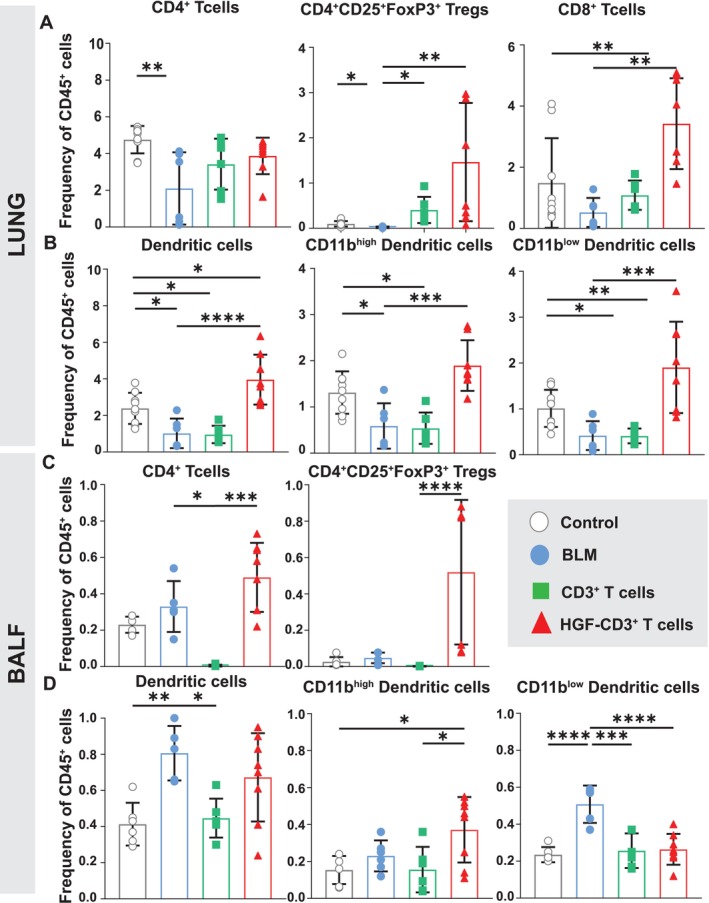
Our findings demonstrate the successful T cell therapy of bleomycin-induced lung injury through the adoptive transfer of HGF-transfected T cells in mice. This treatment resulted in decreased collagen deposition and a balancing of immune cell exhaustion and cytokine homeostasis compared with untreated controls. In vitro testing showed enhanced apoptosis in myofibroblasts induced by HGF-overexpressing T cells.
Taken together, our data highlight the great potential of adoptive T cell transfer as an emerging therapy to counteract lung fibrosis.
特发性肺纤维化(IPF)是一种致命疾病,其病因不明,病理生理复杂,尚未完全了解。该疾病涉及复杂的细胞相互作用,特别是在各种免疫细胞之间。目前,尚无能够逆转纤维化过程或促进肺再生的治疗方法。肝细胞生长因子(HGF)已显示出抗纤维化特性,而经修饰的T细胞的过继转移是治疗各种恶性肿瘤的成熟方法。我们旨在了解肺纤维化进展过程中T细胞的动态变化,并研究在博来霉素损伤的小鼠肺(BLM)模型中过继性T细胞转移的治疗益处。
从未接触过抗原的小鼠脾脏中分离T细胞,在体外转染小鼠HGF质粒,并在博来霉素损伤肺7天后经气管内注入小鼠肺中。收集肺组织和支气管肺泡灌洗液,使用流式细胞术、组织学、qRT-PCR、ELISA和羟脯氨酸测定进行分析。
我们的研究结果表明,通过在小鼠中过继转移HGF转染的T细胞,成功地对博来霉素诱导的肺损伤进行了T细胞治疗。与未治疗的对照组相比,这种治疗导致胶原沉积减少,免疫细胞耗竭和细胞因子稳态得到平衡。体外试验显示,HGF过表达的T细胞诱导成肌纤维细胞凋亡增加。
综上所述,我们的数据突出了过继性T细胞转移作为一种对抗肺纤维化的新兴疗法的巨大潜力。