Nassr Nassr, Rharbaoui Faiza, Weitz Dietmar, Gassenhuber Johann, Rehberg Markus, Kohlmann Markus, Schumacher Fabienne, Lahmar Amel, Kovar Andreas, Perrin Laurent, Wagner Frank-Dietrich, Wiekowski Maria, Nguyen Mai Anh
Sanofi, Frankfurt, Germany.
Sanofi, Bridgewater, New Jersey, USA.
Clin Pharmacol Ther. 2025 Jul;118(1):164-176. doi: 10.1002/cpt.3655. Epub 2025 Mar 30.
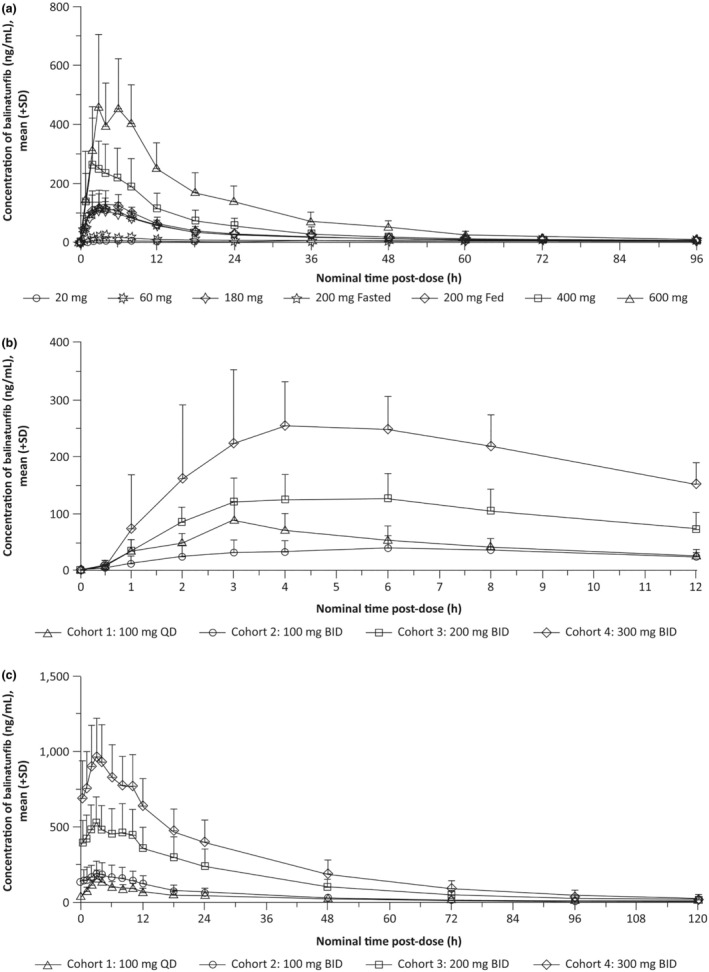
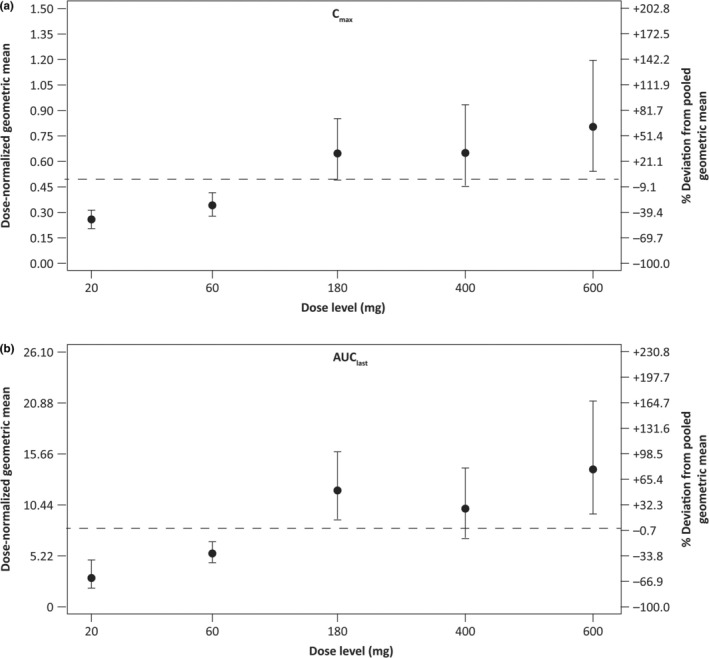
Oral small molecule inhibitors of tumor necrosis factor alpha (TNFα) are emerging as attractive therapeutic agents for the treatment of various autoimmune diseases. Balinatunfib (SAR441566), a novel oral inhibitor of tumor necrosis factor receptor 1 (TNFR1) signaling, changes the configuration of the soluble TNFα (sTNFα) trimer and prevents its heterotrimerization with TNFR1 but not TNFR2, thereby blocking TNFR1 signaling. Herein, we report the results from a first-in-human (FIH) study that evaluated the safety, pharmacokinetics (PK), and pharmacodynamics (PD) following single ascending doses (SAD) and multiple ascending doses (MAD) of balinatunfib in healthy male participants. Single (5-600 mg) and multiple (100-600 mg total daily dose for up to 14 days) oral doses of balinatunfib were well-tolerated in all participants. Consistent PK data were obtained across the studies, with a median t of 2.5-5 hours, a mean terminal half-life of 22-30 hours, and a time to steady state of 5-6 days. A supra-proportional exposure increase was observed in both SAD and MAD studies, which was less pronounced at doses ≥ 180 mg. Food had no relevant effects on the PK characteristics of balinatunfib. As the main PD read-out, complete TNFα occupancy was shown at all tested time points after the treatment started. Balinatunfib, as the first clinically tested oral TNFR1 signal inhibitor, demonstrated a good safety profile along with favorable PK/PD characteristics that allowed both once and twice daily dosing, confirming a successful preclinical-to-clinical translation and guiding dose selection for further clinical efficacy studies.
肿瘤坏死因子α(TNFα)的口服小分子抑制剂正成为治疗各种自身免疫性疾病的有吸引力的治疗药物。新型肿瘤坏死因子受体1(TNFR1)信号传导口服抑制剂巴利那吞非布(SAR441566)可改变可溶性TNFα(sTNFα)三聚体的构型,阻止其与TNFR1而非TNFR2形成异源三聚体,从而阻断TNFR1信号传导。在此,我们报告了一项首次人体(FIH)研究的结果,该研究评估了健康男性受试者单次递增剂量(SAD)和多次递增剂量(MAD)服用巴利那吞非布后的安全性、药代动力学(PK)和药效学(PD)。所有受试者对单次(5 - 600毫克)和多次(每日总剂量100 - 600毫克,持续14天)口服巴利那吞非布均耐受性良好。各项研究均获得了一致的PK数据,中位t为2.5 - 5小时,平均终末半衰期为22 - 30小时,达到稳态的时间为5 - 6天。在SAD和MAD研究中均观察到超比例的暴露增加,在剂量≥180毫克时这种增加不太明显。食物对巴利那吞非布的PK特征无相关影响。作为主要的PD指标,治疗开始后的所有测试时间点均显示完全的TNFα占有率。巴利那吞非布作为首个进行临床试验的口服TNFR1信号抑制剂,显示出良好的安全性以及有利的PK/PD特征,允许每日给药一次和两次,证实了从临床前到临床的成功转化,并为进一步的临床疗效研究指导剂量选择。