Aditianingsih Dita, Heriwardito Aldy, Agusta Laksmi Senja, Leonard El Nissi, Annabelle Chrisella
Department of Anesthesiology and Intensive Care, Faculty of Medicine, Universitas Indonesia, Cipto Mangunkusumo Hospital, Indonesia.
Indian J Anaesth. 2025 Feb;69(2):206-213. doi: 10.4103/ija.ija_457_24. Epub 2025 Jan 29.
Assessing the intravascular volume is necessary in patients undergoing surgery, but predicting how the body will respond to fluid can be challenging. Evaluation of the internal jugular vein distensibility index (IJV-DI) is an alternative method to determine intravascular volume status. This study aims to determine the suitability of measuring stroke volume by using IJV-DI measurement compared with transthoracic echocardiography in assessing the fluid responsiveness in elective surgery patients.
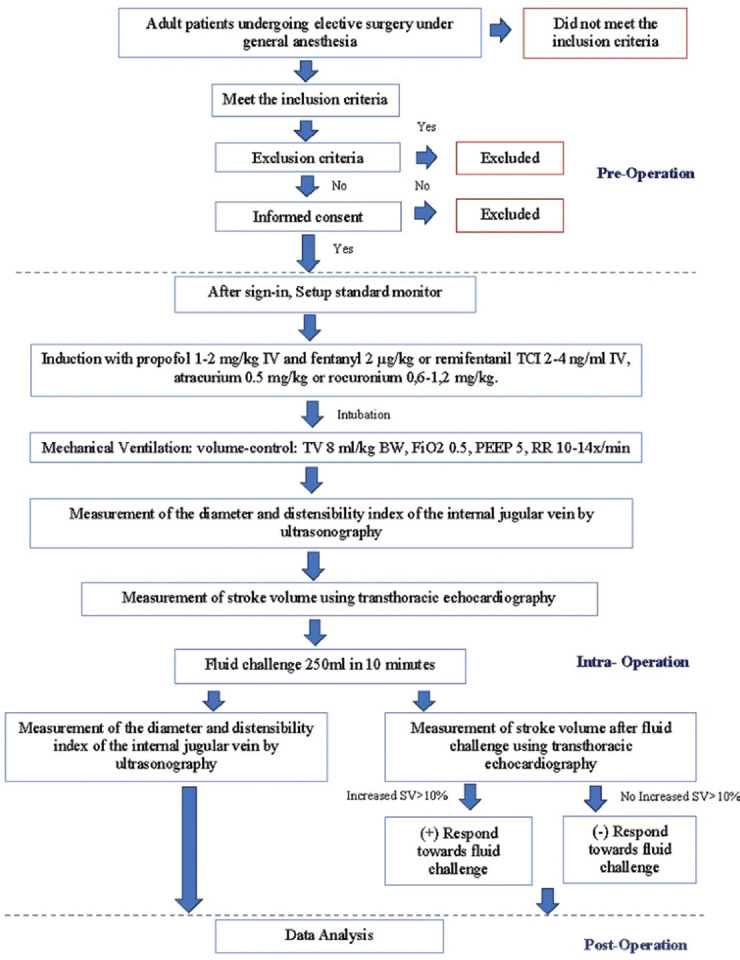
This prospective study involved 79 subjects undergoing elective surgery under general anaesthesia. Following anaesthesia induction, IJV-DI and stroke volume measurements were performed before and after fluid administration. Subjects experiencing an increase in stroke volume of more than 10% were categorised as responders. The primary outcome was the suitability of IJV-DI in determining fluid responsiveness compared to transthoracic echocardiography in elective surgery patients. The data were then analysed to assess its diagnostic value using the receiver operator characteristic (ROC) curve, the appropriate cut-off point using the Youden index, and the correlation using Spearman's correlation test.
A total of 45 subjects were responders. Our analysis revealed an area under the curve (AUC) value of 0.871 (95% CI: 0.790, 0.951). The optimal cut-off value was found at an internal jugular vein distensibility index of >12.62% with a sensitivity of 84.4% and a specificity of 79.4%. A moderate positive correlation existed between the index and stroke volume increase (r = 0.535, < 0.001).
IJV-DI assessment is compatible with transthoracic echocardiography stroke volume measurement for evaluating elective surgery patients' fluid response.
对于接受手术的患者,评估血管内容量很有必要,但预测身体对液体的反应可能具有挑战性。评估颈内静脉扩张指数(IJV-DI)是确定血管内容量状态的一种替代方法。本研究旨在确定与经胸超声心动图相比,使用IJV-DI测量来评估择期手术患者的液体反应性时测量每搏输出量的适用性。
这项前瞻性研究纳入了79例接受全身麻醉下择期手术的受试者。麻醉诱导后,在补液前后进行IJV-DI和每搏输出量测量。每搏输出量增加超过10%的受试者被归类为反应者。主要结局是与经胸超声心动图相比,IJV-DI在确定择期手术患者液体反应性方面的适用性。然后使用受试者工作特征(ROC)曲线分析数据以评估其诊断价值,使用约登指数确定合适的截断点,并使用Spearman相关性检验分析相关性。
共有45例受试者为反应者。我们的分析显示曲线下面积(AUC)值为0.871(95%CI:0.790,0.951)。最佳截断值为颈内静脉扩张指数>12.62%,敏感性为84.4%,特异性为79.4%。该指数与每搏输出量增加之间存在中度正相关(r = 0.535,P < 0.001)。
IJV-DI评估与经胸超声心动图测量每搏输出量在评估择期手术患者的液体反应方面具有一致性。