Noor Humaira, Zheng Yuanning, Itakura Haruka, Gevaert Olivier
Stanford Center for Biomedical Informatics Research, Department of Medicine, Stanford University School of Medicine, Stanford, CA 94305, USA.
Department of Medicine, Division of Oncology, Stanford University School of Medicine, Stanford, CA 94305, USA.
bioRxiv. 2025 Mar 14:2025.03.13.643116. doi: 10.1101/2025.03.13.643116.
Glioblastoma (GBM) is a highly vascularized, heterogeneous tumor, yet anti-angiogenic therapies have yielded limited survival benefits. The lack of validated predictive biomarkers for treatment response stratification remains a major challenge. Aminoacyl tRNA synthetase complex-interacting multicomplex proteins (AIMPs) 1/2/3 have been implicated in CNS diseases, but their roles in gliomas remain unexplored. We investigated their association with angiogenesis and their significance as predictive biomarkers for anti-angiogenic treatment response.
In this multi-cohort retrospective study we analyzed glioma samples from TCGA, CGGA, Rembrandt, Gravendeel, BELOB and REGOMA trials, and four single-cell transcriptomic datasets. Multi-omic analyses incorporated transcriptomic, epigenetic, and proteomic data. Kaplan-Meier and Cox proportional hazards models were used to assess the prognostic value of AIMPs in heterogeneous and homogeneous treatment-groups. Using single-cell transcriptomics, we explored spatial and cell-type-specific AIMP2 expression in GBM.
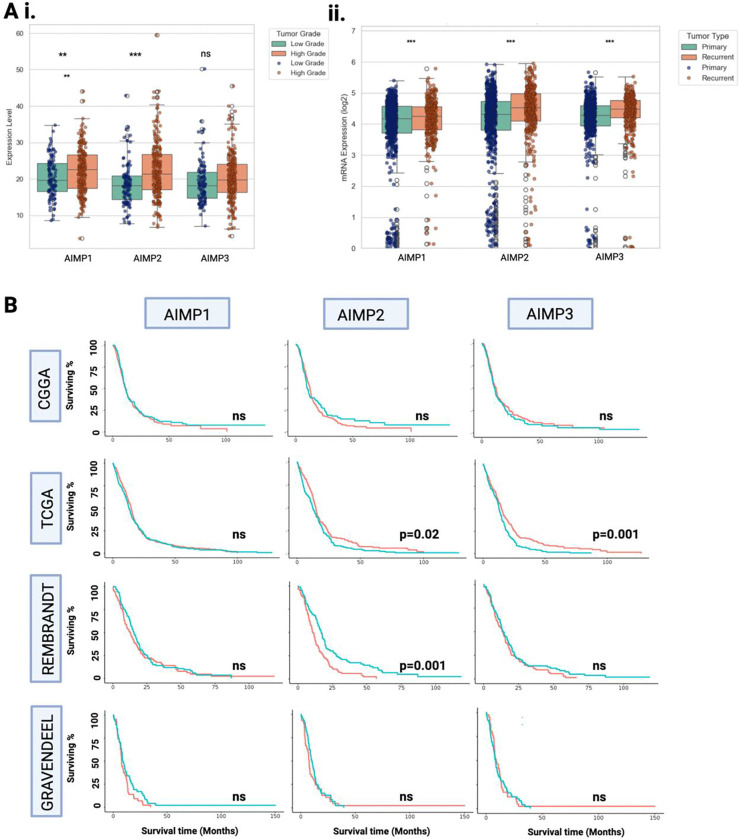
AIMP1/2/3 expressions correlated significantly with angiogenesis across TCGA cancers. In gliomas, AIMPs were upregulated in tumor vs. normal tissues, higher- vs. lower-grade gliomas, and recurrent vs. primary tumors (p<0.05). Upon retrospective analysis of two clinical trials assessing different anti-angiogenic drugs, we found that high-AIMP2 subgroups had improved response to therapies in GBM (REGOMA: HR 4.75 [1.96-11.5], p<0.001; BELOB: HR 2.3 [1.17-4.49], p=0.015). AIMP2-cg04317940 methylation emerged as a clinically applicable stratification marker. Single-cell analysis revealed homogeneous AIMP2 expression in tumor tissues, particularly in AC-like cells, suggesting a mechanistic link to tumor angiogenesis.
These findings provide novel insights into the role of AIMPs in angiogenesis, offering improved patient stratification and therapeutic outcomes in recurrent GBM.
胶质母细胞瘤(GBM)是一种血管高度丰富的异质性肿瘤,但抗血管生成疗法带来的生存获益有限。缺乏用于治疗反应分层的经过验证的预测性生物标志物仍然是一个重大挑战。氨酰基-tRNA合成酶复合物相互作用多复合物蛋白(AIMPs)1/2/3与中枢神经系统疾病有关,但其在胶质瘤中的作用仍未得到探索。我们研究了它们与血管生成的关联以及作为抗血管生成治疗反应预测性生物标志物的意义。
在这项多队列回顾性研究中,我们分析了来自TCGA、CGGA、Rembrandt、Gravendeel、BELOB和REGOMA试验的胶质瘤样本,以及四个单细胞转录组数据集。多组学分析纳入了转录组、表观遗传和蛋白质组数据。使用Kaplan-Meier和Cox比例风险模型评估AIMPs在异质性和同质性治疗组中的预后价值。通过单细胞转录组学,我们探索了GBM中AIMP2的空间和细胞类型特异性表达。
在TCGA的各种癌症中,AIMP1/2/3的表达与血管生成显著相关。在胶质瘤中,AIMPs在肿瘤组织与正常组织、高级别胶质瘤与低级别胶质瘤、复发性肿瘤与原发性肿瘤中均上调(p<0.05)。在对两项评估不同抗血管生成药物的临床试验进行回顾性分析时,我们发现高AIMP2亚组的GBM患者对治疗的反应有所改善(REGOMA:风险比4.75 [1.96 - 11.5],p<0.001;BELOB:风险比2.3 [1.17 - 4.49],p = 0.015)。AIMP2-cg04317940甲基化成为一种临床适用的分层标志物。单细胞分析显示肿瘤组织中AIMP2表达均匀,特别是在AC样细胞中,这表明其与肿瘤血管生成存在机制上的联系。
这些发现为AIMPs在血管生成中的作用提供了新的见解,为复发性GBM患者的分层和治疗结果改善提供了依据。