Sharma Saurabh, Lee David, Maity Surjendu, Singh Prabhjeet, Chadokiya Jay, Mohaghegh Neda, Hassani Alireza, Kim Hanjun, Gangarade Ankit, Ljubimova Julia Y, Kirane Amanda, Holler Eggehard
Department of Surgery, Division of Surgical Oncology, Stanford School of Medicine, Stanford University Medical Center, CA 94305, USA.
Terasaki Institute for Biomedical Innovation, Los Angeles, CA 90064, USA.
bioRxiv. 2025 Mar 12:2025.03.07.641755. doi: 10.1101/2025.03.07.641755.
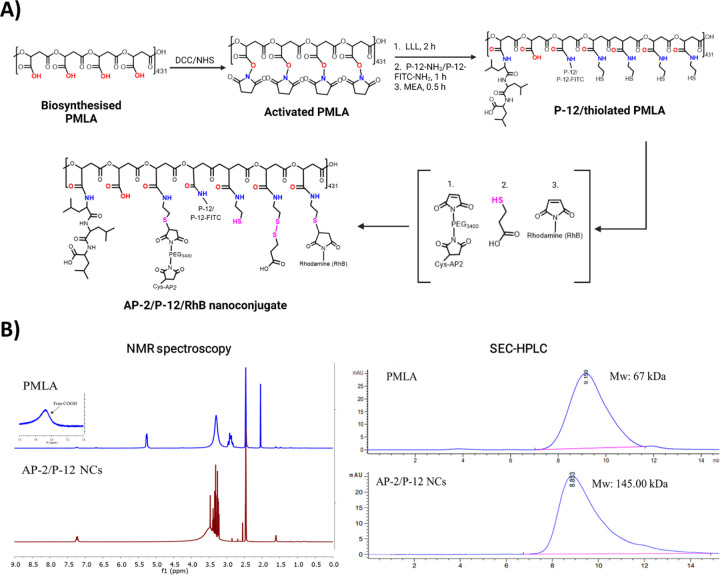
Glioblastoma Multiforme (GBM) represents a significant clinical challenge amongst central nervous system (CNS) tumors, with a dismal mean survival rate of less than 8 months, a statistic that has remained largely unchanged for decades (National Brain Society, 2022). The specialized intricate anatomical features of the brain, notably the blood-brain barrier (BBB), pose significant challenges to effective therapeutic interventions, limiting the potential reach of modern advancements in immunotherapy to impact these types of tumors. This study introduces an innovative, actively targeted immunotherapeutic nanoconjugate (P12/AP-2/NCs) designed to serve as an immunotherapeutic agent capable of traversing the BBB via LRP-1 receptor-mediated transcytosis. P12/AP-2/NCs exert its immune-modulating effects by inhibiting the PD-1/PD-L1 axis through a small-size PD-L1/PD-L2 antagonist peptide Aurigene NP-12 (P12). P12/AP-2/NCs are synthesized from completely biodegradable, functionalized high molecular weight β-poly(L-malic acid) (PMLA) polymer, conjugated with P12 and Angiopep-2 (AP2) to yield P12/AP-2/NCs. Evaluating nanoconjugates for BBB permeability and 3-D tumor model efficacy using an in vitro BBB-Transwell spheroid based model demonstrating successful crossing of the BBB and internalization in brain 3D tumor environments. In addition, the nanoconjugate mediated T cell's cytotoxicity on 3D tumor region death in a U87 GBM 3-D spheroid model. AP2/P12/NCs is selectively inhibited in PD1/PDL1 interaction on T cells and tumor site, increasing inflammatory cytokine secretion and T cell proliferation. In an in-vivo murine brain environment, rhodamine fluorophore-labeled AP2/P12/NCs displayed significantly increased accumulation in the brain during 2-6 h time intervals post-injection with a prolonged bioavailability over unconjugated peptides. AP2/P12/NCs demonstrated a safety profile at both low and high doses based on major organ histopathology evaluations. Our findings introduce a novel, programmable nanoconjugate platform capable of penetrating the BBB for directed delivery of small peptides and significant immune environment modulation without utilizing antibodies, offering promise for treating challenging brain diseases like glioblastoma multiforme and beyond.
多形性胶质母细胞瘤(GBM)是中枢神经系统(CNS)肿瘤中一项重大的临床挑战,其平均生存率低至不到8个月,几十年来这一统计数据基本保持不变(国家脑协会,2022年)。大脑特殊复杂的解剖结构,尤其是血脑屏障(BBB),给有效的治疗干预带来了重大挑战,限制了免疫疗法现代进展对这类肿瘤的潜在影响范围。本研究引入了一种创新的、主动靶向的免疫治疗纳米缀合物(P12/AP-2/NCs),旨在作为一种能够通过LRP-1受体介导的转胞吞作用穿越血脑屏障的免疫治疗剂。P12/AP-2/NCs通过一种小尺寸的PD-L1/PD-L2拮抗剂肽Aurigene NP-12(P12)抑制PD-1/PD-L1轴来发挥其免疫调节作用。P12/AP-2/NCs由完全可生物降解的、功能化的高分子量β-聚(L-苹果酸)(PMLA)聚合物合成,与P12和血管活性肠肽-2(AP2)缀合,得到P12/AP-2/NCs。使用基于体外血脑屏障-Transwell球体模型评估纳米缀合物的血脑屏障通透性和三维肿瘤模型疗效,结果表明其成功穿越血脑屏障并在脑三维肿瘤环境中内化。此外,在U87 GBM三维球体模型中,纳米缀合物介导T细胞对三维肿瘤区域死亡的细胞毒性。AP2/P12/NCs在T细胞和肿瘤部位的PD1/PDL1相互作用中被选择性抑制,增加炎性细胞因子分泌和T细胞增殖。在体内小鼠脑环境中,罗丹明荧光团标记的AP2/P12/NCs在注射后2 - 6小时内大脑中的积累显著增加,其生物利用度比未缀合的肽延长。基于主要器官组织病理学评估,AP2/P12/NCs在低剂量和高剂量下均显示出安全概况。我们的研究结果引入了一种新型的、可编程的纳米缀合物平台,该平台能够穿透血脑屏障,用于定向递送小肽并显著调节免疫环境,且无需使用抗体,为治疗多形性胶质母细胞瘤等具有挑战性的脑部疾病及其他疾病带来了希望。