Carlsson Lena M S, Arnetorp Ida, Andersson-Assarsson Johanna C, Jacobson Peter, Svensson Per-Arne, Taube Magdalena, Ahlin Sofie, Kristensson Felipe M, Karason Kristjan, Larsson Ingrid, Karlsson Cecilia, Pietiläinen Kirsi H, Näslund Ingmar, Carlsson Björn, Peltonen Markku, Sjöholm Kajsa
Institute of Medicine, Sahlgrenska Academy at the University of Gothenburg, Gothenburg, Sweden.
Institute of Health and Care Sciences, Sahlgrenska Academy at the University of Gothenburg, Gothenburg, Sweden.
Lancet Reg Health Eur. 2025 Mar 13;52:101261. doi: 10.1016/j.lanepe.2025.101261. eCollection 2025 May.
The clinical implications of weight regain following weight loss remain uncertain. We analysed mortality, cardiovascular events, cancer, and microvascular disease in individuals with significant weight loss, comparing maintainers to regainers.
Using a prospective cohort design, we analysed 1346 participants who underwent bariatric surgery in the Swedish Obese Subjects (SOS) study, aged 37-60 years with BMI ≥34 (men) or ≥38 (women), recruited 1987-2001. Individuals who regained ≥20% of their 1-year weight loss after 4 years (regain group) were compared to those who regained less (maintenance group). The study was closed on December 31, 2020 with median follow-up of 27 years and 99.9% mortality tracking (ClinicalTrials.govNCT01479452).
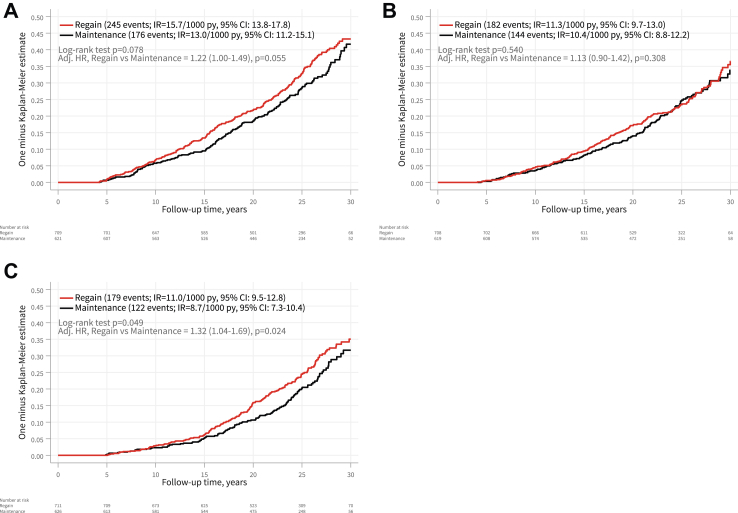
Average weight loss after 1 year was 29.3 ± 11.7 kg and 31.9 ± 13.8 kg and average weight change from year 1 to year 4 was +12.7 ± 6.6 kg and -0.6 ± 7.3 kg in the regain and maintenance groups, respectively. During follow-up, regain and maintenance groups showed similar rates of total mortality and cancer, 12.4 (95% CI: 10.9-14.2) vs 12.4 (10.7-14.3), p = 0.740, and 11.3 (95% CI: 9.7-13.0) vs 10.4 (8.8-12.2) per 1000 person-years (p = 0.308), respectively. The regain group had, however, higher incidence of microvascular disease, 11.0 (95% CI: 9.5-12.8) vs 8.7 (7.3-10.4) per 1000 person-years (p = 0.024), and while not statistically significant, also higher incidence of major adverse cardiovascular events (myocardial infarction, stroke, and heart failure) 15.7 (95% CI: 13.8-17.8) vs 13.0 (11.2-15.1) per 1000 person-years (p = 0.055).
Weight regain was linked to increased vascular disease risk but we could not demonstrate an association with life expectancy.
The Swedish Research Council, the Swedish State under the agreement between the Swedish Government and the county councils, the Health & Medical Care Committee of the Region Västra Götaland, the Adlerbert Research Foundation, the Wilhelm and Martina Lundgren Foundation, the Royal Society of Arts and Sciences in Gothenburg, Academy of Finland, Finnish Medical Foundation, Gyllenberg Foundation, Novo Nordisk Foundation, Finnish Diabetes Research Foundation, Paulo Foundation and Sigrid Juselius Foundation.
体重减轻后体重反弹的临床影响仍不明确。我们分析了体重显著减轻的个体的死亡率、心血管事件、癌症和微血管疾病情况,比较了体重维持者和体重反弹者。
采用前瞻性队列设计,我们分析了瑞典肥胖受试者(SOS)研究中1346名接受减肥手术的参与者,这些参与者年龄在37至60岁之间,男性BMI≥34,女性BMI≥38,于1987年至2001年招募。将4年后体重反弹超过其1年体重减轻量20%的个体(反弹组)与体重反弹较少的个体(维持组)进行比较。该研究于2020年12月31日结束,中位随访时间为27年,死亡率追踪率为99.9%(ClinicalTrials.govNCT01479452)。
1年后,反弹组和维持组的平均体重减轻分别为29.3±11.7千克和31.9±13.8千克,从第1年到第4年的平均体重变化分别为+12.7±6.6千克和-0.6±7.3千克。在随访期间,反弹组和维持组的总死亡率和癌症发生率相似,分别为每1000人年12.4(95%CI:10.9-14.2)和12.4(10.7-14.3),p=0.740,以及每1000人年11.3(95%CI:9.7-13.0)和10.4(8.8-12.2),p=0.308。然而,反弹组的微血管疾病发生率较高,每1000人年为11.0(95%CI:9.5-12.8),而维持组为8.7(7.3-10.4),p=0.024,虽然主要不良心血管事件(心肌梗死、中风和心力衰竭)的发生率在统计学上无显著差异,但反弹组也较高,每1000人年为15.7(95%CI:13.8-17.8),而维持组为13.0(11.2-15.1),p=0.055。
体重反弹与血管疾病风险增加有关,但我们未能证明其与预期寿命存在关联。
瑞典研究理事会、瑞典政府与郡议会协议下的瑞典国家、韦斯特罗斯-哥德堡地区卫生与医疗保健委员会、阿德勒伯特研究基金会、威廉和玛蒂娜·伦德格伦基金会、哥德堡皇家艺术与科学学会、芬兰科学院、芬兰医学基金会、吉伦伯格基金会、诺和诺德基金会、芬兰糖尿病研究基金会、保罗基金会和西格丽德·尤塞利乌斯基金会。