Yang Yifeixue, Huang Ziyi, Yang Yun, Fan Mingxia, Yin Dazhi
Shanghai Key Laboratory of Brain Functional Genomics (Ministry of Education), Affiliated Mental Health Center (ECNU), School of Psychology and Cognitive Science, East China Normal University, Shanghai, China.
Shanghai Key Laboratory of Magnetic Resonance, School of Physics and Electronic Science, East China Normal University, Shanghai, China.
Commun Biol. 2025 Apr 1;8(1):535. doi: 10.1038/s42003-025-07964-6.
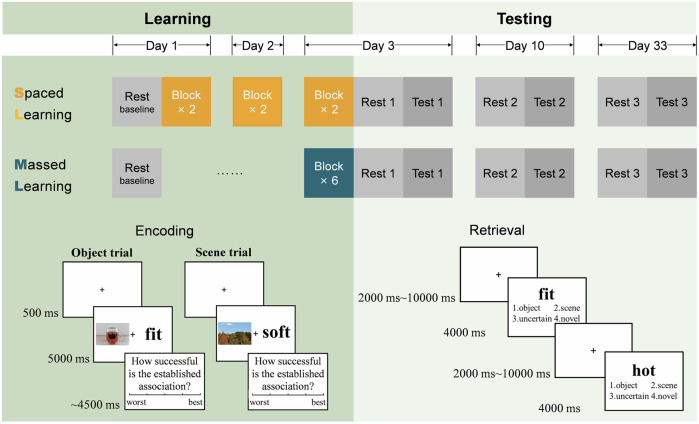
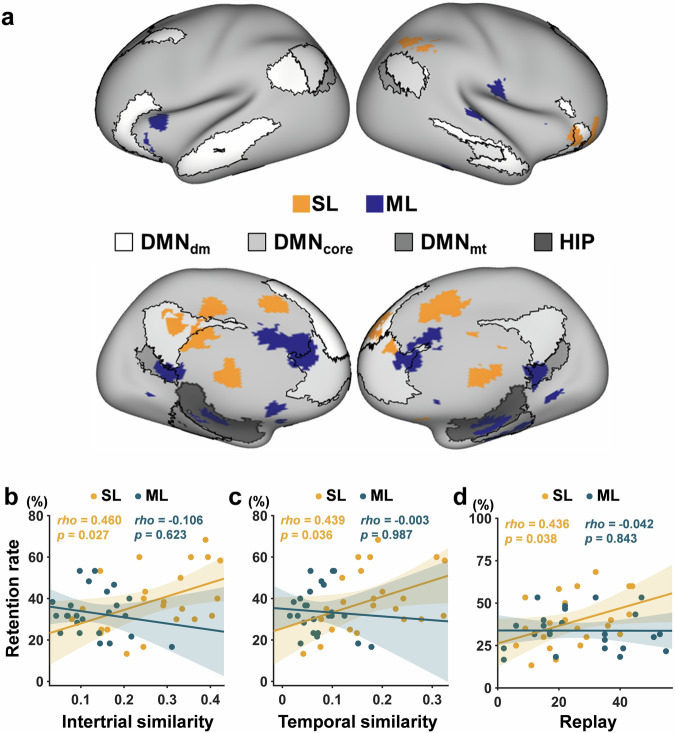
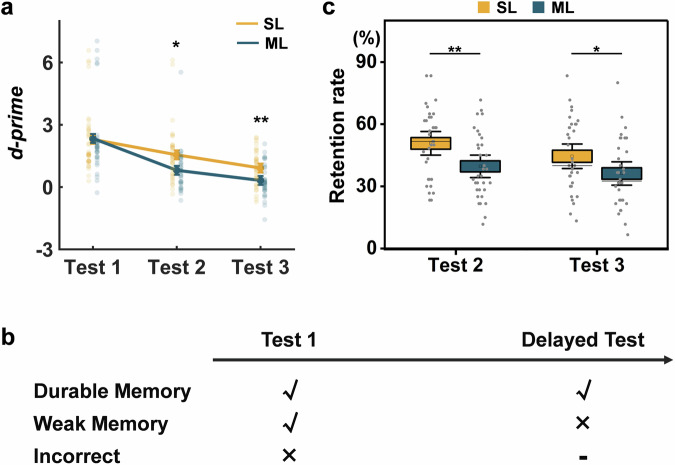
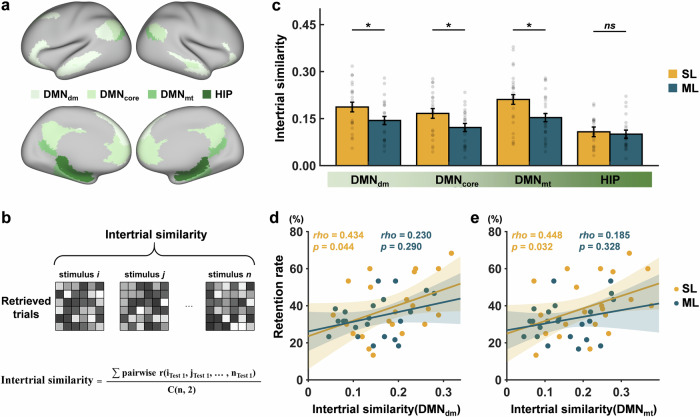
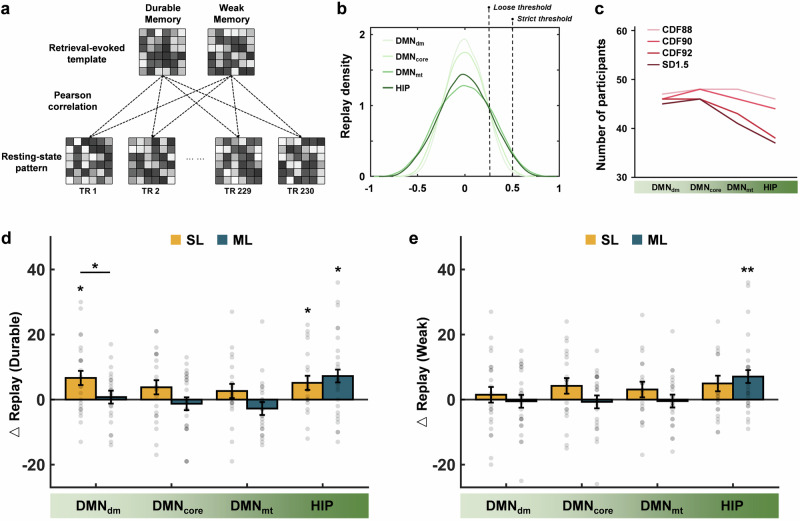
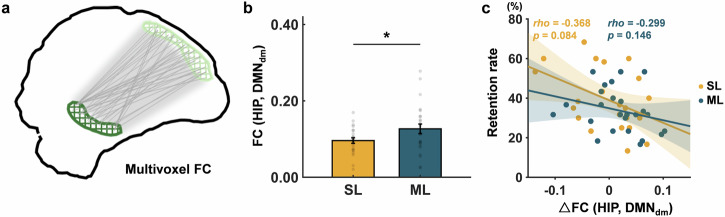
Emerging studies suggest that time-dependent consolidation enables memory stabilization by promoting memory integration and hippocampal-cortical transfer. Compared to massed learning, how time-dependent consolidation contributes to forming durable memory and what neural signatures predict durable memory in spaced learning remain unclear. We recruited 48 participants who underwent either 3-day spaced learning or 1-day massed learning, and both resting-state and task-based fMRI data were collected in multiple delayed tests (i.e., immediate, 1-week, and 1-month). We use representational similarity analysis to assess neural integration and replay in the hippocampus and default mode network (DMN) subsystems. In contrast with massed learning, spaced learning induces higher neural pattern similarity during immediate retrieval only in DMN subsystems. Particularly, the neural pattern similarity in the dorsal-medial DMN (DMN) and medial-temporal DMN subsystems predicts the durable memory defined by 1-month delay. Moreover, we find increased neural replay of durable memory in the DMN for spaced learning and in the hippocampus for both spaced and massed learning. Our findings suggest that time-dependent consolidation promotes neural integration and replay in the cortex rather than in the hippocampus, which may underlie the formation of durable memory after spaced learning.
新兴研究表明,时间依赖性巩固通过促进记忆整合和海马-皮质转移来实现记忆稳定。与集中学习相比,时间依赖性巩固如何有助于形成持久记忆,以及在间隔学习中哪些神经特征可预测持久记忆,目前仍不清楚。我们招募了48名参与者,他们分别接受了为期3天的间隔学习或为期1天的集中学习,并在多次延迟测试(即即时、1周和1个月)中收集了静息态和基于任务的功能磁共振成像数据。我们使用表征相似性分析来评估海马体和默认模式网络(DMN)子系统中的神经整合和重演。与集中学习相比,间隔学习仅在即时检索期间在DMN子系统中诱导更高的神经模式相似性。特别是,背内侧DMN和内侧颞叶DMN子系统中的神经模式相似性可预测由1个月延迟定义的持久记忆。此外,我们发现间隔学习时DMN中持久记忆的神经重演增加,而集中学习和间隔学习时海马体中持久记忆的神经重演均增加。我们的研究结果表明,时间依赖性巩固促进了皮质而非海马体中的神经整合和重演,这可能是间隔学习后形成持久记忆的基础。