Zhang Ling, Xu Wanqi, Zeng Yueying, Wang Long, Luo Jiesi, Zhou Xiaogang, Mei Qibing, Qin Dalian, Wu Anguo, Wu Jianming, Huang Feihong
Luzhou Key Laboratory of Activity Screening and Druggability Evaluation for Chinese Materia Medica, School of Pharmacy, Southwest Medical University, Luzhou, 646000, China.
School of Basic Medical Sciences, Southwest Medical University, Luzhou, 646000, China.
Chin Med. 2025 Apr 1;20(1):44. doi: 10.1186/s13020-025-01092-3.
Radiotherapy can damage hematopoietic stem cells (HSC) in bone marrow, leading to impaired hematopoietic function. Current treatments mainly target differentiated hematopoietic progenitor cells, which may accelerate their depletion. Astragaloside IV (AS-IV), derived from Astragalus membranaceus, shows potential in hematopoiesis, but its direct effects on HSC remain unclear.
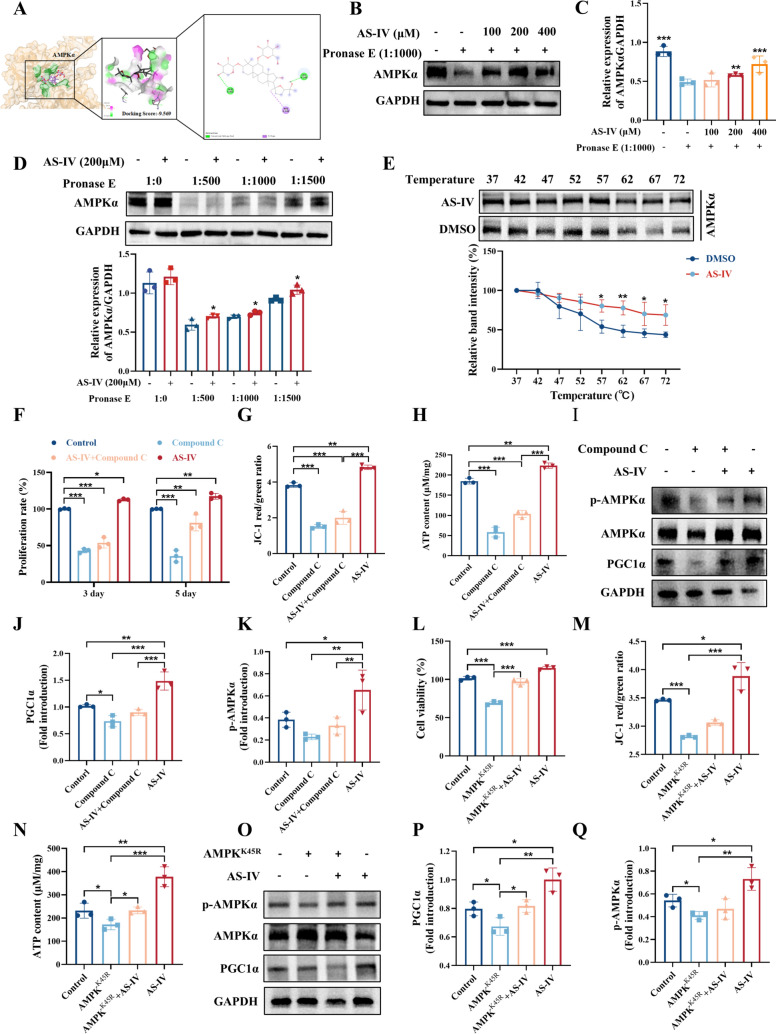
The study employed both in vitro and in vivo approaches. In vitro experiments utilized K562 cells and mouse bone marrow nucleated cells (BMNCs) to evaluate AS-IV's effects on cell proliferation and mitochondrial function. In vivo studies involved a 4.0 Gy total body irradiation mouse model treated with different doses of AS-IV (50 mg/kg and 100 mg/kg). The mechanism of action was investigated through Western blot, flow cytometry, and metabolomics analyses. The AMPK/PGC1α pathway regulation was verified using AMPK inhibitors and mutant plasmid, with molecular docking confirming AS-IV's direct binding to AMPK.
In vitro studies demonstrated that AS-IV significantly promoted the proliferation of K562 cells and BMNC while enhancing their mitochondrial membrane potential, mitochondrial mass, and ATP production. In the irradiated mouse model, AS-IV treatment led to significant improvements in peripheral blood cell counts, including white blood cells, red blood cells, and hemoglobin levels. Further investigation revealed that AS-IV increased the proportion of HSC in both bone marrow and spleen while improving their mitochondrial function. Transcriptomic sequencing and Western blot analysis identified the AMPK/PGC1α signaling pathway as the key mechanism underlying AS-IV-mediated mitochondrial enhancement. These findings were validated through pharmacological inhibition of AMPK and AMPK mutation experiments.
AS-IV accelerates hematopoietic reconstruction following radiation injury via activation of the AMPK/PGC1α signaling pathway, which enhances HSC mitochondrial function.
放疗会损伤骨髓中的造血干细胞(HSC),导致造血功能受损。目前的治疗主要针对分化的造血祖细胞,这可能会加速它们的耗竭。黄芪甲苷IV(AS-IV)源自黄芪,在造血方面显示出潜力,但其对造血干细胞的直接作用仍不清楚。
本研究采用了体外和体内方法。体外实验利用K562细胞和小鼠骨髓有核细胞(BMNCs)来评估AS-IV对细胞增殖和线粒体功能的影响。体内研究涉及用不同剂量的AS-IV(50mg/kg和100mg/kg)治疗的4.0Gy全身照射小鼠模型。通过蛋白质免疫印迹法、流式细胞术和代谢组学分析来研究其作用机制。使用AMPK抑制剂和突变质粒验证AMPK/PGC1α途径调节,分子对接证实AS-IV与AMPK直接结合。
体外研究表明,AS-IV显著促进K562细胞和BMNC的增殖,同时增强其线粒体膜电位、线粒体质量和ATP产生。在照射小鼠模型中,AS-IV治疗导致外周血细胞计数显著改善,包括白细胞、红细胞和血红蛋白水平。进一步研究表明,AS-IV增加了骨髓和脾脏中造血干细胞的比例,同时改善了它们的线粒体功能。转录组测序和蛋白质免疫印迹分析确定AMPK/PGC1α信号通路是AS-IV介导的线粒体增强的关键机制。这些发现通过AMPK的药理学抑制和AMPK突变实验得到验证。
AS-IV通过激活AMPK/PGC1α信号通路加速辐射损伤后的造血重建,该信号通路增强了造血干细胞的线粒体功能。