McInturf A G, Cantor M, Bouyoucos I A, Chapple T K, Debaere S F, Eustache K, Mourier J, Planes S, Sulikowski J A, Zillig K W, Fangue N A, Rummer J L
Coastal Oregon Marine Experiment Station Oregon State University Newport Oregon USA.
Department of Fisheries, Wildlife and Conservation Sciences Oregon State University Corvallis Oregon USA.
Ecol Evol. 2025 Mar 30;15(4):e71107. doi: 10.1002/ece3.71107. eCollection 2025 Apr.
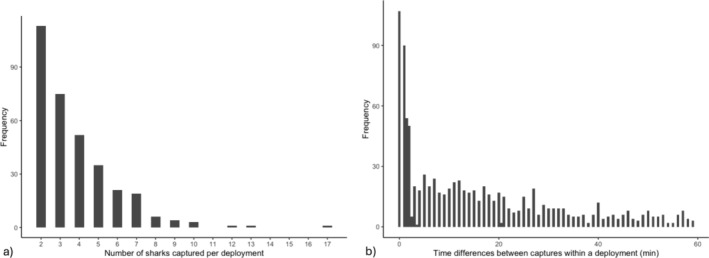
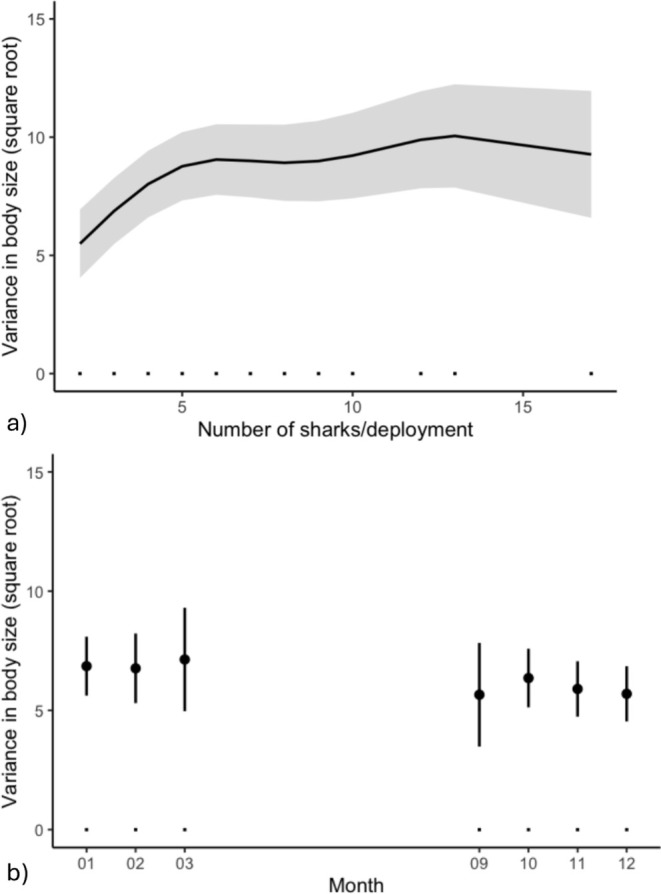
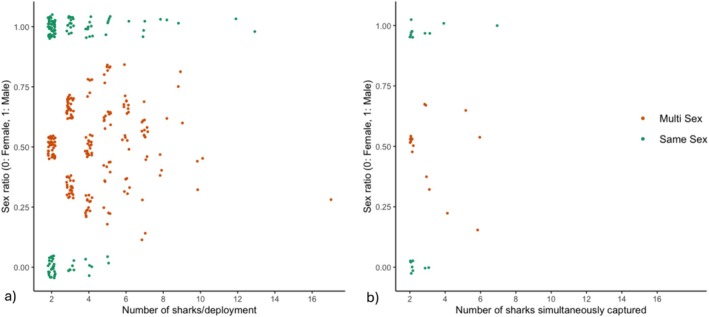
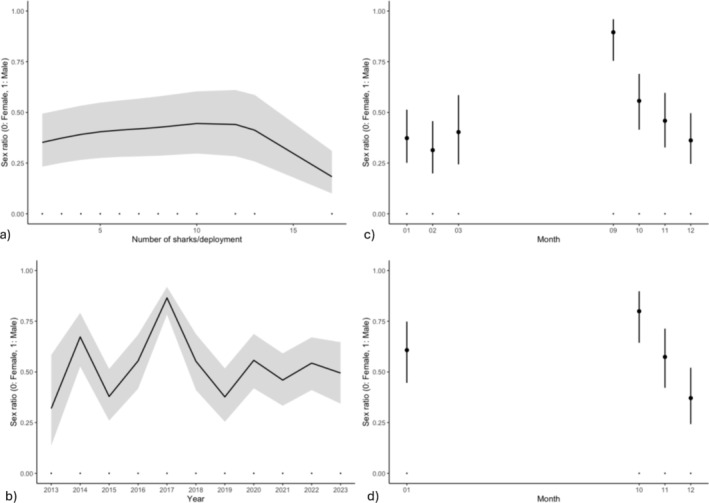
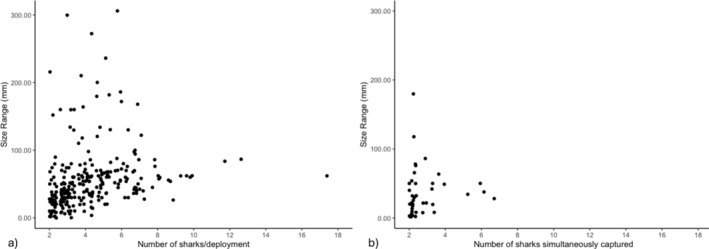
Elasmobranchs (i.e., sharks, skates, rays), known for their cognitive abilities and complex behaviours, often form aggregations that are thought to be crucial for their survival and evolutionary success. However, understanding the drivers behind these aggregations remains challenging due to the dynamism of the marine environment and the difficulty of observing these species directly. Here, we aim to address these challenges by introducing a methodological framework for analysing catch data to infer aggregation behaviour. Within this framework, we outline key metrics to explore, such as the number and density of individuals captured, phenotypic traits, drivers of co-occurrence, individual identification, and kin structure. We then demonstrate how to use this framework in a case study of juvenile blacktip reef sharks () in Moorea, French Polynesia, to determine its real-world application and identify potential limitations. Our results reveal that juvenile blacktip reef sharks around Moorea tend to aggregate during early life stages and that these aggregations appear non-social, indicative of environmental rather than social drivers. We also find that, while catch data can provide valuable insights into elasmobranch aggregations, they must be complemented with targeted research methods to maximise the available data advised within our framework. As findings from our case study demonstrate, this framework has the capacity to broaden our knowledge of elasmobranch aggregations and social behaviours, underscoring the importance of dedicated efforts in research and conservation to manage these vulnerable species effectively.
软骨鱼类(即鲨鱼、鳐鱼、魟鱼)以其认知能力和复杂行为而闻名,它们常常形成聚集,这种聚集被认为对其生存和进化成功至关重要。然而,由于海洋环境的动态性以及直接观察这些物种的困难,了解这些聚集背后的驱动因素仍然具有挑战性。在此,我们旨在通过引入一个分析渔获数据以推断聚集行为的方法框架来应对这些挑战。在这个框架内,我们概述了要探索的关键指标,例如捕获个体的数量和密度、表型特征、共现驱动因素、个体识别以及亲缘结构。然后,我们通过法属波利尼西亚莫雷阿岛的幼年黑鳍礁鲨()案例研究来展示如何使用这个框架,以确定其在现实世界中的应用并识别潜在局限性。我们的结果表明,莫雷阿岛周围的幼年黑鳍礁鲨在生命早期阶段倾向于聚集,并且这些聚集似乎是非社会性的,表明是环境而非社会驱动因素。我们还发现,虽然渔获数据可以为软骨鱼类聚集提供有价值的见解,但必须辅之以有针对性的研究方法,以最大限度地利用我们框架内建议的可用数据。正如我们案例研究的结果所示,这个框架有能力拓宽我们对软骨鱼类聚集和社会行为的认识,强调了在研究和保护方面做出专门努力以有效管理这些脆弱物种的重要性。