Kawabata Kazuya, Krismer Florian, Ito Mizuki, Hara Kazuhiro, Bagarinao Epifanio, Beliveau Vincent, Péran Patrice, Arribarat Germain, Traon Anne Pavy-Le, Meissner Wassilios G, Foubert-Samier Alexandra, Fabbri Margherita, Gordon Mark Forrest, Ogura Aya, Katsuno Masahisa, Rascol Olivier, Scherfler Christoph, Seppi Klaus, Watanabe Hirohisa, Poewe Werner
Department of Neurology, Medical University Innsbruck, Innsbruck, Austria.
Department of Neurology, Fujita Health University School of Medicine, Toyoake, Japan.
Mov Disord. 2025 Jul;40(7):1369-1378. doi: 10.1002/mds.30182. Epub 2025 Apr 2.
To investigate trajectories of regional brain volume changes in multiple system atrophy (MSA) and their potential utility as surrogate markers of disease progression in the cerebellar subtype (MSA-C).
Reliable biomarkers for tracking disease progression in MSA are urgently needed. Although several studies have explored neuroimaging markers, imaging measures that are reliable and reproducible at the individual-level are lacking.
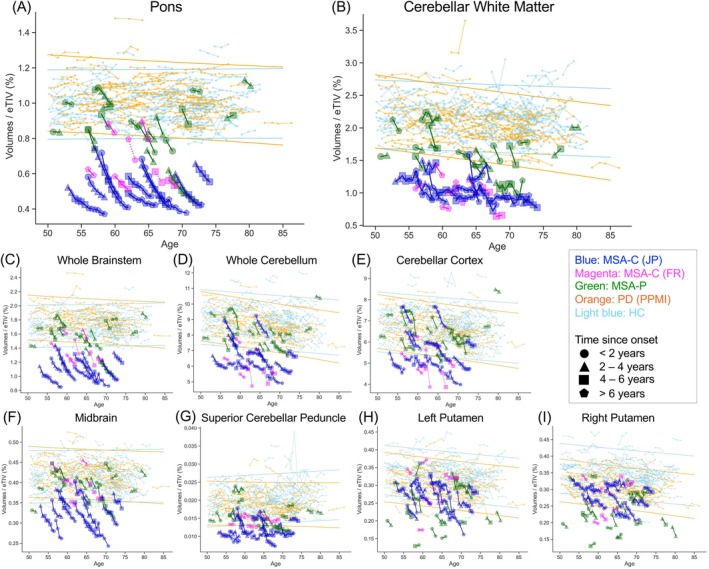
Longitudinal three-dimensional (3D)-T1 images from multiple cohorts of 21 subjects with probable MSA-C, 19 with probable MSA-parkinsonian subtype (MSA-P), 113 with Parkinson's disease, and 227 healthy controls were processed using the FreeSurfer longitudinal pipeline. Extracted volumes were assessed for individual longitudinal trajectories, intra-individual variability, and pontine regional volume decline.
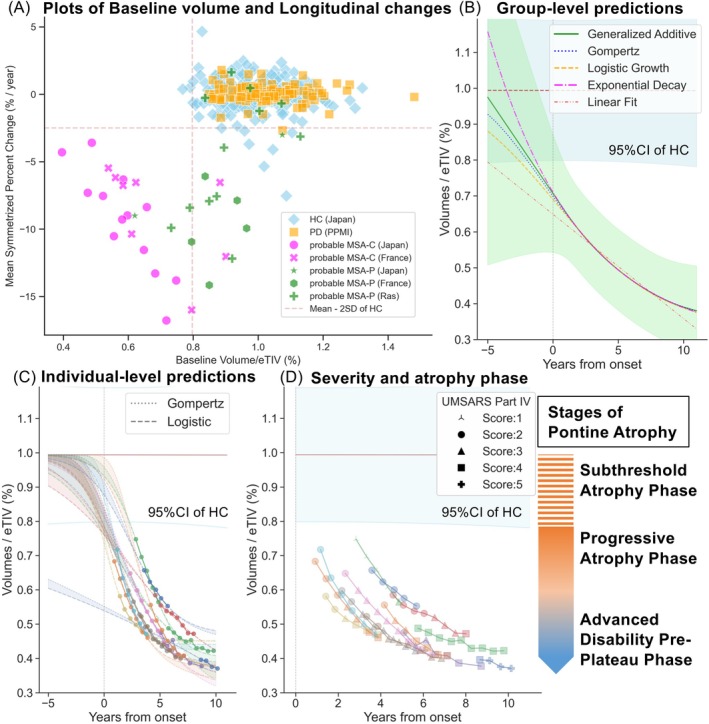
Pontine volumes showed lower intra-individual variability in measurements compared with other infratentorial brain regions. All probable MSA-C patients exhibited a decline in pontine volume, ranging from -3.6% to -16.8% per year (mean: -9.1%), falling more than two standard deviations below the mean of healthy controls. In MSA-C, the temporal dynamics of pontine volumes exhibited nonlinear changes, characterized by progressive atrophy in the earlier period of the disease, followed by a pre-plateau phase associated with advanced disability in the later period. Predictive modeling suggests that pontine atrophy may begin before symptom onset of MSA-C.
Pontine volume is a sensitive marker of disease progression, exhibiting a nonlinear decline with low intra-individual variability in measurements and greater volume loss in the earlier stages, reaching a pre-plateau phase in the later stages with advanced disability. © 2025 The Author(s). Movement Disorders published by Wiley Periodicals LLC on behalf of International Parkinson and Movement Disorder Society.
研究多系统萎缩(MSA)患者脑区体积变化轨迹,以及这些轨迹作为小脑亚型(MSA-C)疾病进展替代标志物的潜在效用。
迫切需要可靠的生物标志物来追踪MSA的疾病进展。尽管多项研究探索了神经影像学标志物,但缺乏在个体水平上可靠且可重复的成像测量方法。
使用FreeSurfer纵向分析流程处理来自多个队列的纵向三维(3D)-T1图像,这些队列包括21例可能为MSA-C的受试者、19例可能为帕金森型多系统萎缩(MSA-P)的受试者、113例帕金森病患者以及227例健康对照。评估提取的体积,以分析个体纵向轨迹、个体内变异性和脑桥区域体积下降情况。
与其他幕下脑区相比,脑桥体积测量的个体内变异性较低。所有可能为MSA-C的患者均出现脑桥体积下降,每年下降幅度为-3.6%至-16.8%(平均:-9.1%),低于健康对照平均值两个标准差以上。在MSA-C中,脑桥体积的时间动态变化呈现非线性变化,其特征为疾病早期进行性萎缩,随后在疾病后期出现与严重残疾相关的平台前期。预测模型表明,脑桥萎缩可能在MSA-C症状出现之前就已开始。
脑桥体积是疾病进展的敏感标志物,呈现非线性下降,测量的个体内变异性低,且在早期阶段体积损失更大,在后期严重残疾时进入平台前期。© 2025作者。《运动障碍》由Wiley Periodicals LLC代表国际帕金森和运动障碍协会出版。