Bae Soong June, Moon Sohyun, Kook Yoonwon, Baek Seung Ho, Lee Minji, Kim Jee Hung, Ahn Sung Gwe, Jeong Joon
Department of Surgery, Gangnam Severance Hospital, Yonsei University College of Medicine, Seoul, Republic of Korea.
Institute for Breast Cancer Precision Medicine, Yonsei University College of Medicine, Seoul, Republic of Korea.
NPJ Breast Cancer. 2025 Apr 2;11(1):33. doi: 10.1038/s41523-025-00747-6.
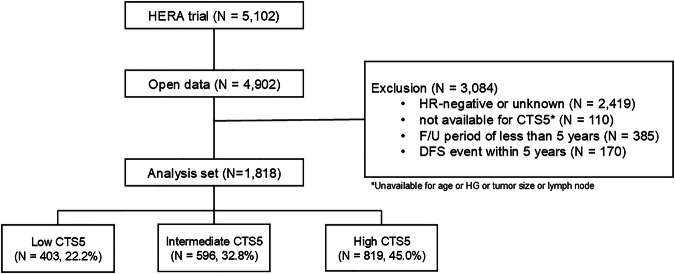
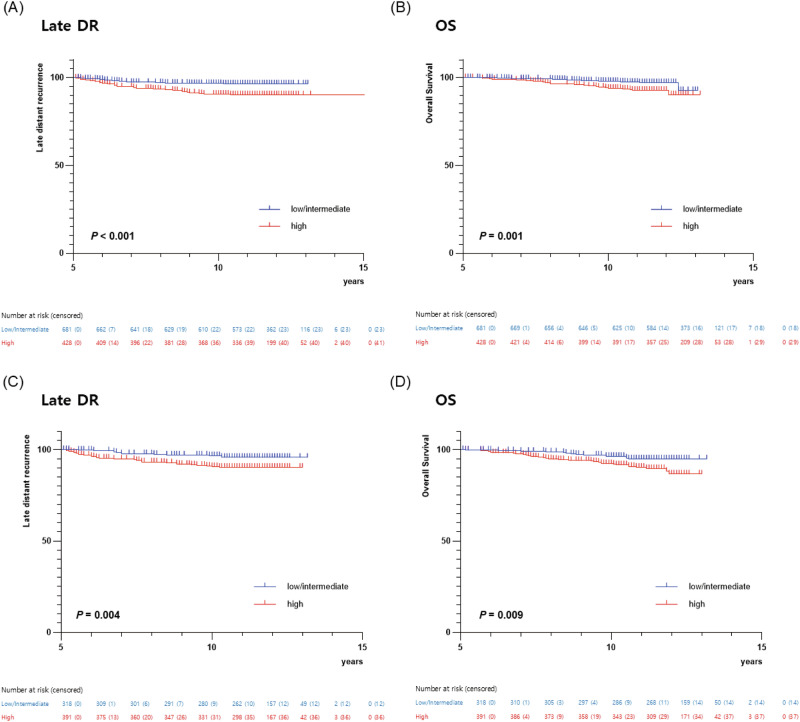
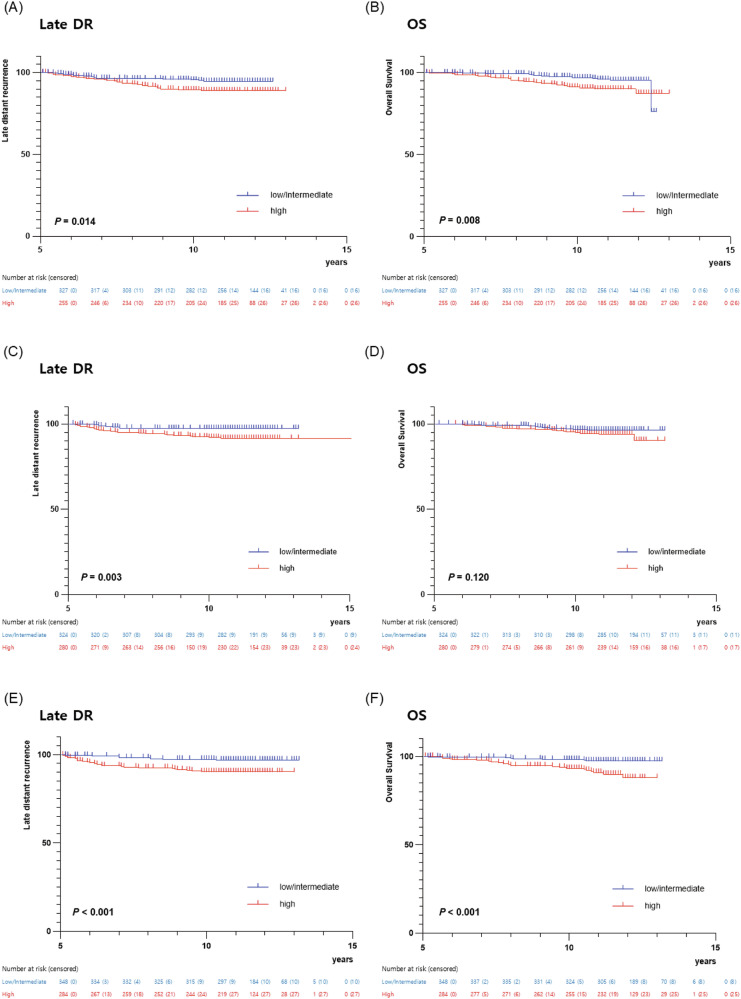
There is currently no reliable predictive tool for late recurrence in hormone receptor (HR)-positive, human epidermal growth factor receptor 2 (HER2)-positive breast cancer. This study aimed to explore the potential of the clinical treatment score post-5l̥years (CTS5) as a predictive tool for long-term survival beyond 5 years in patients with specifically HR-positive, HER2-positive breast cancer. We collected patient-level data from the HERceptin Adjuvant (HERA) (BIG1-01; ClinicalTrials.gov identifier: NCT00045032) trial. Our investigation focused on assessing the risk of late distant recurrence (DR) and overall survival (OS) according to the CTS5 risk score as continuous value and CTS5 stratification risk groups. A total of 1,818 patients with HR-positive, HER2-positive breast cancer were included in this analysis. The CTS5 score, as a continuous variable, emerged as an independent prognostic factor for both late DR (adjusted HR, 2.05; 95% CI, 1.63-2.58; P < 0.001) and OS (adjusted HR, 2.02; 95% CI, 1.58-2.58; P < 0.001), respectively. In addition, multivariable analysis showed a significant association between the high-risk group and adverse outcomes in late DR (adjusted HR, 2.76; 95% CI, 1.84-4.13; P < 0.001) and OS (adjusted HR, 2.44; 95% CI, 1.59-3.73; P < 0.001) compared to low/intermediate group. Consistent results were observed, regardless of age or administration of HER2-targeted therapy. CTS5 is a useful prognostic tool for predicting late DR and OS in HR-positive, HER2-positive breast cancer patients. Extension of endocrine therapy should be actively considered in patients with CTS5 high-risk group.
目前,对于激素受体(HR)阳性、人表皮生长因子受体2(HER2)阳性乳腺癌的晚期复发,尚无可靠的预测工具。本研究旨在探讨5年临床治疗评分(CTS5)作为特定HR阳性、HER2阳性乳腺癌患者5年以上长期生存预测工具的潜力。我们从赫赛汀辅助治疗(HERA)(BIG1-01;ClinicalTrials.gov标识符:NCT00045032)试验中收集了患者水平的数据。我们的研究重点是根据CTS5风险评分作为连续值和CTS5分层风险组来评估晚期远处复发(DR)和总生存期(OS)的风险。本分析共纳入1818例HR阳性、HER2阳性乳腺癌患者。CTS5评分作为一个连续变量,分别成为晚期DR(调整后HR,2.05;95%CI,1.63-2.58;P<0.001)和OS(调整后HR,2.02;95%CI,1.58-2.58;P<0.001)的独立预后因素。此外,多变量分析显示,与低/中风险组相比,高风险组与晚期DR(调整后HR,2.76;95%CI,1.84-4.13;P<0.001)和OS(调整后HR,2.44;95%CI,1.59-3.73;P<0.001)的不良结局之间存在显著关联。无论年龄或HER2靶向治疗的使用情况如何,均观察到一致的结果。CTS5是预测HR阳性、HER2阳性乳腺癌患者晚期DR和OS的有用预后工具。对于CTS5高风险组患者,应积极考虑延长内分泌治疗。