Khan Arshiya, Nayarisseri Anuraj, Singh Sanjeev Kumar
In silico Research Laboratory, Eminent Biosciences, Indore, 452010, Madhya Pradesh, India.
Computer Aided Drug Designing and Molecular Modeling Lab, Department of Bioinformatics, Alagappa University, Karaikudi, 630 003, Tamil Nadu, India.
Sci Rep. 2025 Apr 2;15(1):11241. doi: 10.1038/s41598-025-95359-2.
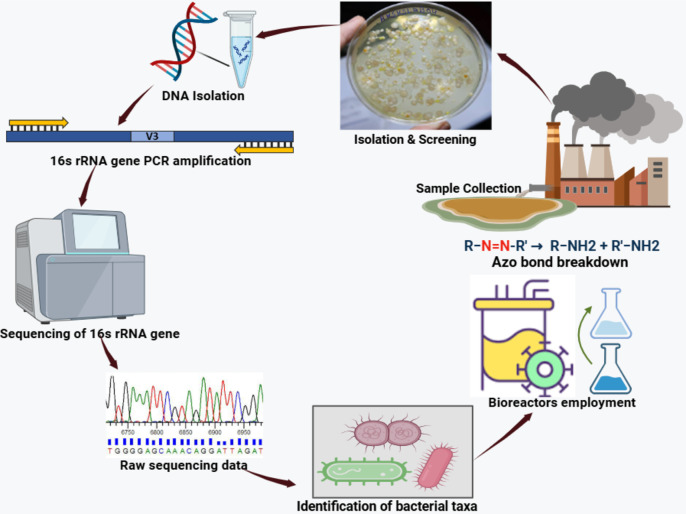
Azo dyes are highly recalcitrant, persistent, and toxic compounds, extensively used in the textile industry. The untreated discharge of dye effluents from the textile industry poses severe environmental and health risks. This research aimed to isolate and identify bacterial strains from textile wastewater that can decolorize azo dyes. After the subsequent screening of 89 isolates, 4 novel strains were identified utilizing the 16S rRNA gene sequencing technique that could effectively decolorize and degrade azo dyes, methyl red, direct yellow 12, and acid black 210. A thorough assessment of physicochemical parameters was conducted to optimize for maximum decolorization for all four strains. At pH 7, 37° C, and 50 mg/L dye concentration, the maximum decolorization for methyl red, direct yellow 12, and acid black 210 was 79.09% > 72.20% > 64.76%; 84.45% > 62.59% > 54.29%; 83.12% > 70.22% > 61.42%; and 92.71% > 83.02% > 69.84%, for isolate 1, isolate 2, isolate 3, and isolate 4, respectively. The novel strains belonged to the Sphingomonas, Pseudomonas, Shewanella, and Priestia species. The unique sequences of these bacterial strains have been submitted to the GenBank database under the accession numbers "OQ202071", "PP708911", "PP708909", and "PP086977," respectively. Further, an enzyme study and statistical optimization of Priestia flexa species was performed. A Central Composite Design and Response Surface Methodology has been applied for synergistic effects of process parameters namely pH (5-9), initial dye concentration (100-250 mg/L), and temperature (25°-45° C) on the decolorization of the model dyes. The regression analysis indicated a strong correlation between the experimental data and the second-order polynomial supported by a high coefficient of determination (R²). For all three dyes analyzed, the difference between the experimental and predicted values was found to be less than 10%. Fourier Transform Infrared spectroscopy was further employed to analyze and confirm the degradation of the three dyes.
偶氮染料是高度难降解、持久且有毒的化合物,广泛应用于纺织工业。纺织工业未经处理的染料废水排放带来了严重的环境和健康风险。本研究旨在从纺织废水中分离和鉴定能够使偶氮染料脱色的细菌菌株。在对89株分离菌进行后续筛选后,利用16S rRNA基因测序技术鉴定出4株新菌株,它们能够有效使偶氮染料、甲基红、直接黄12和酸性黑210脱色并降解。对理化参数进行了全面评估,以优化所有4株菌株的最大脱色效果。在pH 7、37°C和50 mg/L染料浓度下,分离菌1、分离菌2、分离菌3和分离菌4对甲基红、直接黄12和酸性黑210的最大脱色率分别为79.09% > 72.20% > 64.76%;84.45% > 62.59% > 54.29%;83.12% > 70.22% > 61.42%;92.71% > 83.02% > 69.84%。这些新菌株分别属于鞘氨醇单胞菌属、假单胞菌属、希瓦氏菌属和Priestia菌属。这些细菌菌株的独特序列已分别以登录号“OQ202071”、“PP708911”、“PP708909”和 “PP086977”提交至GenBank数据库。此外,还对Priestia flexa菌属进行了酶学研究和统计优化。采用中心复合设计和响应面方法研究了工艺参数即pH(5 - 9)、初始染料浓度(100 - 250 mg/L)和温度(25°C - 45°C)对模型染料脱色的协同作用。回归分析表明实验数据与二阶多项式之间具有很强的相关性,决定系数(R²)较高。对于所分析的所有三种染料,实验值与预测值之间的差异小于10%。进一步采用傅里叶变换红外光谱法分析并确认了三种染料的降解情况。