Fang Wei, Wang Huanping, Zhang Xiaoran, Zhu Hongxia, Yan Wei, Gao Yang
Department of Endocrinology, Chengdu Shuangliu Hospital of Traditional Chinese Medicine, Chengdu, China.
Department of Endocrinology, Hospital of Chengdu University of Traditional Chinese Medicine, Chengdu, China.
Front Pharmacol. 2025 Mar 19;16:1426847. doi: 10.3389/fphar.2025.1426847. eCollection 2025.
Immune checkpoint inhibitors-induced pancreatitis (ICIs-P) is an uncommon immune-related adverse event. The available evidence consists mostly of case reports, case series, and narrative reviews. This research focuses on the clinical characteristics and management options for ICIs-P to provide a practice-based global perspective on this disease.
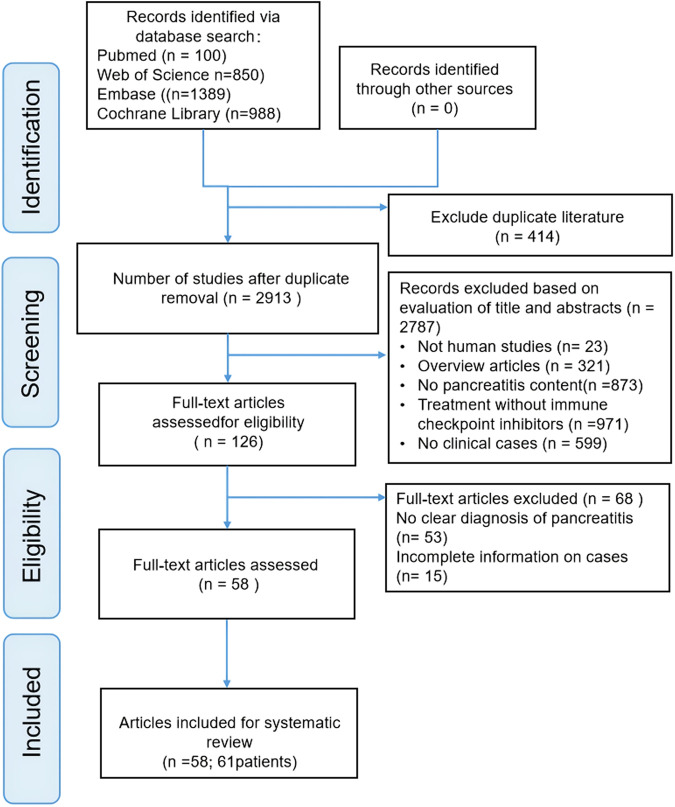
Five electronic databases were systematically reviewed to identify the relevant studies. Furthermore, we performed a disproportionality analysis utilizing OpenVigil 2.1 to interrogate the United States Food and Drug Administration's Adverse Event Reporting System (FAERS) database.
A total of 61 patients from 58 studies were included in this study. Most patients with ICIs-P were males (60.7%). Most patients received anti-PD-1/PD-L1 monotherapy (78.7%) or anti-PD-1/PD-L1 monotherapy in conjunction with CTLA-4 blockade (19.7%). The median time from the initiation of immune checkpoint inhibitors treatment to pancreatitis was 108 days (range 52-278). Most cases were severe or life-threatening (G3-G4; 64.0%). Corticosteroids were administered to 73.8% of the patients during the treatment of pancreatitis. Regarding treatment outcomes, ICIs-P was reversible in most cases (83.6%), despite the 8.2% relapse and 8.2% deaths. We identified 606 reports of pancreatitis associated with ICIs in the FAERS database, with the greatest proportion of males (50.7%), 62.0% of PD-1 inhibitors, and 22.1% of all reports of death or life-threatening outcomes. Signals indicating pancreatitis were observed across all ICIs, with particular emphasis on Cemiplimab, Pembrolizumab and Nivolumab.
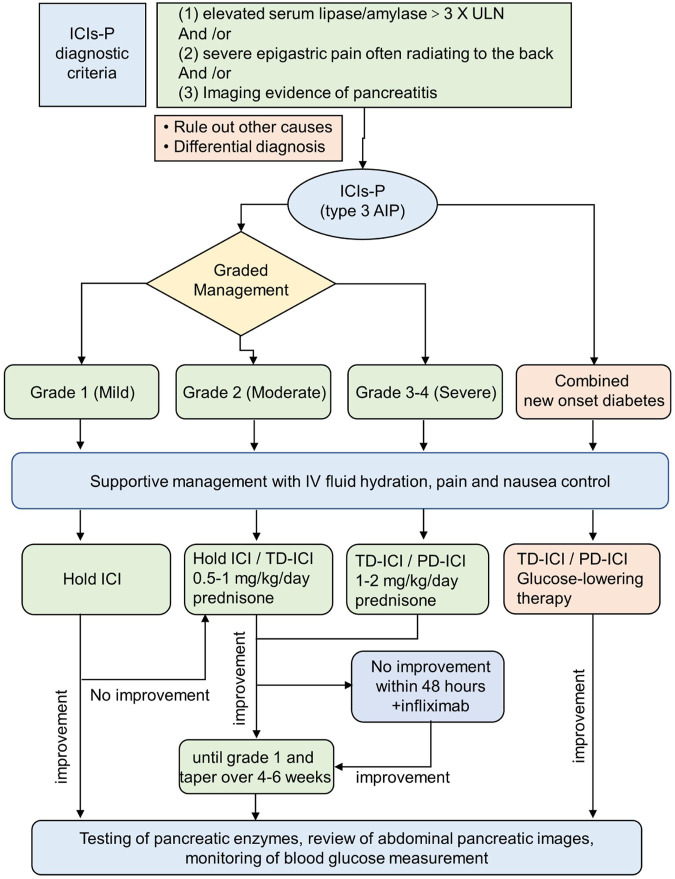
By using a pharmacovigilance database, we discovered an elevated risk of pancreatitis following ICIs therapy, especially with PD-1 inhibitors. Meanwhile, risk factors for ICIs-P remain poorly understood, and diagnosis is challenging. Which may manifest as asymptomatic elevated pancreatic enzyme levels or clinical pancreatitis. Patients with pancreatitis symptoms should have their lipase and amylase levels and radiology evaluated. Diagnosis should be made by excluding other causes. Steroids are the cornerstone of ICIs-P treatment and slow dose reduction is recommended to reduce recurrence.
免疫检查点抑制剂诱导的胰腺炎(ICIs-P)是一种罕见的免疫相关不良事件。现有证据主要包括病例报告、病例系列和叙述性综述。本研究聚焦于ICIs-P的临床特征和管理方案,以提供基于实践的对该疾病的全球视角。
系统检索了五个电子数据库以识别相关研究。此外,我们利用OpenVigil 2.1进行了不成比例分析,以查询美国食品药品监督管理局的不良事件报告系统(FAERS)数据库。
本研究共纳入了来自58项研究的61例患者。大多数ICIs-P患者为男性(60.7%)。大多数患者接受抗PD-1/PD-L1单药治疗(78.7%)或抗PD-1/PD-L1单药治疗联合CTLA-4阻断(19.7%)。从开始免疫检查点抑制剂治疗到发生胰腺炎的中位时间为108天(范围52 - 278天)。大多数病例为重度或危及生命(G3 - G4;64.0%)。73.8%的患者在胰腺炎治疗期间接受了皮质类固醇治疗。关于治疗结果,ICIs-P在大多数情况下是可逆的(83.6%),尽管有8.2%的复发率和8.2%的死亡率。我们在FAERS数据库中识别出606例与ICIs相关的胰腺炎报告,其中男性比例最高(50.7%),PD-1抑制剂占62.0%,所有死亡或危及生命结局报告中占22.1%。在所有ICIs中均观察到提示胰腺炎的信号,尤其以西米普利单抗、帕博利珠单抗和纳武利尤单抗为重点。
通过使用药物警戒数据库,我们发现ICIs治疗后胰腺炎风险升高,尤其是使用PD-1抑制剂时。同时,ICIs-P的危险因素仍了解不足,诊断具有挑战性。其可能表现为无症状的胰腺酶水平升高或临床胰腺炎。有胰腺炎症状的患者应评估其脂肪酶和淀粉酶水平及影像学检查。应通过排除其他病因来做出诊断。类固醇是ICIs-P治疗的基石,建议缓慢减量以降低复发率。