Zhang Yue, Fang Yisheng, Wu Jianhua, Huang Genjie, Bin Jianping, Liao Yulin, Shi Min, Liao Wangjun, Huang Na
Department of Oncology, Nanfang Hospital, Southern Medical University, Guangzhou, China.
Department of Cardiology, Nanfang Hospital, Southern Medical University, Guangzhou, China.
Front Pharmacol. 2022 Apr 1;13:817662. doi: 10.3389/fphar.2022.817662. eCollection 2022.
Immune checkpoint inhibitors (ICIs) are considered cornerstones of oncology treatment with durable anti-tumor efficacy, but the increasing use of ICIs is associated with the risk of developing immune-related adverse events (irAEs). Although ICI-associated pancreatic adverse events (AEs) have been reported in patients treated with ICIs, the clinical features and spectrum of pancreatic AEs are still not well-defined. Therefore, this study aimed to identify the association between pancreatic AEs and ICIs treatments and to characterize the main features of ICI-related pancreatic injury (ICIPI) based on the Food and Drug Administration Adverse Event Reporting System (FAERS) database.
Data from the first quarter of 2015 to the first quarter of 2021 in the database were extracted to conduct a disproportionality analysis. The selection of AEs related to the pancreas relied on previous studies and preferred terms from the Medical Dictionary for Regulatory Activities. Two main disproportionality analyses-the reporting odds ratio (ROR) and information component (IC)-were used to evaluate potential associations between ICIs and pancreatic AEs.
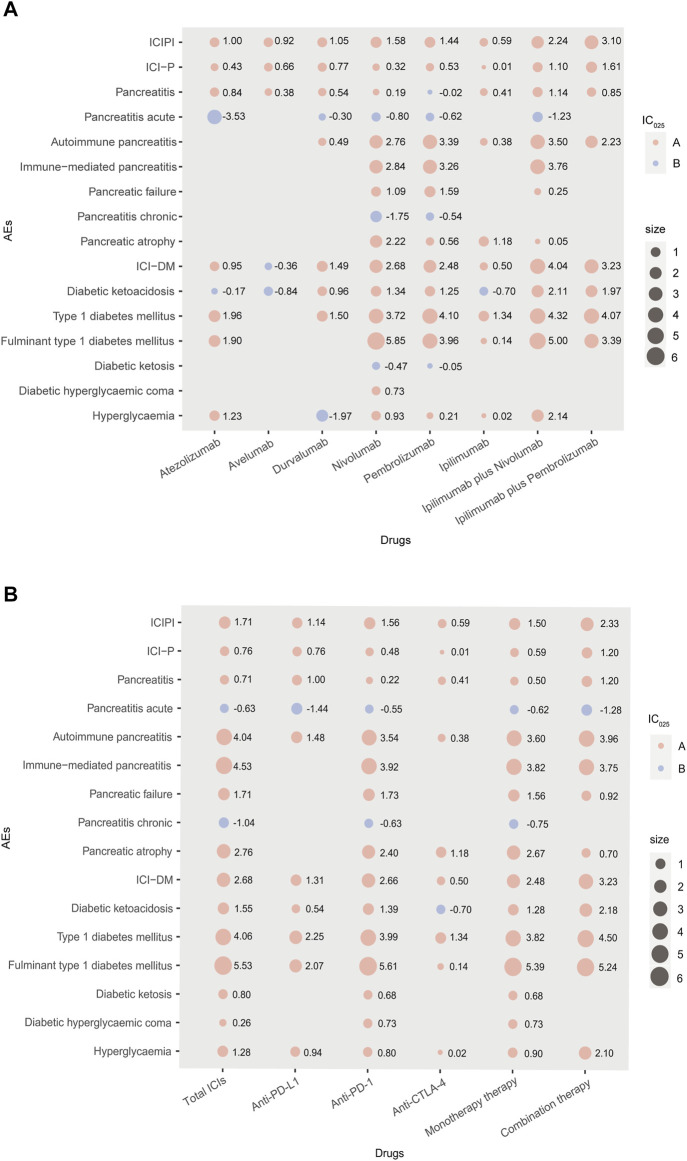
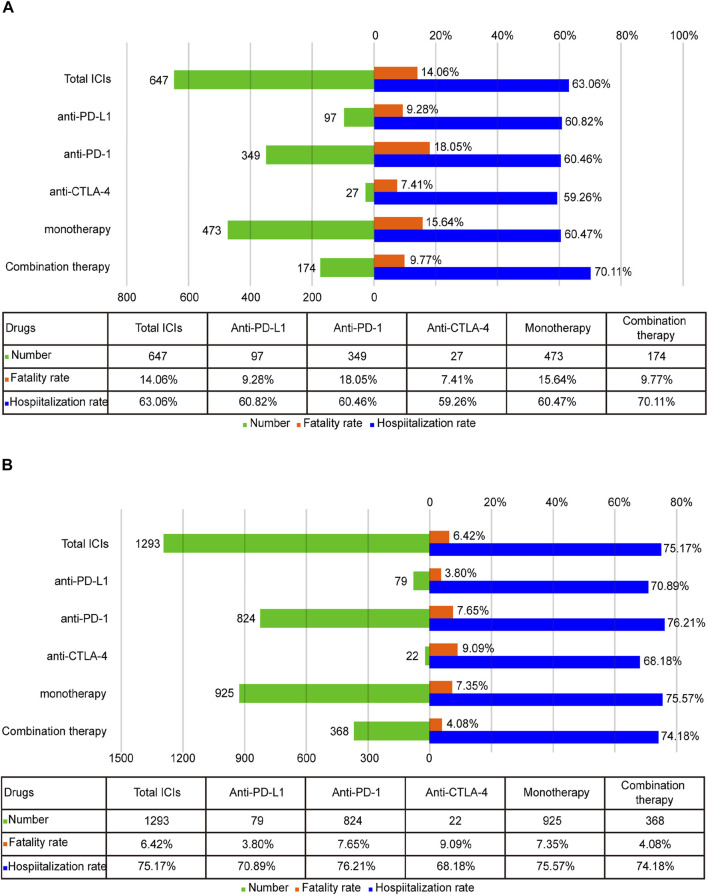
In total, 2,364 cases of pancreatic AEs in response to ICIs were extracted from the FAERS database, of which, 647 were identified as ICI-associated pancreatitis and 1,293 were identified as ICI-associated diabetes mellitus. Generally, significant signals can be detected between pancreatic AEs and all ICIs treatments (ROR = 3.30, IC = 1.71). For monotherapy, the strongest signal associated with pancreatitis was reported for anti-PD-L1 (ROR = 1.75, IC = 0.76), whereas that with diabetes mellitus was reported for anti-PD-1 (ROR = 6.39, IC = 2.66). Compared with monotherapy, combination therapy showed stronger associations with both ICI-associated pancreatitis (ROR = 2.35, IC = 1.20 . ROR = 1.52, IC = 0.59) and ICI-associated diabetes mellitus (ROR = 9.53, IC = 3.23 . ROR = 5.63, IC = 2.48), but lower fatality proportion.
ICIs were significantly associated with the over-reporting frequency of pancreatic AEs, in which combination therapy posed a higher reporting frequency. Therefore, patients should be informed of these potential toxicities before ICIs medications are administered.
免疫检查点抑制剂(ICIs)被认为是肿瘤治疗的基石,具有持久的抗肿瘤疗效,但ICIs使用的增加与发生免疫相关不良事件(irAEs)的风险相关。尽管在接受ICIs治疗的患者中已报告了与ICI相关的胰腺不良事件(AEs),但胰腺AEs的临床特征和范围仍未明确界定。因此,本研究旨在确定胰腺AEs与ICIs治疗之间的关联,并基于美国食品药品监督管理局不良事件报告系统(FAERS)数据库,对ICI相关胰腺损伤(ICIPI)的主要特征进行描述。
提取数据库中2015年第一季度至2021年第一季度的数据进行不成比例分析。与胰腺相关的AEs的选择依赖于先前的研究以及《监管活动医学词典》中的首选术语。使用两种主要的不成比例分析方法——报告比值比(ROR)和信息成分(IC)——来评估ICIs与胰腺AEs之间的潜在关联。
总共从FAERS数据库中提取了2364例对ICIs有反应的胰腺AEs病例,其中647例被确定为ICI相关胰腺炎,1293例被确定为ICI相关糖尿病。总体而言,在胰腺AEs与所有ICIs治疗之间可检测到显著信号(ROR = 3.30,IC = 1.71)。对于单药治疗,与胰腺炎相关的最强信号是抗PD-L1(ROR = 1.75,IC = 0.76),而与糖尿病相关的最强信号是抗PD-1(ROR = 6.39,IC = 2.66)。与单药治疗相比,联合治疗与ICI相关胰腺炎(ROR = 2.35,IC = 1.20;ROR = 1.52,IC = 0.59)和ICI相关糖尿病(ROR = 9.53,IC = 3.23;ROR = 5.63,IC = 2.48)均显示出更强的关联,但致死比例较低。
ICIs与胰腺AEs的报告频率过高显著相关,其中联合治疗的报告频率更高。因此,在给予ICIs药物之前,应告知患者这些潜在毒性。