Mahraz Mohamed Adil, Salim Rajae, Loukili El Hassania, Laftouhi Abdelouahid, Haddou Salima, Elrherabi Amal, Bouhrim Mohamed, Herqash Rashed N, Shahat Abdelaaty A, Eto Bruno, Hammouti Belkheir, Rais Zakia, Taleb Mustapha
Laboratory of Engineering, Electrochemistry, Modelling and Environment, Faculty of Sciences Dhar El Mahraz, Sidi Mohammed Ben Abdellah University, Fez, 30050, Morocco.
Euromed University of Fes, UEMF, Fes, Morocco.
Open Life Sci. 2025 Mar 26;20(1):20221050. doi: 10.1515/biol-2022-1050. eCollection 2025.
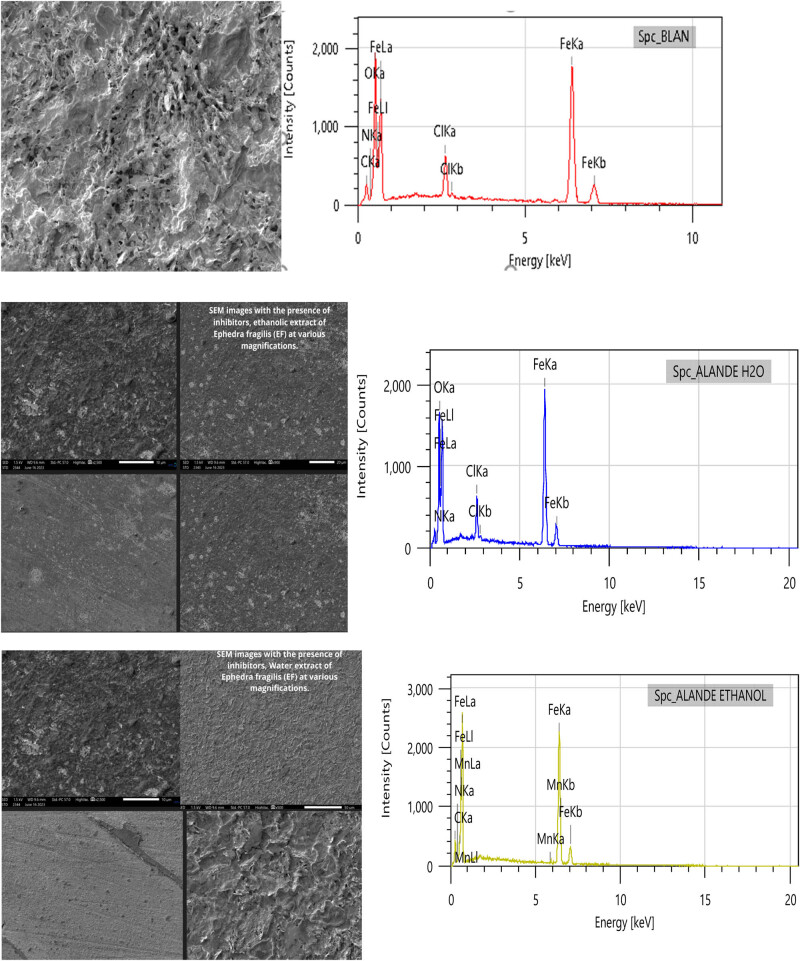
The present study introduces an innovative approach to sustainable corrosion inhibition by utilizing the aerial parts of (EF) as a natural inhibitor for steel in hydrochloric acid solutions. Unlike conventional synthetic inhibitors, EF extracts offer an eco-friendly and renewable alternative, emphasizing their potential for industrial applications. Both water and ethanolic extracts were evaluated, and their bioactive compounds were identified using high-performance liquid chromatography. The ethanolic extract was rich in , , and , while the aqueous extract predominantly contained , , and . Electrochemical techniques, including open circuit potential, electrochemical impedance spectroscopy, and potentiodynamic polarization, demonstrated remarkable corrosion inhibition efficiency, reaching up to 97%. The extracts exhibited mixed-type inhibition behavior, with efficiency improving as the concentration increased. Specifically, inhibition efficiencies of 96.13 and 96.84% were achieved using the Tafel method, highlighting the superior performance of EF extracts compared to many synthetic counterparts. Furthermore, scanning electron microscopy revealed the formation of a dense, protective organic layer on the steel surface, which underpins the high inhibition efficiency. This study not only validates the use of EF as an efficient, sustainable corrosion inhibitor but also opens new avenues for the integration of plant-based inhibitors into industrial practices, providing a long-term, eco-friendly solution to steel corrosion challenges.
本研究引入了一种创新方法,通过利用(EF)的地上部分作为盐酸溶液中钢铁的天然缓蚀剂来实现可持续缓蚀。与传统的合成缓蚀剂不同,EF提取物提供了一种环保且可再生的替代方案,强调了它们在工业应用中的潜力。对水提取物和乙醇提取物都进行了评估,并使用高效液相色谱法鉴定了它们的生物活性化合物。乙醇提取物富含[具体成分1]、[具体成分2]和[具体成分3],而水提取物主要含有[具体成分4]、[具体成分5]和[具体成分6]。电化学技术,包括开路电位、电化学阻抗谱和动电位极化,显示出显著的缓蚀效率,高达97%。提取物表现出混合型抑制行为,随着浓度增加效率提高。具体而言,使用塔菲尔方法实现了96.13%和96.84%的抑制效率,突出了EF提取物相对于许多合成同类物的优越性能。此外,扫描电子显微镜显示在钢铁表面形成了致密的保护性有机层,这是高抑制效率的基础。本研究不仅验证了EF作为一种高效、可持续的缓蚀剂的用途,还为将植物基缓蚀剂整合到工业实践中开辟了新途径,为钢铁腐蚀挑战提供了一种长期、环保的解决方案。