Meseguer-Henarejos Ana-Belén, López-García Juan-José, López-Pina José-Antonio, Martínez-González-Moro Ignacio, Martínez-Carrasco Ángel
Department of Physiotherapy, University of Murcia, Murcia, Spain.
Department of Basic Psychology and Methodology, University of Murcia, Murcia, Spain.
PLoS One. 2025 Apr 3;20(4):e0318302. doi: 10.1371/journal.pone.0318302. eCollection 2025.
The Balance Evaluation Systems Test (BESTest) and two abbreviated versions, Mini-BESTest and Brief-BESTest are used to assess functioning of balance control systems. Its reliability across different populations remains to be determined.
The present study followed reliability generalization procedures to estimate an average internal consistency and inter and intra-rater reliability for the BESTest, Mini-BESTest and Brief-BEStest. In this study, the heterogeneity of reliability coefficients in each instrument is evaluated. If heterogeneity is significant, a moderator analysis is performed to identify the characteristic which explains such variability.
A search of the PubMed, Embase, PsycINFO, Web of Science, Scopus and CINAHL databases was carried out to February 10th 2024. Two reviewers independently selected empirical studies published in English or Spanish that applied the BESTest, Mini-BESTest and/or Brief-BESTest and reported any reliability coefficient and/or internal consistency with data at hand.
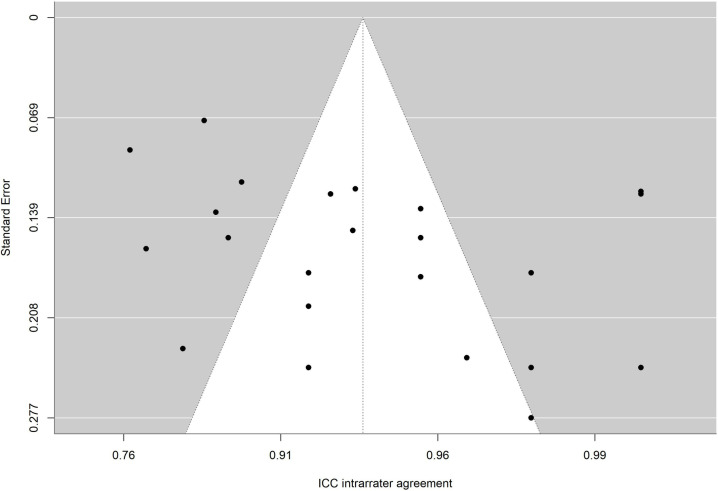
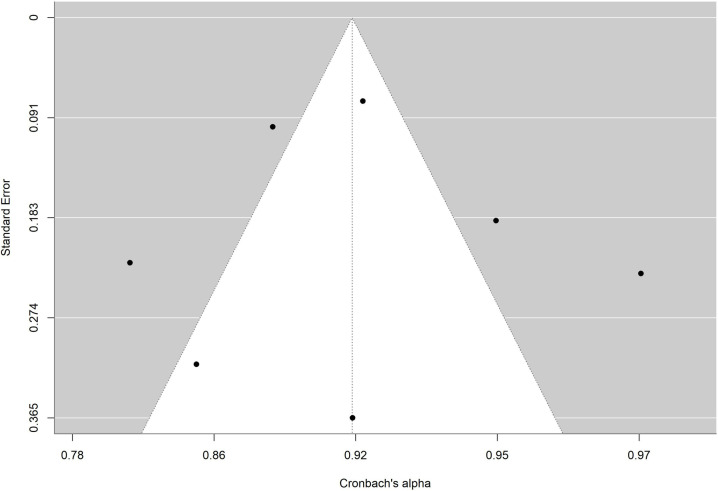
Sixty-four studies reported any reliability estimate BESTest, Mini-BESTest and/or Brief-BESTest scores (N. = 5225 participants). Mean Cronbach alpha for the Mini-BESTest and Brief-BESTest (total score = 0.92) indicating no variability in estimated internal consistency. Likewise, no variability was obtained for inter-rater and intra-rater mean agreement of the BESTest (ICC = 0.97; 0.94), Mini-BESTest (ICC = 0.95; 0.94) and Brief-BESTest (ICC = 0.96; 0.95). Mean scores, standard deviation of scores, mean age, gender, population type, mean history of the disorder, disease, raters´ experience, number of raters, rater formation, continent of study and design type presented statistically significant relationships with ICC and/or Cronbach´s alpha for BESTest and the two abbreviated versions.
The mean intraclass correlations and Cronbach alpha obtained for BESTest, Mini-BESTest and Brief-BESTest exhibited an excellent inter and intra-rater reliability and internal consistency. The average reliability obtained three scales adequate to be applied for screening balance problems in different populations. Some continuous and categorical moderator variables increase reliability and internal consistency of these scales.
平衡评估系统测试(BESTest)及其两个简化版本,即迷你BESTest和简短BESTest,用于评估平衡控制系统的功能。其在不同人群中的可靠性仍有待确定。
本研究遵循可靠性概括程序,以估计BESTest、迷你BESTest和简短BESTest的平均内部一致性以及评分者间和评分者内的可靠性。在本研究中,评估了每种工具中可靠性系数的异质性。如果异质性显著,则进行调节分析以确定解释这种变异性的特征。
检索了截至2024年2月10日的PubMed、Embase、PsycINFO、Web of Science、Scopus和CINAHL数据库。两名评审员独立选择以英文或西班牙文发表的实证研究,这些研究应用了BESTest、迷你BESTest和/或简短BESTest,并报告了任何可靠性系数和/或手头数据的内部一致性。
64项研究报告了BESTest、迷你BESTest和/或简短BESTest分数的任何可靠性估计值(N = 5225名参与者)。迷你BESTest和简短BESTest的平均Cronbach阿尔法系数(总分 = 0.92)表明估计的内部一致性没有变化。同样,BESTest(ICC = 0.97;0.94)、迷你BESTest(ICC = 0.95;0.94)和简短BESTest(ICC = (0.96;0.95)的评分者间和评分者内平均一致性也没有变化。平均分数、分数标准差、平均年龄、性别、人群类型、疾病平均病史、疾病、评分者经验、评分者数量、评分者组成、研究所在大陆和设计类型与BESTest及其两个简化版本的ICC和/或Cronbach阿尔法系数呈现出统计学上的显著关系。
BESTest、迷你BESTest和简短BESTest获得的平均组内相关系数和Cronbach阿尔法系数表现出出色的评分者间和评分者内可靠性以及内部一致性。获得的这三个量表的平均可靠性足以用于筛查不同人群中的平衡问题。一些连续和分类的调节变量提高了这些量表的可靠性和内部一致性。