
解析用于烷烃脱氢的PtSn@K-MFI催化剂中复杂的K-Pt-Sn相互作用
Resolving Complex K-Pt-Sn Interactions in PtSn@K-MFI Catalysts for Alkane Dehydrogenation.
作者信息
Martínez Gómez-Aldaraví Adrián, Millán Reisel, Millet Isabel, Alós Aroa, Vidal-Moya Alejandro, Meyer Randall J, Martínez Cristina, Corma Avelino, Boronat Mercedes, Serna Pedro, Moliner Manuel
机构信息
Instituto de Tecnología Química, Universitat Politècnica de València-Consejo Superior de Investigaciones Científicas, Avenida de los Naranjos s/n, València 46022, Spain.
ExxonMobil Technology and Engineering Co., Annandale, New Jersey 08801, United States.
出版信息
J Am Chem Soc. 2025 Apr 16;147(15):12833-12844. doi: 10.1021/jacs.5c01536. Epub 2025 Apr 3.
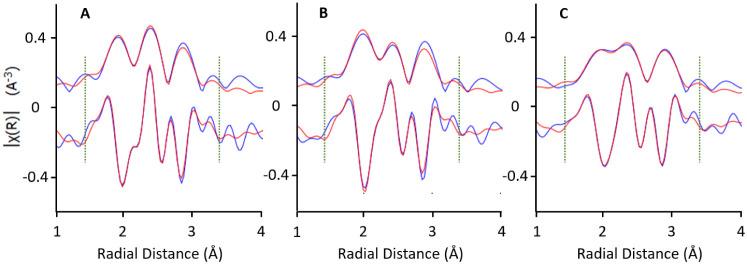
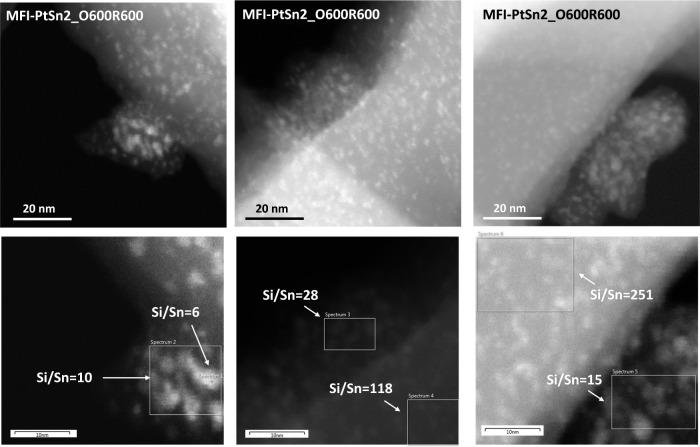
K and Sn contents were rationalized during the synthesis of PtSn@K-MFI to maximize metal dispersion and stability along the MFI crystallites. Experimental results and theoretical calculations reveal a stoichiometry of ∼1 K per unit cell of MFI, limiting then the final K incorporation within siliceous MFI crystals at ∼0.7 wt %. Above this stoichiometry, K is not incorporated into the final solids unless significant amounts of Sn are simultaneously present, leading to the formation of tin-silicate precipitates. The optimized PtSn@K-MFI catalysts improve the catalytic performance of well-established references, as PtSn/SiO, for the propane dehydration (PDH) reaction. In particular, low Sn loadings (below 0.5 wt %) result in higher time-on-stream (TOS) deactivation catalytic profiles but excellent regenarability after consecutive PDH reaction, while higher Sn content (close to 1 wt %) minimizes TOS deactivation due to the maximization of Pt-Sn bonds but consecutive regenerations result in significant metal sintering. Increasing Sn contents within MFI crystallites facilitates Pt sintering and, thus, occurring catalyst deactivation upon regeneration cycles. As a result of complex interconnected nucleation/crystallization processes, fine-tuning rationalizations of one-pot synthesis approaches can substantially influence the final atomic and subnanometric metal interactions and, consequently, the catalytic and sintering-resistance properties when exposed to highly demanding industrial conditions.
在合成PtSn@K-MFI的过程中,对钾(K)和锡(Sn)的含量进行了优化,以最大限度地提高金属在MFI微晶上的分散度和稳定性。实验结果和理论计算表明,MFI的每个晶胞中钾的化学计量比约为1,这限制了最终钾在硅质MFI晶体中的掺入量,约为0.7 wt%。超过这个化学计量比,除非同时存在大量的锡,否则钾不会掺入最终的固体中,这会导致锡酸盐沉淀的形成。优化后的PtSn@K-MFI催化剂提高了成熟参比催化剂(如PtSn/SiO)在丙烷脱水(PDH)反应中的催化性能。特别是,低锡负载量(低于0.5 wt%)会导致更高的在线时间(TOS)失活催化曲线,但在连续PDH反应后具有优异的可再生性,而较高的锡含量(接近1 wt%)由于Pt-Sn键的最大化而使TOS失活最小化,但连续再生会导致显著的金属烧结。MFI微晶中锡含量的增加会促进铂的烧结,从而在再生循环时导致催化剂失活。由于复杂的相互连接的成核/结晶过程,一锅法合成方法的微调优化会极大地影响最终的原子和亚纳米级金属相互作用,进而影响在苛刻工业条件下的催化性能和抗烧结性能。




 Zotero 插件