Inayat Ali Alijaan, Azam Iqbal, Tikmani Shiyam S, Saleem Sarah
Population and Reproductive Health Section, Department of Community Health Sciences, The Aga Khan University, Karachi, Pakistan
Epidemiology and Biostatistics Section, Department of Community Health Sciences, Aga Khan University Hospital, Karachi, Pakistan.
BMJ Open. 2025 Apr 2;15(4):e096404. doi: 10.1136/bmjopen-2024-096404.
Adolescent Sexual and Reproductive Health encompasses their physical and emotional well-being, including their ability to avoid unwanted pregnancies, unsafe abortions, sexually transmitted infections (STIs) and any type of sexual violence and coercion. However, these risks may be mitigated through improved knowledge, encouraging positive attitudes, and adopting better practices. This study aimed to identify the factors associated with knowledge, attitudes and practices (KAP) related to HIV, STI, family planning and pregnancy among adolescents residing in rural Thatta.
A cross-sectional study.
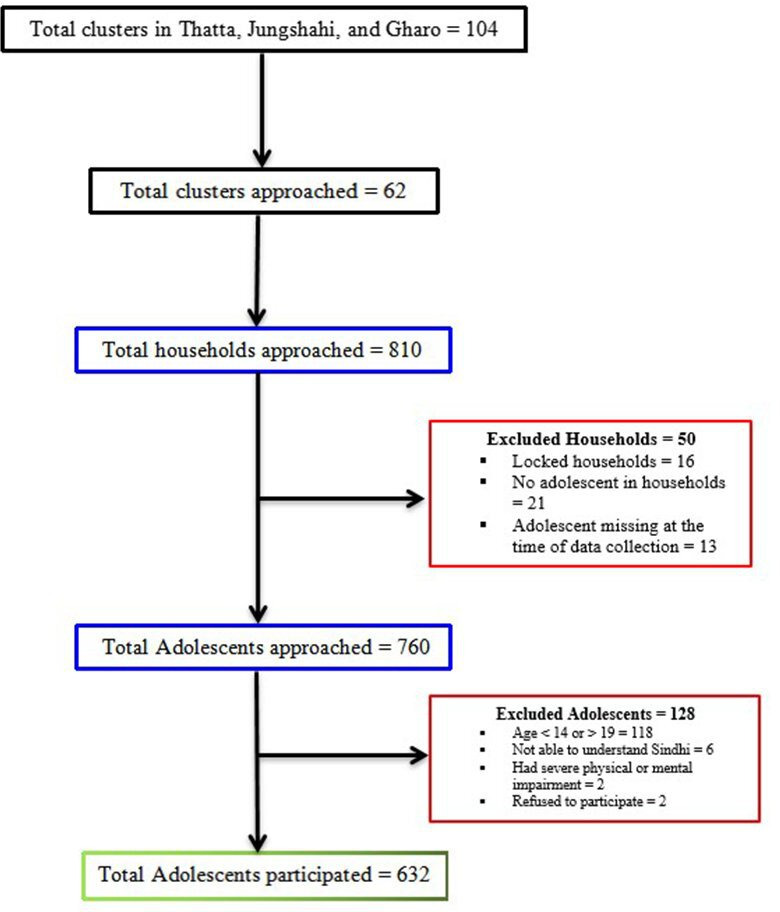
62 villages from Thatta, Gharo and Jungshahi registered under the Global Network Maternal and Newborn Health Registry in Thatta, Pakistan.
632 adolescents aged 14-19 years.
The association between sociodemographic factors and KAP was assessed using a modified version of the 'Asking Young People about Sexual and Reproductive Behaviors' tool. Statistical analysis was performed on Stata V.15.0 using multiple linear regression.
Among 632 adolescents, 82.7% were females. No significant differences were found in mean scores of knowledge and attitudes between males and females. However, a difference of 0.13 (95% CI 0.005, 0.24) in practice scores was observed. In design-based multivariable analysis, adolescents' marital status (β 5.13; 95% CI 1.34, 8.91) and father's occupation (β 3.41; 95% CI 0.90, 5.93) were associated with knowledge. Marital status (β 1.34; 95% CI 0.82, 1.86), household income (β -2.36; 95% CI -4.64, -0.07), father's occupation (β -1.42; 95% CI -2.52, -0.33) and mother's education (β -1.41; 95% CI -2.71, -0.11) were associated with attitudes. Moreover, marital status (β 0.24; 95% CI 0.06, 0.41) and mother's occupation (β 0.64; 95% CI 0.38, 0.90) were associated with practices.
No differences in knowledge and attitudes between male and female adolescents were found. These findings suggest that community awareness programmes should be implemented to improve sexual and reproductive health KAP for both male and female adolescents in Thatta.
青少年性与生殖健康涵盖其身心健康,包括避免意外怀孕、不安全堕胎、性传播感染(STIs)以及任何形式性暴力和胁迫的能力。然而,通过增进知识、鼓励积极态度和采用更好的做法,这些风险可能会降低。本研究旨在确定与巴基斯坦塔塔农村地区青少年的艾滋病毒、性传播感染、计划生育和怀孕相关的知识、态度和做法(KAP)的相关因素。
横断面研究。
在巴基斯坦塔塔的全球孕产妇和新生儿健康登记处登记的来自塔塔、加罗和琼沙希的62个村庄。
632名14 - 19岁的青少年。
使用“询问青少年性与生殖行为”工具的修改版评估社会人口学因素与KAP之间的关联。使用Stata V.15.0进行多元线性回归统计分析。
在632名青少年中,82.7%为女性。男性和女性在知识和态度的平均得分上未发现显著差异。然而,在实践得分上观察到0.13(95%可信区间0.005,0.24)的差异。在基于设计的多变量分析中,青少年的婚姻状况(β 5.13;95%可信区间1.34,8.91)和父亲的职业(β 3.41;95%可信区间0.90,5.93)与知识相关。婚姻状况(β 1.34;95%可信区间0.82,1.86)、家庭收入(β -2.36;95%可信区间 -4.64,-0.07)、父亲的职业(β -1.42;95%可信区间 -2.52,-0.33)和母亲的教育程度(β -1.41;95%可信区间 -2.71,-0.11)与态度相关。此外,婚姻状况(β 0.24;95%可信区间0.06,0.41)和母亲的职业(β 0.64;95%可信区间0.38,0.90)与做法相关。
未发现男女青少年在知识和态度上存在差异。这些发现表明,应实施社区宣传计划,以改善塔塔地区男女青少年的性与生殖健康KAP。