Ngai Stephanie, Evers Egmond Samir, Seoane Angela Katherine Lao, Ameh George, Anoko Julienne N, Barnadas Céline, Choi Mary J, Diaz Janet, Fontana Luca, Formenty Pierre, Nezu Ingrid Hammermeister, Jacquerioz Frédérique, Klena John, Laurenson-Schafer Henry, de Waroux Olivier le Polain, Legand Anaïs, Carrera Raquel Medialdea, Metcalf Tatiana, Montgomery Joel, Morreale Silvia, Negrón María E, Nvé Justino Obama, Ayekaba Mitoha Ondo'o, Pavlin Boris I, Shoemaker Trevor, Hernandez Yaimara Torres, Venta Mabel Varona, Gutierrez Emily Z, Ndoho Florentino Abaga Ondo
Emerg Infect Dis. 2025 May;31(5):887-895. doi: 10.3201/eid3105.241749. Epub 2025 Apr 3.
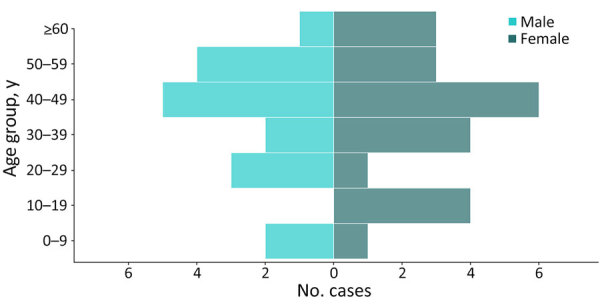
In February 2023, the government of Equatorial Guinea declared an outbreak of Marburg virus disease. We describe the response structure and epidemiologic characteristics, including case-patient demographics, clinical manifestations, risk factors, and the serial interval and timing of symptom onset, treatment seeking, and recovery or death. We identified 16 laboratory-confirmed and 23 probable cases of Marburg virus disease in 5 districts and noted several unlinked chains of transmission and a case-fatality ratio of 90% (35/39 cases). Transmission was concentrated in family clusters and healthcare settings. The median serial interval was 18.5 days; most transmission occurred during late-stage disease. Rapid isolation of symptomatic case-patients is critical in preventing transmission and improving patient outcomes; community engagement and surveillance strengthening should be prioritized in emerging outbreaks. Further analysis of this outbreak and a One Health surveillance approach can help prevent and prepare for future potential spillover events.
2023年2月,赤道几内亚政府宣布爆发马尔堡病毒病。我们描述了应对结构和流行病学特征,包括病例患者的人口统计学信息、临床表现、危险因素,以及症状出现、就医、康复或死亡的间隔时间和时间安排。我们在5个地区确定了16例实验室确诊病例和23例疑似马尔堡病毒病病例,并注意到几条无关联的传播链,病死率为90%(39例中的35例)。传播集中在家庭聚集和医疗机构中。平均间隔时间为18.5天;大多数传播发生在疾病后期。对有症状的病例患者进行快速隔离对于预防传播和改善患者预后至关重要;在新出现的疫情中,应优先开展社区参与和加强监测。对此次疫情的进一步分析以及“同一健康”监测方法有助于预防和应对未来潜在的溢出事件。