• 文献检索
  • 文档翻译
  • 深度研究
  • 学术资讯
  • Suppr Zotero 插件Zotero 插件
  • 邀请有礼
  • 套餐&价格
  • 历史记录
应用&插件
Suppr Zotero 插件Zotero 插件浏览器插件Mac 客户端Windows 客户端微信小程序
定价
高级版会员购买积分包购买API积分包
服务
文献检索文档翻译深度研究API 文档MCP 服务
关于我们
关于 Suppr公司介绍联系我们用户协议隐私条款
关注我们

Suppr 超能文献

核心技术专利:CN118964589B侵权必究
粤ICP备2023148730 号-1Suppr @ 2026

文献检索

告别复杂PubMed语法,用中文像聊天一样搜索,搜遍4000万医学文献。AI智能推荐,让科研检索更轻松。

立即免费搜索

文件翻译

保留排版,准确专业,支持PDF/Word/PPT等文件格式,支持 12+语言互译。

免费翻译文档

深度研究

AI帮你快速写综述,25分钟生成高质量综述,智能提取关键信息,辅助科研写作。

立即免费体验

非洲局部、国家和区域病毒性出血热大流行潜力:多阶段分析。

Local, national, and regional viral haemorrhagic fever pandemic potential in Africa: a multistage analysis.

机构信息

Institute for Health Metrics and Evaluation, University of Washington, Seattle, WA, USA.

Department of Zoology, University of Oxford, Oxford, UK; Harvard Medical School, Harvard University, Boston, MA, USA; Boston Children's Hospital, Boston, MA, USA.

出版信息

Lancet. 2017 Dec 16;390(10113):2662-2672. doi: 10.1016/S0140-6736(17)32092-5. Epub 2017 Oct 12.

DOI:10.1016/S0140-6736(17)32092-5
PMID:
29031848
原文链接:https://pmc.ncbi.nlm.nih.gov/articles/PMC5735217/
Abstract

BACKGROUND

Predicting when and where pathogens will emerge is difficult, yet, as shown by the recent Ebola and Zika epidemics, effective and timely responses are key. It is therefore crucial to transition from reactive to proactive responses for these pathogens. To better identify priorities for outbreak mitigation and prevention, we developed a cohesive framework combining disparate methods and data sources, and assessed subnational pandemic potential for four viral haemorrhagic fevers in Africa, Crimean-Congo haemorrhagic fever, Ebola virus disease, Lassa fever, and Marburg virus disease.

METHODS

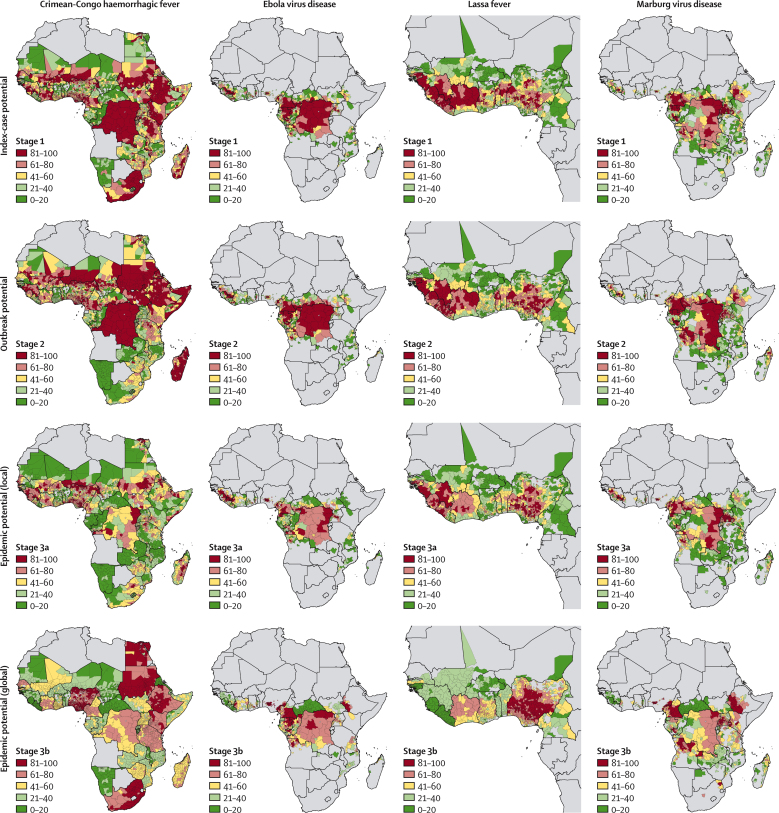
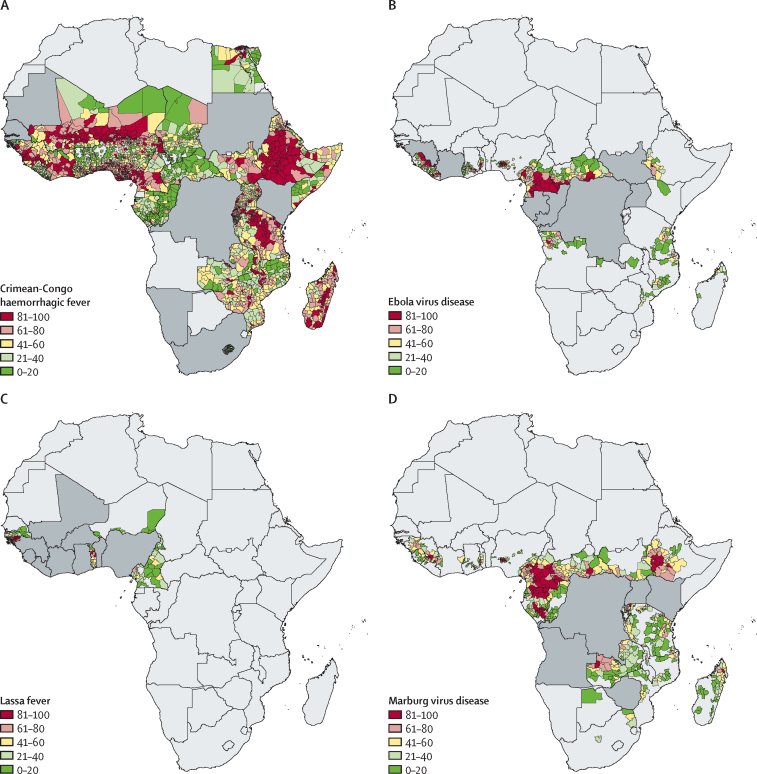
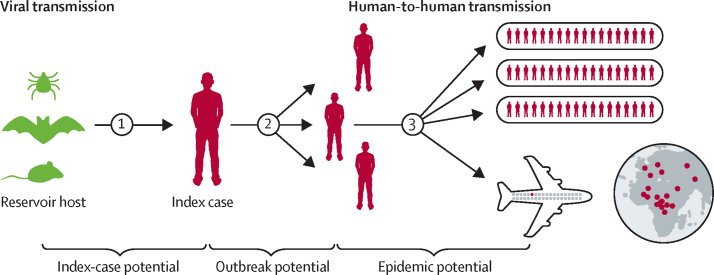
In this multistage analysis, we quantified three stages underlying the potential of widespread viral haemorrhagic fever epidemics. Environmental suitability maps were used to define stage 1, index-case potential, which assesses populations at risk of infection due to spillover from zoonotic hosts or vectors, identifying where index cases could present. Stage 2, outbreak potential, iterates upon an existing framework, the Index for Risk Management, to measure potential for secondary spread in people within specific communities. For stage 3, epidemic potential, we combined local and international scale connectivity assessments with stage 2 to evaluate possible spread of local outbreaks nationally, regionally, and internationally.

FINDINGS

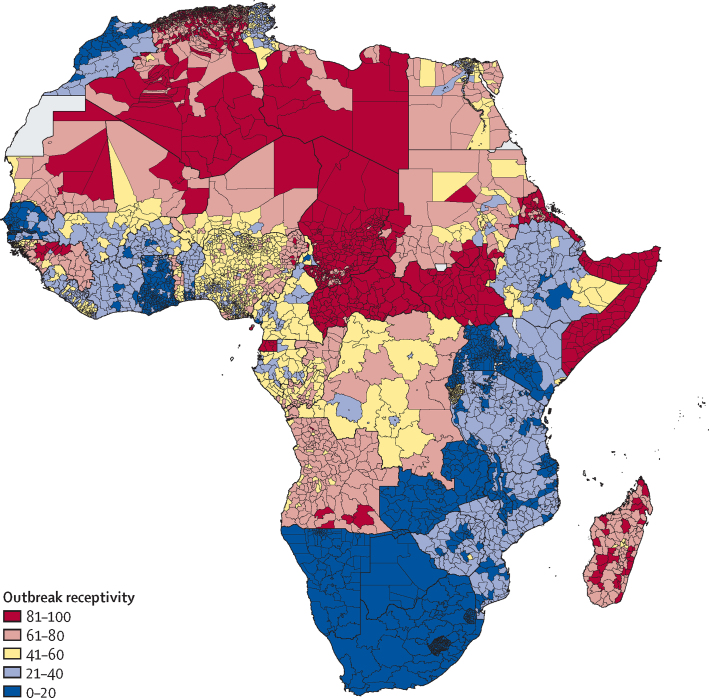
We found epidemic potential to vary within Africa, with regions where viral haemorrhagic fever outbreaks have previously occurred (eg, western Africa) and areas currently considered non-endemic (eg, Cameroon and Ethiopia) both ranking highly. Tracking transitions between stages showed how an index case can escalate into a widespread epidemic in the absence of intervention (eg, Nigeria and Guinea). Our analysis showed Chad, Somalia, and South Sudan to be highly susceptible to any outbreak at subnational levels.

INTERPRETATION

Our analysis provides a unified assessment of potential epidemic trajectories, with the aim of allowing national and international agencies to pre-emptively evaluate needs and target resources. Within each country, our framework identifies at-risk subnational locations in which to improve surveillance, diagnostic capabilities, and health systems in parallel with the design of policies for optimal responses at each stage. In conjunction with pandemic preparedness activities, assessments such as ours can identify regions where needs and provisions do not align, and thus should be targeted for future strengthening and support.

FUNDING

Paul G Allen Family Foundation, Bill & Melinda Gates Foundation, Wellcome Trust, UK Department for International Development.

摘要

背景

预测病原体何时何地出现具有一定难度,然而,正如最近的埃博拉和寨卡疫情所表明的那样,及时有效的应对措施是关键。因此,对于这些病原体,从被动反应向主动反应转变至关重要。为了更好地确定减轻和预防疫情爆发的优先事项,我们开发了一个综合框架,结合了不同的方法和数据源,并评估了非洲四种病毒性出血热(克里米亚-刚果出血热、埃博拉病毒病、拉沙热和马尔堡病毒病)的次国家级大流行潜力。

方法

在这一多阶段分析中,我们量化了广泛的病毒性出血热疫情潜力的三个阶段。使用环境适宜性图来定义第 1 阶段,即指标病例潜力,评估由于人畜共患病宿主或媒介的溢出而感染风险的人群,确定可能出现指标病例的地方。第 2 阶段,即疫情潜力,对现有框架——风险管理指标进行迭代,以衡量特定社区内人员的二次传播潜力。第 3 阶段,即流行潜力,我们将地方和国际规模的连通性评估与第 2 阶段相结合,以评估地方疫情在国家、地区和国际范围内的可能传播。

结果

我们发现非洲内部的流行潜力存在差异,以前发生过病毒性出血热疫情的地区(如西非)和目前被认为是非疫区的地区(如喀麦隆和埃塞俄比亚)排名都很高。跟踪各阶段之间的转变表明,如果没有干预,一个指标病例可能会升级为广泛的疫情(如尼日利亚和几内亚)。我们的分析表明,乍得、索马里和南苏丹在次国家级层面极易受到任何疫情的影响。

解释

我们的分析提供了对潜在疫情轨迹的统一评估,旨在使国家和国际机构能够预先评估需求并将资源集中在目标上。在每个国家内部,我们的框架确定了存在风险的次国家级地点,以便在平行于设计每个阶段的最佳应对政策的同时,改善监测、诊断能力和卫生系统。结合大流行准备活动,我们这样的评估可以确定需求和供应不匹配的地区,从而应该成为未来加强和支持的目标。

资助

保罗·艾伦家族基金会、比尔及梅琳达·盖茨基金会、惠康信托基金会、英国国际发展部。
https://cdn.ncbi.nlm.nih.gov/pmc/blobs/b7a4/5735217/efa85b130ca7/gr4.jpg
https://cdn.ncbi.nlm.nih.gov/pmc/blobs/b7a4/5735217/a82a01e56cbd/gr1.jpg
https://cdn.ncbi.nlm.nih.gov/pmc/blobs/b7a4/5735217/3605fc9dd18e/gr2.jpg
https://cdn.ncbi.nlm.nih.gov/pmc/blobs/b7a4/5735217/1ee624b87495/gr3.jpg
https://cdn.ncbi.nlm.nih.gov/pmc/blobs/b7a4/5735217/efa85b130ca7/gr4.jpg
https://cdn.ncbi.nlm.nih.gov/pmc/blobs/b7a4/5735217/a82a01e56cbd/gr1.jpg
https://cdn.ncbi.nlm.nih.gov/pmc/blobs/b7a4/5735217/3605fc9dd18e/gr2.jpg
https://cdn.ncbi.nlm.nih.gov/pmc/blobs/b7a4/5735217/1ee624b87495/gr3.jpg
https://cdn.ncbi.nlm.nih.gov/pmc/blobs/b7a4/5735217/efa85b130ca7/gr4.jpg

相似文献

1
Local, national, and regional viral haemorrhagic fever pandemic potential in Africa: a multistage analysis.非洲局部、国家和区域病毒性出血热大流行潜力:多阶段分析。
Lancet. 2017 Dec 16;390(10113):2662-2672. doi: 10.1016/S0140-6736(17)32092-5. Epub 2017 Oct 12.
2
Viral haemorrhagic fever.病毒性出血热
Clin Med (Lond). 2015 Feb;15(1):61-6. doi: 10.7861/clinmedicine.15-1-61.
3
[Viral haemorrhagic fevers--evolution of the epidemic potential].[病毒性出血热——流行潜力的演变]
Zh Mikrobiol Epidemiol Immunobiol. 2002 Jan-Feb(1):91-8.
4
Imported viral haemorrhagic fever with a potential for person-to-person transmission: review and recommendations for initial management of a suspected case in Belgium.具有人际传播潜力的输入性病毒性出血热:比利时疑似病例初始管理的综述与建议
Acta Clin Belg. 2002 Sep-Oct;57(5):233-40. doi: 10.1179/acb.2002.047.
5
Emergence of deadly viral haemorrhagic fever disease outbreaks in West Africa.致命病毒性出血热疾病在西非的爆发。
Virulence. 2023 Dec;14(1):2176980. doi: 10.1080/21505594.2023.2176980.
6
Multi-Pathogen Innovative (5 in 1) Vaccine for Viral Haemorrhagic Fevers will Save More Lives.用于病毒性出血热的多病原体创新型(五合一)疫苗将挽救更多生命。
West Afr J Med. 2023 Jan 30;40(1):121-124.
7
Viral haemorrhagic fevers in healthcare settings.医疗机构中的病毒性出血热。
J Hosp Infect. 2013 Mar;83(3):185-92. doi: 10.1016/j.jhin.2012.10.013. Epub 2013 Jan 16.
8
Lessons from nosocomial viral haemorrhagic fever outbreaks.医院获得性病毒性出血热暴发的教训。
Br Med Bull. 2005 Dec 22;73-74:123-37. doi: 10.1093/bmb/ldh054. Print 2005.
9
Global Spread of Hemorrhagic Fever Viruses: Predicting Pandemics.出血热病毒的全球传播:预测大流行
Methods Mol Biol. 2018;1604:3-31. doi: 10.1007/978-1-4939-6981-4_1.
10
Is the COVID-19 pandemic masking the deadlier Lassa fever epidemic in Nigeria?新冠疫情是否掩盖了尼日利亚更致命的拉沙热疫情?
J Clin Virol. 2020 Jul;128:104434. doi: 10.1016/j.jcv.2020.104434. Epub 2020 May 13.

引用本文的文献

1
Improving risk analysis of the environmental drivers of the spillover, emergence/re-emergence and spread of Crimean-Congo haemorrhagic fever virus, Marburg virus and Middle East respiratory syndrome coronavirus in the East Africa Region.改进对克里米亚-刚果出血热病毒、马尔堡病毒和中东呼吸综合征冠状病毒在东非地区溢出、出现/再次出现及传播的环境驱动因素的风险分析。
BMJ Glob Health. 2025 Apr 16;10(4):e019162. doi: 10.1136/bmjgh-2025-019162.
2
Outbreak of Marburg Virus Disease, Equatorial Guinea, 2023.2023年,赤道几内亚马尔堡病毒病疫情
Emerg Infect Dis. 2025 May;31(5):887-895. doi: 10.3201/eid3105.241749. Epub 2025 Apr 3.
3

本文引用的文献

1
Mapping under-5 and neonatal mortality in Africa, 2000-15: a baseline analysis for the Sustainable Development Goals.绘制 2000-2015 年非洲 5 岁以下儿童和新生儿死亡率地图:可持续发展目标的基线分析。
Lancet. 2017 Nov 11;390(10108):2171-2182. doi: 10.1016/S0140-6736(17)31758-0. Epub 2017 Sep 25.
2
Identifying Future Disease Hot Spots: Infectious Disease Vulnerability Index.识别未来的疾病热点:传染病脆弱性指数。
Rand Health Q. 2017 Jun 19;6(3):5. eCollection 2017 Jun.
3
Taking the health aid debate to the subnational level: the impact and allocation of foreign health aid in Malawi.
Rift Valley Fever in Rwanda Is Urging for Enhancing Global Health Security Through Multisectoral One Health Strategy.
卢旺达的裂谷热促使通过多部门一体化健康战略加强全球卫生安全。
Microorganisms. 2025 Jan 5;13(1):91. doi: 10.3390/microorganisms13010091.
4
Public health trends in neurologically relevant infections: a global perspective.神经相关感染的公共卫生趋势:全球视角
Ther Adv Infect Dis. 2024 Sep 17;11:20499361241274206. doi: 10.1177/20499361241274206. eCollection 2024 Jan-Dec.
5
Potent immunogenicity and protective efficacy of a multi-pathogen vaccination targeting Ebola, Sudan, Marburg and Lassa viruse.针对埃博拉、苏丹、马尔堡和拉萨热病毒的多病原体疫苗具有强大的免疫原性和保护效力。
PLoS Pathog. 2024 Jun 26;20(6):e1012262. doi: 10.1371/journal.ppat.1012262. eCollection 2024 Jun.
6
Human movement and environmental barriers shape the emergence of dengue.人类活动和环境障碍塑造了登革热的出现。
Nat Commun. 2024 May 28;15(1):4205. doi: 10.1038/s41467-024-48465-0.
7
Serological Evidence of Crimean-Congo Haemorrhagic Fever in Livestock in the Omaheke Region of Namibia.纳米比亚奥马赫克地区牲畜中克里米亚-刚果出血热的血清学证据
Microorganisms. 2024 Apr 22;12(4):838. doi: 10.3390/microorganisms12040838.
8
Investigating Crimean-Congo haemorrhagic fever virus seropositivity in camels and human behavioural risks in an abattoir in Nigeria.调查尼日利亚一个屠宰场中的骆驼中克里米亚-刚果出血热病毒血清阳性率和人类行为风险。
Epidemiol Infect. 2024 Feb 1;152:e29. doi: 10.1017/S0950268824000189.
9
Zoonoses research in Somalia: A scoping review using a One Health approach.索马里的人畜共患病研究:采用“同一健康”方法的范围界定综述
One Health. 2023 Sep 1;17:100626. doi: 10.1016/j.onehlt.2023.100626. eCollection 2023 Dec.
10
Serological evidence and factors associated with Crimean-Congo haemorrhagic fever in sheep in Burkina Faso.布基纳法索绵羊中克里米亚-刚果出血热的血清学证据及相关因素
Vet Med Sci. 2023 Nov 20;10(2). doi: 10.1002/vms3.1322.
将卫生援助辩论延伸至国家以下层面:外国卫生援助在马拉维的影响与分配
BMJ Glob Health. 2017 Jan 11;2(1):e000129. doi: 10.1136/bmjgh-2016-000129. eCollection 2017.
4
Emerging infectious diseases: A proactive approach.新发传染病:主动应对。
Proc Natl Acad Sci U S A. 2017 Apr 18;114(16):4055-4059. doi: 10.1073/pnas.1701410114. Epub 2017 Apr 10.
5
WorldPop, open data for spatial demography.世界人口数据,空间人口学的开放数据。
Sci Data. 2017 Jan 31;4:170004. doi: 10.1038/sdata.2017.4.
6
Post-Ebola reforms: ample analysis, inadequate action.埃博拉疫情后的改革:分析充分,行动不足。
BMJ. 2017 Jan 23;356:j280. doi: 10.1136/bmj.j280.
7
Spatial spread of the West Africa Ebola epidemic.西非埃博拉疫情的空间传播。
R Soc Open Sci. 2016 Aug 3;3(8):160294. doi: 10.1098/rsos.160294. eCollection 2016 Aug.
8
Containing Ebola at the Source with Ring Vaccination.通过环状疫苗接种从源头控制埃博拉疫情
PLoS Negl Trop Dis. 2016 Nov 2;10(11):e0005093. doi: 10.1371/journal.pntd.0005093. eCollection 2016 Nov.
9
Global, regional, and national comparative risk assessment of 79 behavioural, environmental and occupational, and metabolic risks or clusters of risks, 1990-2015: a systematic analysis for the Global Burden of Disease Study 2015.1990 - 2015年79种行为、环境与职业及代谢风险或风险群组的全球、区域和国家比较风险评估:全球疾病负担研究2015的系统分析
Lancet. 2016 Oct 8;388(10053):1659-1724. doi: 10.1016/S0140-6736(16)31679-8.
10
Global, regional, and national disability-adjusted life-years (DALYs) for 315 diseases and injuries and healthy life expectancy (HALE), 1990-2015: a systematic analysis for the Global Burden of Disease Study 2015.1990 - 2015年全球、区域和国家315种疾病和损伤的伤残调整生命年(DALYs)及健康预期寿命(HALE):全球疾病负担研究2015的系统分析
Lancet. 2016 Oct 8;388(10053):1603-1658. doi: 10.1016/S0140-6736(16)31460-X.