Yadollahzadeh Fatemeh, Akbarianrad Zahra, Jafarian-Amiri Seyedeh Roghayeh, Zabihi Ali, Aziznejadroshan Parvin, Nikbakht Hossein-Ali
Student Research Committee, Fatemeh Yadollahzadeh (MSc), Babol University of Medical Sciences, Babol, Iran.
Amirkola Children's Non-Communicable Disease Research Center, Health Research Center, Babol University of Medical Sciences, Babol, Iran.
BMC Pediatr. 2025 Apr 3;25(1):273. doi: 10.1186/s12887-025-05626-4.
Using non-pharmacological methods to reduce the pain of hospitalized infants is one of the most important priorities in the health of newborns. Pain relief during painful procedures can help prevent unwanted physical and psychological effects. This study was conducted with the aim of investigating the effect of combined non-pharmacological interventions on venous blood sampling pain in preterm infants.
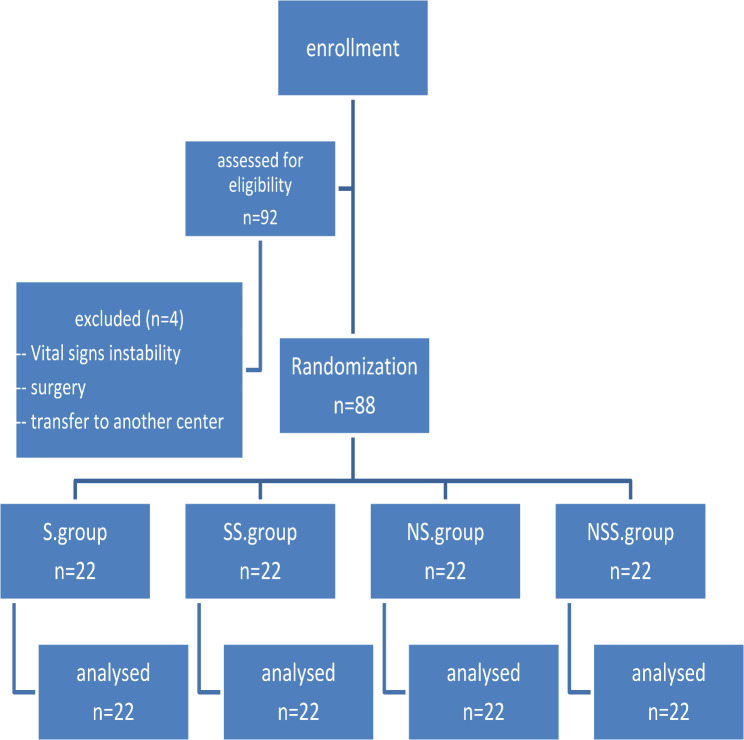
In this clinical trial study, 88 preterm infants admitted to the Neonatal Intensive Care Unit of Rouhani Hospital was randomly assigned to four groups of sucrose (S), the combined group of sucrose and non-nutritive sucking (NS), the combined group of swaddle and sucrose (SS) and the combined group of sucrose, non-nutritive sucking and swaddling (NSS). In order to collect information, were used the premature Infant Pain Profile Scale (PIPP) and demographic characteristics questionnaire.
This study showed that during blood sampling, the difference in the mean pain score of two groups of S and NS was equal to 3.54 (95% CI = 1.85, 5.24) and in two groups S and NSS was equal to 4.68 (95% CI = 2.99, 6.38), and these differences were significant (P < 0.001). In addition, the mean pain difference in all study groups was significant in two time periods before-during and during-after blood sampling (P < 0.001). Also, the mean pain difference in the two time periods before-during and during-after in NS and NSS groups was significant compared to the control group (sucrose) (P < 0.001).
Based on the results of this study, the use of combined non-pharmacological interventions of NSS has been more effective in reducing the pain caused by venous blood sampling than other conditions where two or one non-pharmacological intervention were used.
采用非药物方法减轻住院婴儿的疼痛是新生儿健康领域最重要的优先事项之一。在痛苦的操作过程中缓解疼痛有助于预防不必要的生理和心理影响。本研究旨在调查联合非药物干预对早产儿静脉采血疼痛的影响。
在这项临床试验研究中,将88名入住鲁哈尼医院新生儿重症监护病房的早产儿随机分为四组:蔗糖组(S)、蔗糖与非营养性吸吮联合组(NS)、襁褓与蔗糖联合组(SS)以及蔗糖、非营养性吸吮与襁褓联合组(NSS)。为收集信息,使用了早产儿疼痛量表(PIPP)和人口统计学特征问卷。
本研究表明,在采血过程中,S组和NS组的平均疼痛评分差异为3.54(95%可信区间=1.85,5.24),S组和NSS组的平均疼痛评分差异为4.68(95%可信区间=2.99,6.38),这些差异具有统计学意义(P<0.001)。此外,所有研究组在采血前-采血期间和采血期间-采血后两个时间段的平均疼痛差异均具有统计学意义(P<0.001)。而且,与对照组(蔗糖组)相比,NS组和NSS组在采血前-采血期间和采血期间-采血后两个时间段的平均疼痛差异具有统计学意义(P<0.001)。
基于本研究结果,与使用两种或一种非药物干预的其他情况相比,使用NSS联合非药物干预在减轻静脉采血引起的疼痛方面更有效。