Montgomery Matthew J, Harwood James F, Yougang Aurelie P, Wilson-Bahun Théodel A, Tedjou Armel N, Keumeni Christophe Rostand, Wondji Charles S, Kamgang Basile, Kilpatrick A Marm
U.S. Naval Medical Research Unit EURAFCENT, PSC 824, Box 23, FPO AE 09623, Naval Air Station Sigonella, Italy.
Ecology and Evolutionary Biology Department, University of California Santa Cruz, 130 McAllister Way, Santa Cruz, CA, 95060, USA.
Parasit Vectors. 2025 Apr 6;18(1):135. doi: 10.1186/s13071-025-06764-5.
Urbanization can influence disease vectors by altering larval habitat, microclimates, and host abundance. The global increase in urbanization, especially in Africa, is likely to alter vector abundance and pathogen transmission. We investigated the effect of urbanization and weather on the abundance of two mosquitoes, Aedes aegypti and Aedes albopictus, and infection with dengue, chikungunya, and Zika viruses at 63 sites in six cities spanning a 900-km latitudinal range in Cameroon, Central Africa.
We used human landing catches and backpack-mounted aspirators to sample mosquitoes and collected larval habitat, host availability, and weather (temperature, precipitation, humidity) data for each site in each city. We analyzed land use and land cover information and satellite photos at varying radii around sites (100 m to 2 km) to quantify the extent of urbanization and the number of structures around each site. We used a continuous urbanization index (UI; range 0-100) that increased with impermeable surface and decreased with forest cover.
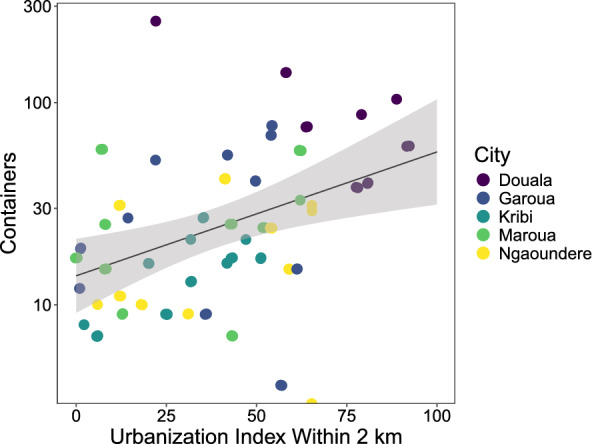
Urbanization increased larval habitat, human host availability, and Ae. aegypti mosquito abundance. Aedes aegypti abundance increased 1.7% (95% CI 0.69-2.7%) with each 1 unit increase in the urbanization index in all six cities (Douala, Kribi, Yaounde, Ngaoundere, Garoua, and Maroua) with a 5.4-fold increase from UI = 0 to UI = 100, and also increased with rainfall. In contrast, Ae. albopictus abundance increased with urbanization in one city, but showed no influence of urbanization in two other cites. Across three cities, Ae. albopictus abundance increased with rainfall, temperature, and humidity. Finally, we did not detect Zika, dengue, or chikungunya viruses in any specimens, and found weak evidence of interspecific competition in analyses of adult population growth rates.
These results show that urbanization consistently increases Ae. aegypti abundance across a broad range of habitats in Central Africa, while effects on Ae. albopictus were more variable and the abundance of both species were influenced by rainfall. Future urbanization of Africa will likely increase Ae. aegypti abundance, and climate change will likely alter abundance of both species through changes in precipitation and temperature.
城市化可通过改变幼虫栖息地、微气候和宿主数量来影响病媒。全球城市化进程的加快,尤其是在非洲,可能会改变病媒数量和病原体传播。我们在中非喀麦隆六个城市的63个地点进行了调查,研究城市化和天气对埃及伊蚊和白纹伊蚊这两种蚊子数量以及登革热、基孔肯雅热和寨卡病毒感染情况的影响,这些地点跨越了900公里的纬度范围。
我们使用人饵诱捕法和背负式吸气器对蚊子进行采样,并收集每个城市每个地点的幼虫栖息地、宿主可利用性和天气(温度、降水、湿度)数据。我们分析了不同半径(100米至2公里)范围内各地点周围的土地利用和土地覆盖信息以及卫星照片,以量化城市化程度和每个地点周围的建筑物数量。我们使用了一个连续的城市化指数(UI;范围为0 - 100),该指数随着不透水表面的增加而增加,随着森林覆盖的减少而降低。
城市化增加了幼虫栖息地、人类宿主可利用性以及埃及伊蚊的数量。在所有六个城市(杜阿拉、克里比、雅温得、恩冈代雷、加鲁阿和马鲁阿),城市化指数每增加1个单位,埃及伊蚊数量增加1.7%(95%置信区间0.69 - 2.7%),从UI = 0到UI = 100增加了5.4倍,并且随着降雨量增加。相比之下,白纹伊蚊数量在一个城市随着城市化增加,但在另外两个城市未显示出城市化的影响。在三个城市中,白纹伊蚊数量随着降雨量、温度和湿度增加。最后,我们在任何标本中均未检测到寨卡、登革热或基孔肯雅病毒,并且在成蚊种群增长率分析中发现种间竞争的证据较弱。
这些结果表明,城市化持续增加了中非广泛栖息地中埃及伊蚊的数量,而对白纹伊蚊的影响则更具变异性,并且两种蚊子的数量均受降雨量影响。非洲未来的城市化可能会增加埃及伊蚊数量,而气候变化可能会通过降水和温度变化改变两种蚊子的数量。