van den Berg Bellis, Zuure Marrit B, Vermunt Paulien, Zondervan-Zwijnenburg Mariëlle, Minkman Mirella
Vilans, Dutch Center of Excellence for Care and Support, PO Box 8228, Utrecht, 3503 RE, the Netherlands.
Orikami Digital Health Products, Ridderstraat 29, Nijmegen, 6511 TM, the Netherlands.
BMC Health Serv Res. 2025 Apr 8;25(1):511. doi: 10.1186/s12913-025-12640-w.
Previous research showed the potential of quality improvement programs in nursing home care. However, studies that quantitatively evaluate the effectiveness of quality of care improvement programs are scarce. In this study, we examine the results of a Dutch nation-wide programme that was established to support the implementation of the Quality Framework for Nursing Home care.
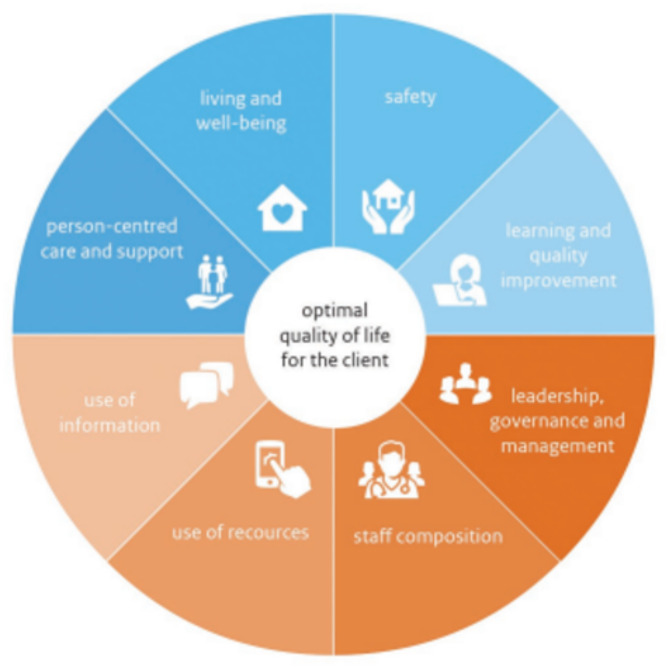
The Dignity & Pride at every Facility (D&PF) program was accessible to all Dutch nursing home facilities. Problem analysis per facility was conducted by means of a quantitative Quality Scan targeting all eight themes of the quality framework. Based on the baseline measurements nursing home facilities received tailored support from an external expert coach. The Quality Scan was repeated at the end of the support trajectories, 9 to 24 months later depending on the type of support provided. Scan data of 331 nursing home facilities was used to quantify the effectiveness of the D&PF program, the contribution of tailored support and the influence of organizational factors on care outcomes.
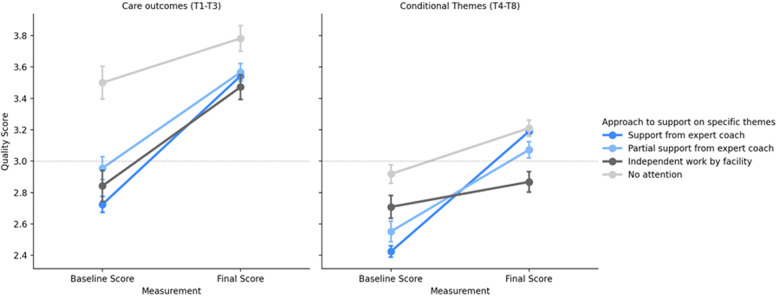
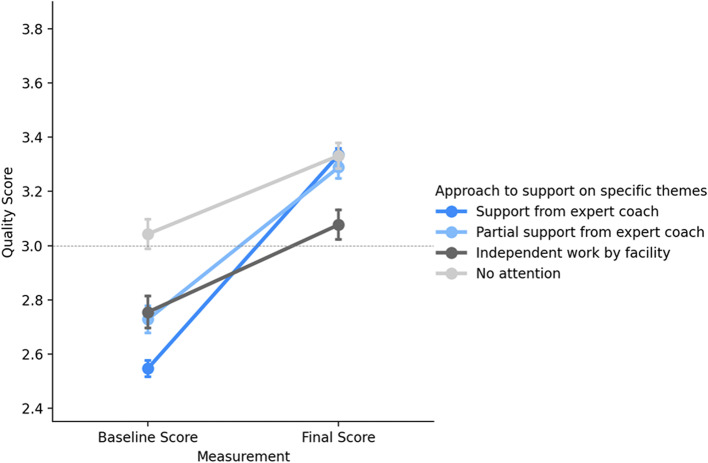
The entire pool of participating facilities scored better on the final scan (M = 3.21, SD = 0.74) than on the baseline scan (M = 2.64, SD = 0.87, p < 0.001). Greater improvements on theme level were seen when (partial) support was provided by an external expert coach. The probability of achieving high scores on care outcomes (person-centred care, resident safety and well-being) was significantly increased with high scores on organizational conditions. A multilevel model demonstrated that the themes Learning and improvement, Responsive workforce and Use of resources were statistically significant associated with positive care outcomes.
This study demonstrates significant improvements across all themes of the quality framework and provides supporting evidence for the positive contribution of tailored on-site support of external expert coaches. This study also indicates that a supportive organizational environment and a learning-oriented culture are of significant importance for good care outcomes in terms of safety, person-centred care and resident well-being.
先前的研究表明了质量改进计划在养老院护理中的潜力。然而,定量评估护理质量改进计划有效性的研究却很匮乏。在本研究中,我们考察了一项荷兰全国性计划的结果,该计划旨在支持养老院护理质量框架的实施。
所有荷兰养老院机构均可参与“各机构的尊严与自豪”(D&PF)计划。每个机构通过针对质量框架所有八个主题的定量质量扫描进行问题分析。基于基线测量结果,养老院机构从外部专家教练那里获得了量身定制的支持。在支持轨迹结束时重复进行质量扫描,9至24个月后进行,具体时间取决于所提供支持的类型。使用331家养老院机构的扫描数据来量化D&PF计划的有效性、量身定制支持的贡献以及组织因素对护理结果的影响。
参与计划的所有机构在最终扫描中的得分(M = 3.21,标准差 = 0.74)高于基线扫描(M = 2.64,标准差 = 0.87,p < 0.001)。当由外部专家教练提供(部分)支持时,在主题层面上有更大的改进。组织条件得分高时,在护理结果(以人为主的护理、居民安全和福祉)上获得高分的概率显著增加。一个多层次模型表明,“学习与改进”“响应式员工队伍”和“资源利用”等主题与积极的护理结果在统计学上显著相关。
本研究表明质量框架的所有主题都有显著改进,并为外部专家教练量身定制的现场支持的积极贡献提供了支持证据。本研究还表明,支持性的组织环境和以学习为导向的文化对于在安全、以人为主的护理和居民福祉方面取得良好护理结果至关重要。