Singh Sanjiv, Singh Kaushalendra Kumar
School of business, University of petroleum and energy studies (UPES), Dehradun, Uttarakhand, 248013, India.
Department of Statistics, Banaras Hindu University, Varanasi, Uttar Pradesh, 221005, India.
BMC Pregnancy Childbirth. 2025 Apr 8;25(1):404. doi: 10.1186/s12884-025-07524-0.
Along with other low- and middle-income countries unintended pregnancies are a matter of grave concern for India as well as world. Preventing unintended pregnancy can significantly reduce fertility as well as population health.
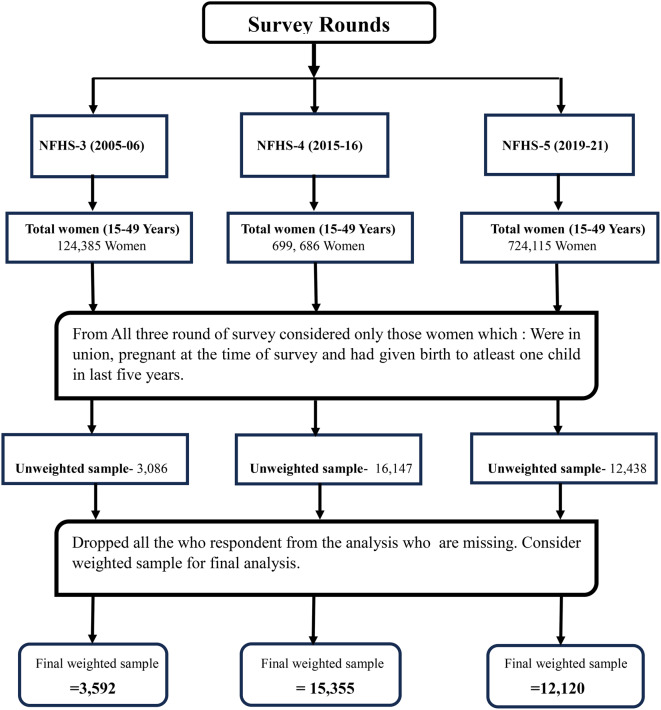
Our study used data from three recent rounds of national family health survey (NFHS) which were conducted in 2005-06 (NFHS-3), 2015-16 (NFHS-4) and 2019-21 (NFHS-5). In union, currently married and pregnant women who have given birth to at least one child in last five years were taken into consideration for study. Dependent variable was unintended pregnancy (current pregnancy) which included mistimed as well as unwanted pregnancy. Univariate, bivariate analysis with point-to-point change was done to know aboutdependent variable. To know about important covariate of change in unintended pregnancy logistic regression has been used followed by multivariable decomposition analysis.
Over all three - survey rounds considered in our study; prevalence of unintended pregnancy declined from 31.76% (NFHS-3) to 15.87% (NFHS-5). Highest percentage decline of 23.02% from NFHS-3 (39.01%) to NFHS-5 (15.99%) in unintended pregnancy was in the women of Muslim religion. Women of rural area have 19% lower chance of unintended pregnancy with adjusted odds ratio 0.81. Odds of having current unintended pregnancy were about 8 times in women whose last birth was unwanted. Women with incorrect knowledge of ovulatory cycle have 20% higher chance of having unintended pregnancy. After analysis it was found that out of total change in unintended pregnancies was proximately 23% due to compositional change and about 77% change was due to behavioural change.
Over the time prevalence of unintended pregnancies declining which can be helpful for better health to both child and women. Important factors leading to a decline in unintended pregnancy were young age groups, high education level, unwanted last birth, no and negative fertility gap, no intention to contraceptive use and incorrect knowledge of the ovulatory cycle. Most of decline in unintended pregnancies was due to behavioural change of women considered in our study.
与其他低收入和中等收入国家一样,意外怀孕对印度乃至全世界来说都是一个严重关切的问题。预防意外怀孕可显著降低生育率并改善人口健康状况。
我们的研究使用了最近三轮全国家庭健康调查(NFHS)的数据,这些调查分别在2005 - 2006年(NFHS - 3)、2015 - 2016年(NFHS - 4)和2019 - 2021年(NFHS - 5)进行。纳入研究的是在过去五年中至少生育过一个孩子的已婚且怀孕的女性。因变量是意外怀孕(当前怀孕),包括时机不当的怀孕以及意外怀孕。进行了单变量、双变量分析以及逐点变化分析以了解因变量。为了解意外怀孕变化的重要协变量,使用了逻辑回归,随后进行多变量分解分析。
在我们研究中考虑的所有三轮调查中,意外怀孕的患病率从31.76%(NFHS - 3)降至15.87%(NFHS - 5)。意外怀孕率从NFHS - 3(39.01%)到NFHS - 5(15.99%)下降幅度最大,为23.02%,这一降幅出现在穆斯林宗教女性中。农村地区女性意外怀孕的几率降低19%,调整后的优势比为0.81。上一胎为意外生育的女性当前意外怀孕的几率约为其他女性的8倍。对排卵周期知识了解错误的女性意外怀孕的几率高20%。分析发现,意外怀孕的总体变化中,约23%归因于构成变化,约77%的变化归因于行为变化。
随着时间推移,意外怀孕的患病率在下降,这对儿童和女性的健康改善有益。导致意外怀孕率下降的重要因素包括年轻年龄组、高教育水平、上一胎为意外生育、无生育间隔或生育间隔为负、不打算使用避孕药具以及对排卵周期知识了解错误。我们研究中意外怀孕率的下降主要归因于女性的行为变化。