Strandberg Jesper, Gade Inger Lise, Nybo Jette, Thomsen Janus Nikolaj Laust, Kristensen Søren Risom
The Coagulation Unit, Department of Clinical Biochemistry, Aalborg University Hospital, Aalborg, Denmark.
Department of Clinical Medicine, Aalborg University, Aalborg, 9000, Denmark.
Thromb J. 2025 Apr 8;23(1):30. doi: 10.1186/s12959-025-00713-z.
Treatment with combined oral contraceptives (COC) is associated with an increased risk of venous thromboembolism. Several changes of coagulant and anticoagulant factors induced by ethinyloestradiol during treatment with COC, have been demonstrated. Thrombin generation is a global test measuring both coagulant and anticoagulant factors, but the effect of COC on individuals starting COC, has not been examined before on the new equipment, ST Genesia. The aim of this project was to examine the effect of COC on thrombin generation on ST Genesia, in individuals before and after starting COC.
Twenty-four female participants between 15 and 34 years of age, who were about to start treatment with ethinylestradiol/levonorgestrel-containing COC, were included in the study. Two blood samples were drawn from each of the study subjects, a baseline sample immediately before first COC dose, and a follow-up blood sample approximately 3-4 months after COC start. Standard biochemical analyses as well as standard and special coagulation analyses including thrombin generation on ST Genesia, were performed in all samples.
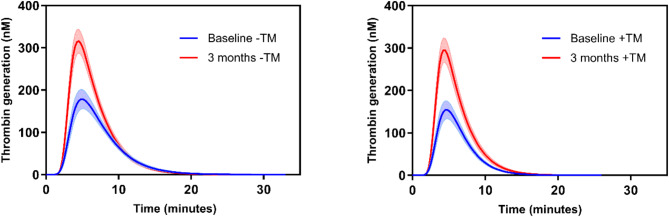
Thrombin generation, i.e., endogenous thrombin generation (ETP) and peak increased considerably after COC start, whereas time-to-peak was shortened. Thrombin-antithrombin complexes (TAT), prothrombin fragments (F1 + 2) and sex hormone binding globulin (SHBG) increased, and the coagulation inhibitors tissue factor pathway inhibitor (TFPI), protein S activity and antithrombin decreased slightly after COC start.
Although the coagulation factors only changed modestly, the global test thrombin generation performed on ST Genesia showed a considerable change after start of COC.
复方口服避孕药(COC)治疗与静脉血栓栓塞风险增加相关。已证实COC治疗期间乙炔雌二醇诱导的凝血和抗凝因子发生了多种变化。凝血酶生成是一种衡量凝血和抗凝因子的整体检测方法,但之前尚未在新设备ST Genesia上研究过COC对开始使用COC的个体的影响。本项目的目的是在开始使用COC之前和之后,研究COC对使用ST Genesia检测凝血酶生成的影响。
本研究纳入了24名年龄在15至34岁之间、即将开始使用含乙炔雌二醇/左炔诺孕酮的COC进行治疗的女性参与者。从每个研究对象采集两份血样,一份是在首次服用COC剂量前立即采集的基线样本,另一份是在开始服用COC约3至4个月后的随访血样。对所有样本进行标准生化分析以及标准和特殊凝血分析,包括使用ST Genesia检测凝血酶生成。
开始服用COC后,凝血酶生成,即内源性凝血酶生成(ETP)和峰值显著增加,而达到峰值的时间缩短。凝血酶 - 抗凝血酶复合物(TAT)、凝血酶原片段(F1 +2)和性激素结合球蛋白(SHBG)增加,开始服用COC后,凝血抑制剂组织因子途径抑制剂(TFPI)、蛋白S活性和抗凝血酶略有下降。
尽管凝血因子变化不大,但在ST Genesia上进行的整体检测凝血酶生成在开始服用COC后显示出相当大的变化。