Hao Shijie, Zou Jianpeng
College of Rehabilitation Medicine, Shandong University of Traditional Chinese Medicine, Jinan, China.
Department of Rehabilitation and Physiotherapy, Affiliated Hospital of Shandong University of Traditional Chinese Medicine, Jinan, China.
Front Aging Neurosci. 2025 Mar 25;17:1503296. doi: 10.3389/fnagi.2025.1503296. eCollection 2025.
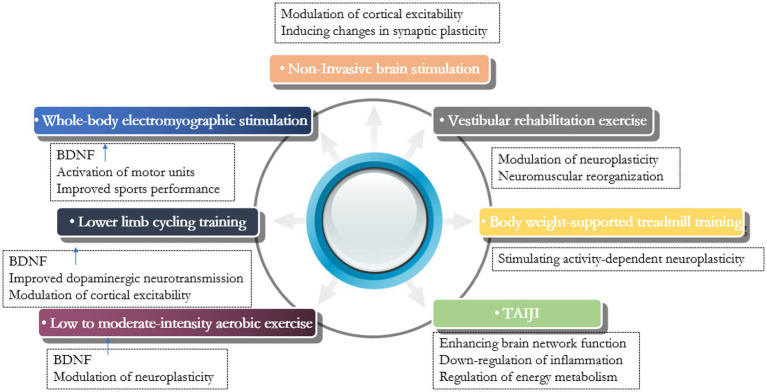
Parkinson's disease-related fatigue has an insidious onset and complex pathomechanisms, causing many adverse effects on patients. In clinical practice, Parkinson's disease-related fatigue has not received sufficient attention, and its early diagnosis and targeted interventions are inadequate. Currently, pharmacological treatments for Parkinson's disease-related fatigue have limited efficacy and nonpharmacological therapies such as non-invasive brain stimulation techniques and exercise therapy have been shown to have a role in improving Parkinson's disease-related fatigue. Further studies have revealed that modulation of functional cortical excitability, induction of neuroplasticity changes, inhibition of oxidative stress, improvement of cardiorespiratory fitness, and enhancement of muscle strength may be potential mechanisms of action of non-pharmacological therapies. As relevant research continues to progress, targeted therapy based on the theory of neuroplasticity may become an important therapeutic idea for Parkinson's disease-related fatigue. This article provides an overview of the diagnosis, etiology, and treatment of Parkinson's disease-related fatigue, and on this basis proposes a new diagnostic and therapeutic idea of targeting neuroplasticity to improve Parkinson's disease-related fatigue for clinical reference. Further studies on the pathological mechanisms of Parkinson's disease-related fatigue are needed in the future to optimize the treatment regimen of Parkinson's disease-related fatigue to improve the efficacy of treatment for the benefit of patients.
帕金森病相关疲劳起病隐匿,发病机制复杂,给患者带来诸多不良影响。在临床实践中,帕金森病相关疲劳尚未得到充分重视,其早期诊断和针对性干预不足。目前,针对帕金森病相关疲劳的药物治疗效果有限,而非侵入性脑刺激技术和运动疗法等非药物疗法已被证明在改善帕金森病相关疲劳方面有一定作用。进一步研究表明,调节皮质功能兴奋性、诱导神经可塑性变化、抑制氧化应激、改善心肺功能适应性以及增强肌肉力量可能是非药物疗法的潜在作用机制。随着相关研究不断进展,基于神经可塑性理论的靶向治疗可能成为帕金森病相关疲劳的重要治疗思路。本文综述了帕金森病相关疲劳的诊断、病因及治疗,并在此基础上提出以神经可塑性为靶点改善帕金森病相关疲劳的新诊断和治疗思路,以供临床参考。未来还需要进一步研究帕金森病相关疲劳的病理机制,以优化帕金森病相关疲劳的治疗方案,提高治疗效果,造福患者。