Huang Chung-Feng, Heo Jeong, Chien Rong-Nan, Baek Yang-Hyun, Kao Jia-Horng, Kim Ju-Hyun, Chang Ting-Tsung, Byun Kwan-Soo, Chen Jyh-Jou, Jeong Sook-Hyang, Hu Tsung-Hui, Kim Young-Seok, Peng Cheng-Yuan, Tak Won-Young, Wang Horng-Yuan, Yoon Seung-Kew, Sheen I-Shyan, Hsu Yu-Chun, Yim Hyung-Joon, Tsai Pei-Chien, Yeh Ming-Lun, Ahn Sang-Hoon, Dai Chia-Yen, Paik Seung-Woon, Huang Jee-Fu, Kim Yoon-Jun, Chuang Wan-Long, Lim Young-Suk, Yu Ming-Lung
Hepatobiliary Division, Department of Internal Medicine and Hepatitis Center, Kaohsiung Medical University Hospital, Kaohsiung Medical University, 100 Tzyou Road, Kaohsiung, 807, Taiwan.
Department of Internal Medicine, College of Medicine, Pusan National University and Biomedical Research Institute, Pusan National University Hospital, Busan, Republic of Korea.
Infect Dis Ther. 2025 May;14(5):1089-1101. doi: 10.1007/s40121-025-01145-y. Epub 2025 Apr 10.
BACKGROUND/AIMS: Direct-acting antivirals (DAAs) are highly effective in treating hepatitis C virus (HCV) infection. The long-term hepatic and extrahepatic outcomes of DAAs in chronic hepatitis C (CHC) patients receiving curative antivirals are elusive.
CHC patients were retrieved from two phase III sofosbuvir-based clinical trials conducted from 2013-2014. Patients who achieved a sustained virological response have been followed prospectively for 5 years since 2016. A propensity score-matched interferon-based historical control with a 1:3 ratio was used for comparison. Quality of life (QoL) was measured by the SF-36, liver fibrosis was measured by electrography, and fibrosis-related markers were followed annually in the prospective cohort.
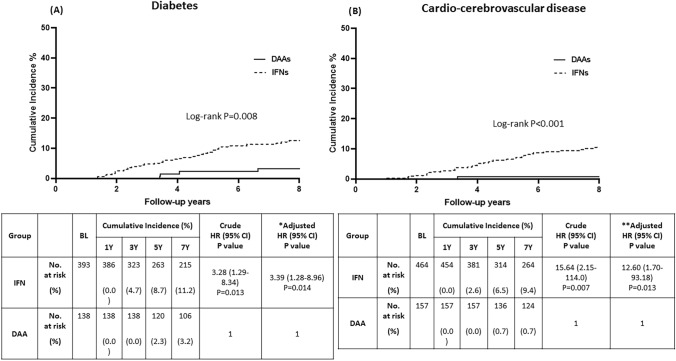
A total of 160 DAA- and 480 interferon-treated patients were enrolled. Twenty-eight patients developed hepatocellular carcinoma (HCC) over a follow-up period of 4424 person-years (annual incidence: 0.6%). The incidence of HCC did not differ significantly between the DAA cohort and interferon-treated patients (P = 0.07). Cox regression analysis revealed that FIB-4 was the only factor independently associated with HCC development (hazard ratio [HR]: 95% confidence interval [CI] 3.59/1.68-7.66, P = 0.001). The incidence of newly developed cardio-cerebrovascular disease was 13.8 per 1000 person-years and 0.9 per 1000 person-years in interferon-treated patients and the DAA cohort, respectively (P < 0.001). Interferon-based patients had a significantly greater incidence of cardio-cerebrovascular disease (HR/CI 3.39/1.28-8.96, P = 0.014). There was a substantial decrease in liver stiffness (P = 0.08) and M2BPGi (P = 0.05) and a significant reduction in LOXL2 (P = 0.02) over 5 years. A significant decrease in QoL was observed in role limitations due to physical health and emotional problems, whereas the other parameters were maintained consistently throughout the 5 years of follow-up.
HCV eradication by DAAs improved liver- and non-liver-related outcomes, constantly promoted liver fibrosis regression, and maintained quality of life after HCV cure.
NCT03042520.
背景/目的:直接作用抗病毒药物(DAAs)在治疗丙型肝炎病毒(HCV)感染方面非常有效。接受根治性抗病毒治疗的慢性丙型肝炎(CHC)患者使用DAAs后的长期肝脏和肝外转归尚不清楚。
从2013年至2014年进行的两项基于索磷布韦的III期临床试验中检索CHC患者。自2016年以来,对实现持续病毒学应答的患者进行了5年的前瞻性随访。采用倾向评分匹配的1:3比例的基于干扰素的历史对照进行比较。生活质量(QoL)采用SF-36量表进行测量,肝纤维化采用电描记法进行测量,在前瞻性队列中每年跟踪纤维化相关标志物。
共纳入160例接受DAAs治疗的患者和480例接受干扰素治疗的患者。在4424人年的随访期内,有28例患者发生肝细胞癌(HCC)(年发病率:0.6%)。DAAs队列和接受干扰素治疗的患者之间HCC的发病率没有显著差异(P = 0.07)。Cox回归分析显示,FIB-4是与HCC发生独立相关的唯一因素(风险比[HR]:95%置信区间[CI] 3.59/1.68 - 7.66,P = 0.001)。在接受干扰素治疗的患者和DAAs队列中,新发心脑血管疾病的发病率分别为每1000人年13.8例和每1000人年0.9例(P < 0.001)。基于干扰素治疗的患者心脑血管疾病的发病率显著更高(HR/CI 3.39/1.28 - 8.96,P = 0.014)。在5年中,肝脏硬度(P = 0.08)和M2BPGi(P = 0.05)大幅下降,LOXL2显著降低(P = 0.02)。在因身体健康和情绪问题导致的角色限制方面,观察到QoL显著下降,而在5年的随访中其他参数保持稳定。
DAAs根除HCV改善了肝脏和非肝脏相关转归,持续促进肝纤维化消退,并在HCV治愈后维持生活质量。
NCT03042520。