
冠心病患者的运动恐惧:罗杰斯进化概念分析
Kinesiophobia in patients with coronary heart disease: a Rodgers' evolutionary concept analysis.
作者信息
Zhang Mei-Jun, Liu Si, Xiong Xiao-Yun, Liu Meng-Die, Xiang Qin
机构信息
Department of Nursing, The Second Affiliated Hospital of Nanchang University, Jiangxi Medical College, Nanchang University, Nanchang, Jiangxi, China.
School of Nursing, Jiangxi Medical College, Nanchang University, Nanchang, Jiangxi, China.
出版信息
Front Psychol. 2025 Mar 26;16:1499962. doi: 10.3389/fpsyg.2025.1499962. eCollection 2025.
INTRODUCTION
Research on kinesiophobia in coronary heart disease is increasing, but existing studies primarily adopt concepts from the chronic pain domain, neglecting the specific characteristics of coronary heart disease patients. This gap limits effective identification and management.
OBJECTIVE
This study aims to clarify the concept of kinesiophobia in coronary heart disease using Rodgers' evolutionary concept analysis.
METHODOLOGY
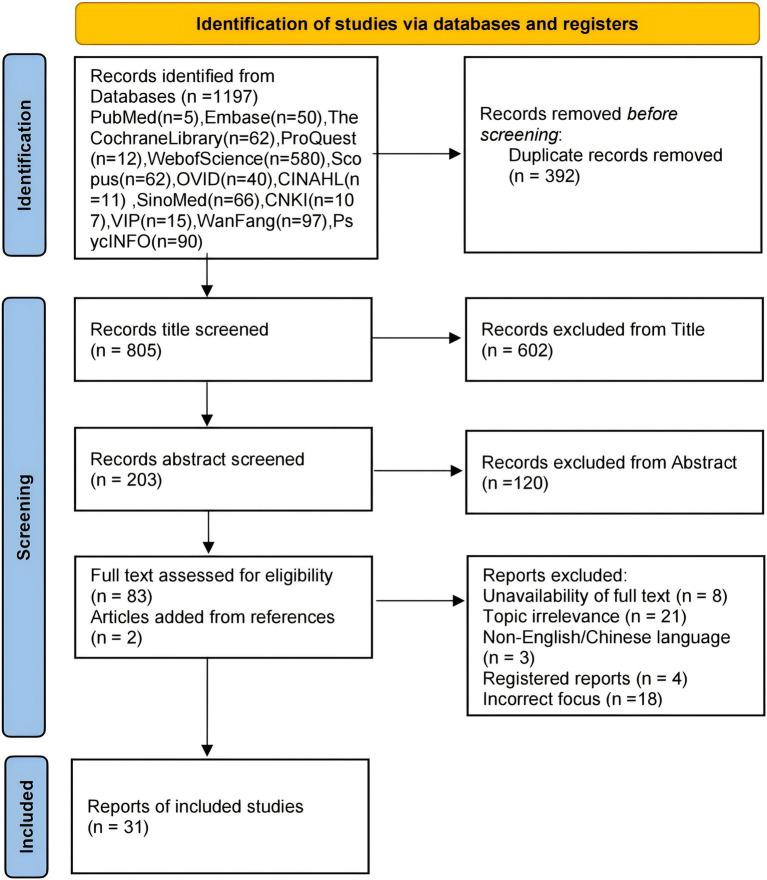
Rodgers' evolutionary concept analysis method was applied to review the literature. A comprehensive search was conducted in PubMed, Web of Science, PsycINFO, CINAHL, Cochrane Library, Embase, Scopus, ProQuest, OVID, CNKI, Wanfang Data, CBM, and VIP Database (up to June 30, 2024). Inclusion criteria: Studies on coronary heart disease patients, addressing the concept's attributes, antecedents, and consequences, published in English or Chinese. Exclusion criteria: Unavailable full text, gray literature, non-peer-reviewed texts, and study protocols.
RESULTS
A total of 31 articles were included. The attributes of kinesiophobia in coronary heart disease patients were identified as self-symptomatic distress, complex emotional responses, subjective avoidance behavior with personality tendencies, and misperceptions with negative reactions. Antecedents included sociodemographic, disease-related, and psychological factors. Consequences encompassed reduced participation in cardiac rehabilitation, decreased functional capacity, increased major adverse cardiac events, and lower quality of life.
CONCLUSION
In this study, we found that kinesiophobia in patients with coronary heart disease is a subjective avoidance behavior that includes both "fear of pain or weakness" and "fear of cardiac events" based on personality tendencies, driven by complex emotional responses and misperceptions based on their own symptomatic disturbances, and presents an excessive and irrational fear of movement. This analysis highlights the need for early identification and multidisciplinary interventions tailored to this population. It also provides a foundation for developing more specific and objective assessment tools.
引言
冠心病运动恐惧的研究日益增多,但现有研究主要采用慢性疼痛领域的概念,忽视了冠心病患者的特殊特征。这一差距限制了有效的识别和管理。
目的
本研究旨在运用罗杰斯的进化概念分析法阐明冠心病运动恐惧的概念。
方法
采用罗杰斯的进化概念分析法对文献进行综述。在PubMed、科学网、PsycINFO、护理学与健康领域数据库、考克兰图书馆、Embase、Scopus、ProQuest、OVID、中国知网、万方数据、中国生物医学文献数据库和维普数据库中进行全面检索(截至2024年6月30日)。纳入标准:关于冠心病患者的研究,涉及该概念的属性、前因和后果,以英文或中文发表。排除标准:无法获取全文、灰色文献、非同行评审文本和研究方案。
结果
共纳入31篇文章。冠心病患者运动恐惧的属性被确定为自我症状困扰、复杂的情绪反应、具有人格倾向的主观回避行为以及伴有负面反应的错误认知。前因包括社会人口学、疾病相关和心理因素。后果包括心脏康复参与度降低、功能能力下降、主要不良心脏事件增加以及生活质量降低。
结论
在本研究中,我们发现冠心病患者的运动恐惧是一种主观回避行为,基于人格倾向,包括“对疼痛或虚弱的恐惧”和“对心脏事件的恐惧”,由复杂的情绪反应和基于自身症状困扰的错误认知驱动,并表现为对运动过度且不合理的恐惧。这一分析强调了早期识别以及针对该人群的多学科干预的必要性。它还为开发更具体、客观的评估工具奠定了基础。

 Zotero 插件