Fan Xue, Wu Luming, Cheng Tong, Lv Weilong, Tian Jiao, Tao Jijun, Tu Shiyan, Tan Fangjun, Wang Yiqing
Gansu International Scientific and Technological Cooperation Base of Reproductive Medicine Transformation Application and Key Laboratory for Reproductive Medicine and Embryo of Gansu Province, The First Hospital of Lanzhou University and The First School of Clinical Medicine, Lanzhou University, West Donggang Road 1, Lanzhou, 730000, China.
Institute of Materia Medica, Chinese Academy of Medical Sciences and Peking Union Medical College, Beijing, 100050, China.
Sci Rep. 2025 Apr 10;15(1):12225. doi: 10.1038/s41598-025-97122-z.
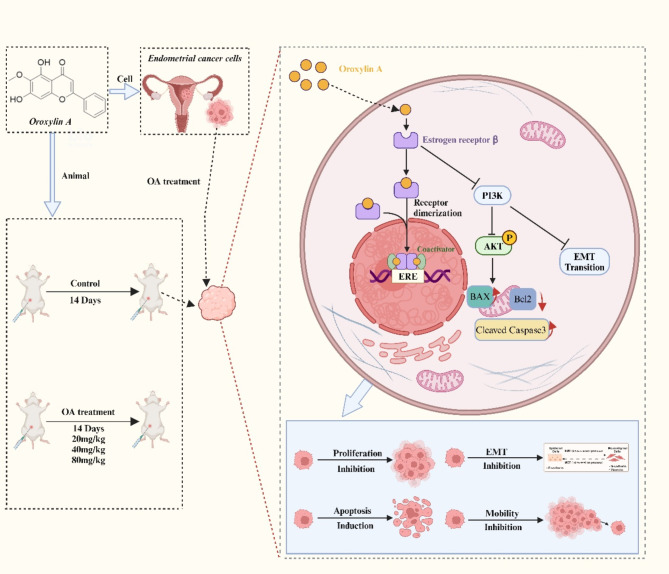
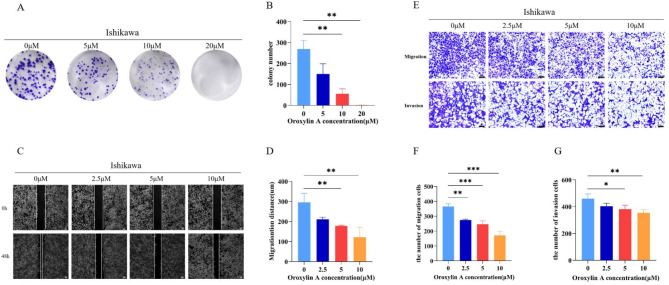
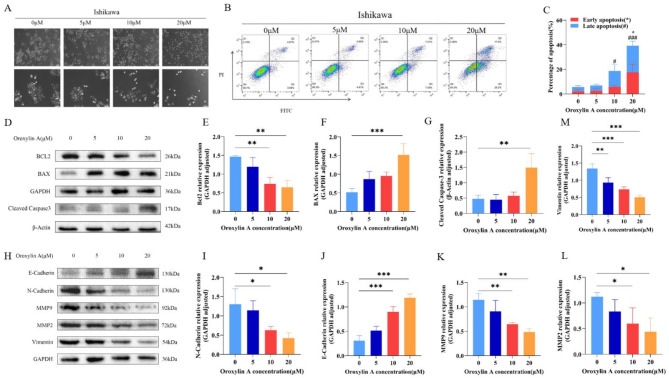
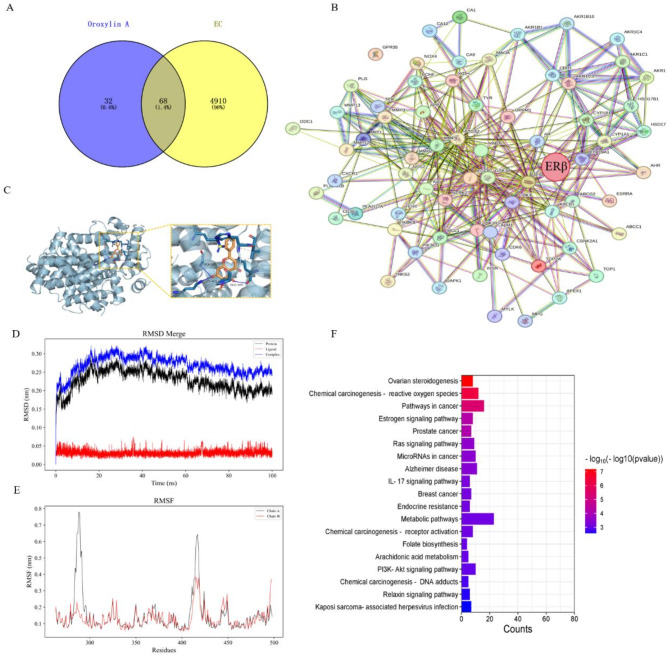
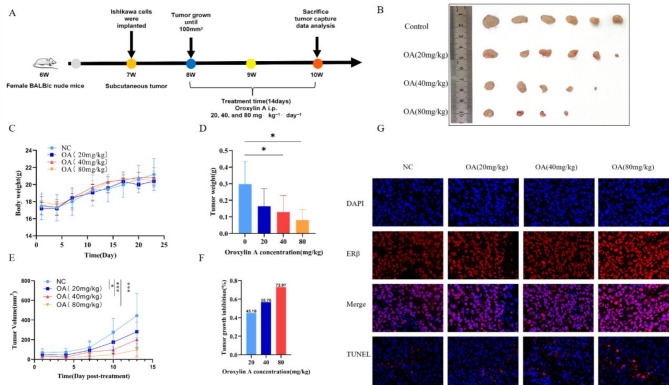
Endometrial cancer (EC) is a prevalent gynecological cancer worldwide, often associated with poor prognosis after recurrence or metastasis. Oroxylin A (OA) is an active flavonoid compound with a strong anti-tumor function. However, the effects of OA on EC remain unknown. In this study, we planned to investigate the anti-EC effects of OA and explore its mechanisms. Five cell lines were used for in vitro experiments, and female BALB/c nude mice were applied for xenograft experiments. The cytotoxicity and experimental concentration of OA were detected by CCK-8. Wound healing, transwell, and colony formation assays were used to evaluate the anti-metastatic and anti-proliferative activities of OA on EC cells. TUNEL assay and flow cytometry were applied for the evaluation of apoptosis. Network pharmacology was used to explore potential targets, and molecular dynamics simulations and dockings were applied for the quantification of binding energy, and stability of OA. RT-qPCR, WB, and immunofluorescence were applied for the detection of localization and expression of correlated markers. The results showed that OA notably inhibited the proliferation, migration, and invasion of Ishikawa cells. Meanwhile, in vivo Ishikawa xenograft assays demonstrated that OA notably inhibited growth and promoted apoptosis of EC. Mechanistically, after treatment with OA, the expressions of Cleaved Caspase-3, BAX, E-cadherin, and ERβ were increased, while the expressions of Bcl-2, Vimentin, N-cadherin, MMP2, MMP9, PI3K and phospho-AKT (Ser473) were decreased. Therefore, OA may exhibit significant anti-EC effects by regulating the ERβ/PI3K/AKT pathway to promote apoptosis and inhibit epithelial-mesenchymal transition (EMT).
子宫内膜癌(EC)是全球一种常见的妇科癌症,复发或转移后通常预后较差。木犀草素A(OA)是一种具有强大抗肿瘤功能的活性黄酮类化合物。然而,OA对EC的影响尚不清楚。在本研究中,我们计划研究OA对EC的抗癌作用并探索其机制。使用五种细胞系进行体外实验,并将雌性BALB/c裸鼠用于异种移植实验。通过CCK-8检测OA的细胞毒性和实验浓度。采用伤口愈合、Transwell和集落形成试验评估OA对EC细胞的抗转移和抗增殖活性。采用TUNEL试验和流式细胞术评估细胞凋亡。利用网络药理学探索潜在靶点,并应用分子动力学模拟和对接来量化OA的结合能和稳定性。采用RT-qPCR、WB和免疫荧光检测相关标志物的定位和表达。结果表明,OA显著抑制Ishikawa细胞的增殖、迁移和侵袭。同时,体内Ishikawa异种移植试验表明,OA显著抑制EC的生长并促进其凋亡。机制上,OA处理后,Cleaved Caspase-3、BAX、E-cadherin和ERβ的表达增加,而Bcl-2、Vimentin、N-cadherin、MMP2、MMP9、PI3K和磷酸化AKT(Ser473)的表达降低。因此,OA可能通过调节ERβ/PI3K/AKT通路促进凋亡并抑制上皮-间质转化(EMT),从而发挥显著的抗EC作用。