Chen Evan M, Miller D Claire, Sun Yuwei, Kumar Anika, Richards Jason, Acharya Nisha R
F.I. Proctor Foundation, Department of Ophthalmology, University of California, San Francisco, San Francisco, California.
Ophthalmol Sci. 2025 Jan 27;5(4):100718. doi: 10.1016/j.xops.2025.100718. eCollection 2025 Jul-Aug.
Initial studies during the coronavirus disease 2019 (COVID-19) pandemic demonstrated a possible increased risk of COVID-19 infection and severe outcomes with prior or concurrent immunomodulatory therapy (IMT). The purpose of this study was to determine the impact of the COVID-19 pandemic on treatment patterns for noninfectious uveitis (NIU).
Retrospective interrupted time series (ITS) analysis using Optum Labs Data Warehouse, a national deidentified health care database in the United States with administrative claims and electronic health record data.
Individuals with a new diagnosis of NIU from December 1, 2017, to December 31, 2020, with continuous enrollment ≥1 year before this diagnosis.
This study was divided into 3 time periods: prepandemic (December 1, 2017-November 30, 2019), early pandemic (March 1, 2020-December 31, 2020), and postvaccine period (January 1, 2021-September 30, 2021) corresponding to time before the pandemic, during the pandemic when no COVID-19 vaccine was available, and after widespread utilization of the vaccine began. Normalized prescription rates of uveitis therapies were modeled as an ITS. In the time-to-treatment analysis, Cox proportional hazard models were used to determine differences in likelihood of different modalities between time periods.
Temporal trends in the initial therapeutic choice for NIU.
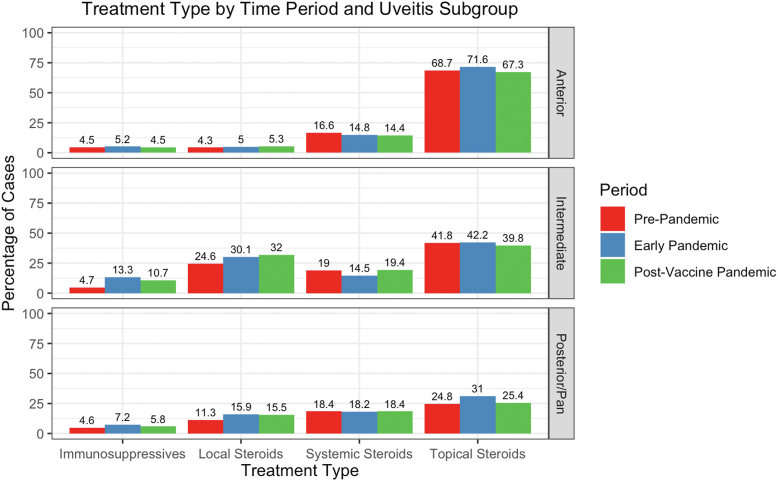
This study included 22 444 patients with a new NIU diagnosis. The average age was 61.9 (standard deviation 17.5) years, and 59.3% were female. There were no significant temporal breaks in prescribing trends for topical, local, and systemic corticosteroids or immunosuppressive therapy (disease-modifying antirheumatic drugs and biologics) between pandemic periods (all > 0.05) in ITS analysis. Overall, topical steroids were more likely to be prescribed in the early versus prepandemic period (hazard ratio [HR] 1.10; 95% confidence interval [CI] 1.06-1.15; < 0.001). Intraocular steroids also saw greater relative use during the early (HR 1.29; 95% CI 1.13-1.46; < 0.001) and postvaccine (HR 1.29; 95% CI 1.14-1.46; < 0.001) period. Use of IMTs increased in the postvaccine period compared with that in the prepandemic period (HR 1.25; 95% CI 1.07-1.46; < 0.001).
No significant differences in prescribing patterns for NIU were observed between pandemic periods. However, utilization of topical and local steroids for NIU was, overall, increased in the early compared with the prepandemic period.
The author(s) have no proprietary or commercial interest in any materials discussed in this article.
2019年冠状病毒病(COVID-19)大流行期间的初步研究表明,既往或同时接受免疫调节治疗(IMT)可能会增加感染COVID-19以及出现严重后果的风险。本研究的目的是确定COVID-19大流行对非感染性葡萄膜炎(NIU)治疗模式的影响。
使用Optum Labs数据仓库进行回顾性中断时间序列(ITS)分析,该数据库是美国一个全国性的去识别化医疗保健数据库,包含行政索赔和电子健康记录数据。
2017年12月1日至2020年12月31日期间新诊断为NIU且在该诊断前连续登记≥1年的个体。
本研究分为3个时间段:大流行前(2017年12月1日至2019年11月30日)、大流行早期(2020年3月1日至2020年12月31日)和疫苗接种后时期(2021年1月1日至2021年9月30日),分别对应大流行前、大流行期间无COVID-19疫苗可用以及疫苗开始广泛使用之后的时间。将葡萄膜炎治疗药物的标准化处方率建模为中断时间序列。在治疗时间分析中,使用Cox比例风险模型来确定不同时间段之间不同治疗方式使用可能性的差异。
NIU初始治疗选择的时间趋势。
本研究纳入了22444例新诊断为NIU的患者。平均年龄为61.9(标准差17.5)岁,59.3%为女性。在中断时间序列分析中,大流行期间局部、局部和全身用皮质类固醇或免疫抑制治疗(改善病情抗风湿药和生物制剂)的处方趋势没有显著的时间断点(均P>0.05)。总体而言,与大流行前相比,大流行早期更有可能开具局部类固醇(风险比[HR]1.10;95%置信区间[CI]1.06 - 1.15;P<0.001)。眼内类固醇在大流行早期(HR 1.29;95% CI 1.13 - 1.46;P<0.001)和疫苗接种后时期(HR 1.29;95% CI 1.14 - 1.46;P<0.001)的相对使用也更多。与大流行前相比,疫苗接种后时期免疫调节治疗的使用增加(HR 1.25;95% CI 1.07 - 1.46;P<0.001)。
大流行期间NIU的处方模式没有显著差异。然而总体而言,与大流行前相比,大流行早期NIU局部和局部用类固醇的使用有所增加。
作者对本文讨论的任何材料均无所有权或商业利益。