Zhao Hongyang, Yan Yumin, Zhang Linghao, Li Xin, Jia Lan, Ma Liang, Su Xin
State Key Laboratory of Organic-Inorganic Composites, Beijing Advanced Innovation Center for Soft Matter Science and Engineering, Beijing Key Laboratory of Bioprocess, College of Life Science and Technology, Beijing University of Chemical Technology, Beijing, 100029, China.
Department of thoracic surgery, Tianjin Chest Hospital, Tianjin, 300222, China.
Adv Sci (Weinh). 2025 Jun;12(22):e2416490. doi: 10.1002/advs.202416490. Epub 2025 Apr 11.
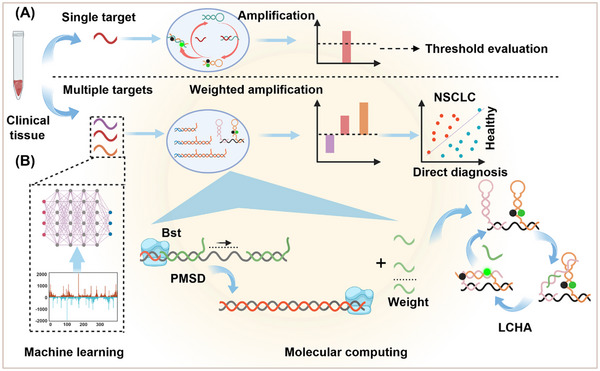
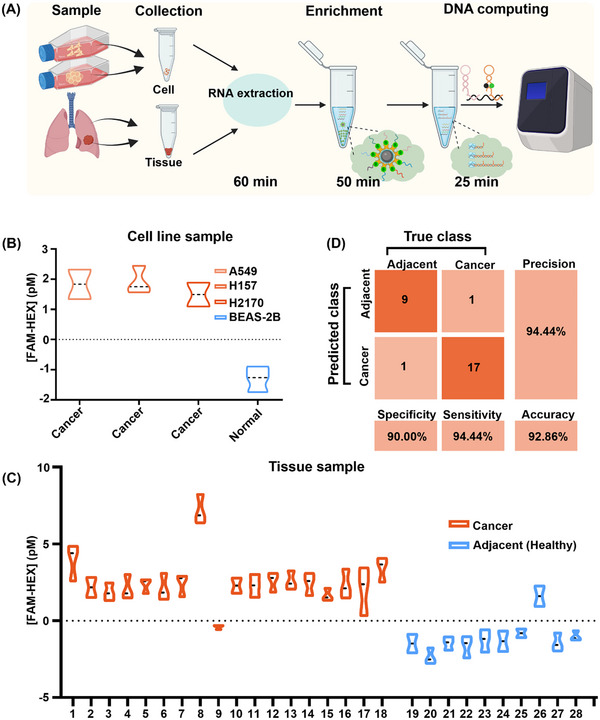
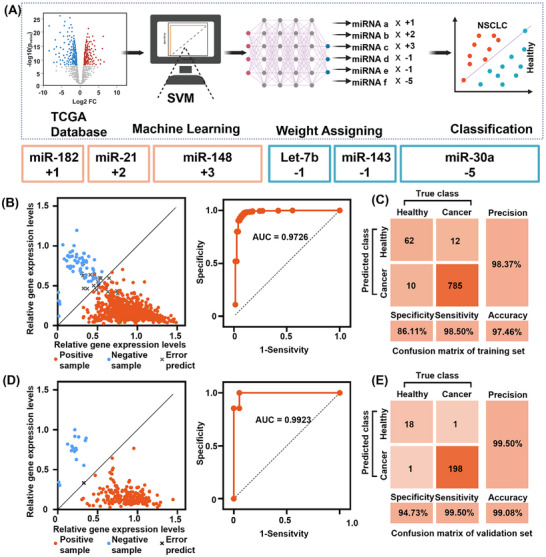
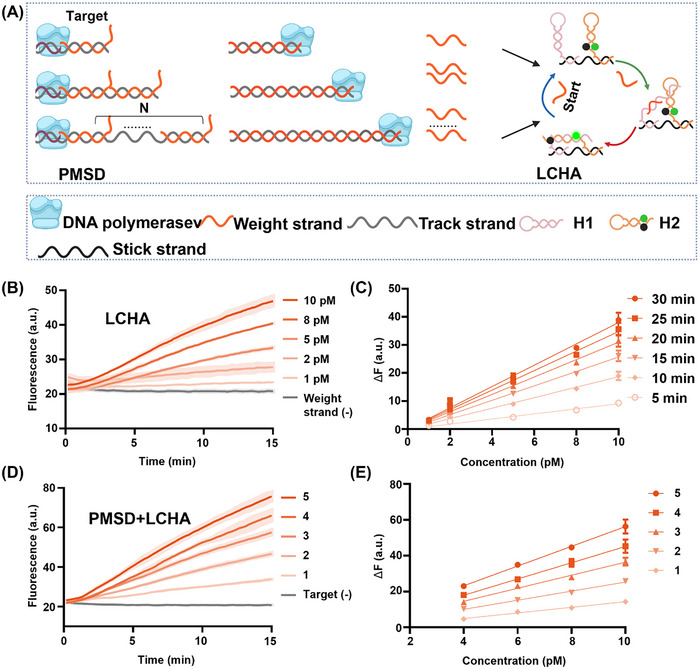
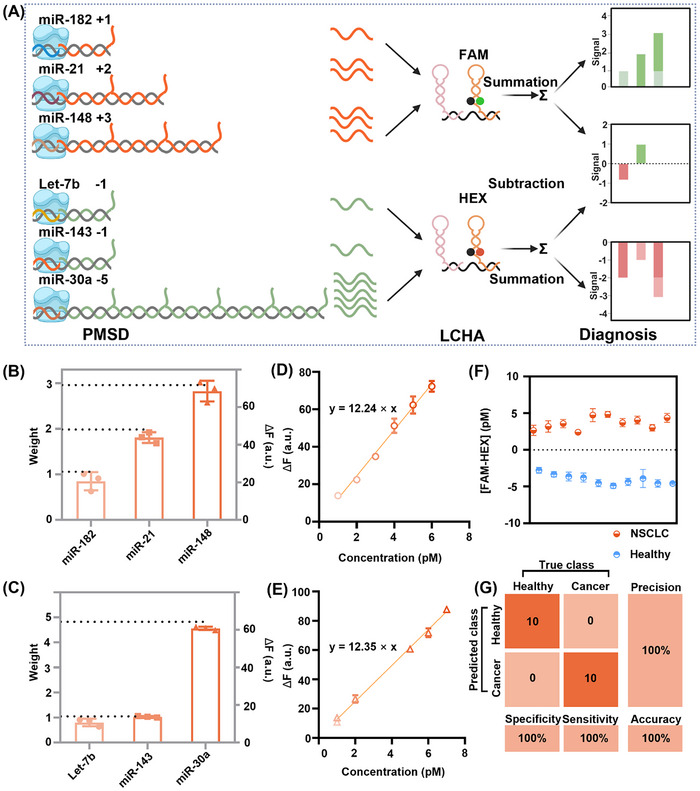
The expression levels of microRNAs (miRNAs) are strongly linked to cancer progression, making them promising biomarkers for cancer detection. Enzyme-free signal amplification DNA circuits have facilitated the detection of low-abundance miRNAs. However, these methods may neglect the diagnostic value (or weight) of different miRNAs. Here, a molecular computing approach with weighted signal amplification is presented. Polymerase-mediated strand displacement is employed to assign weights to target miRNAs, reflecting the miRNAs' diagnostic values, followed by amplification of the weighted signals using localized DNA catalytic hairpin assembly. This method is applied to diagnose miRNAs for non-small cell lung cancer (NSCLC). Machine learning is used to identify NSCLC-specific miRNAs and assign corresponding weights for optimum classification of healthy and lung cancer individuals. With the molecular computing of the miRNAs, the diagnostic output is simplified as a single channel of fluorescence intensity. Cancer tissues (n = 18) and adjacent cancer tissues (n = 10) are successfully classified within 2.5 h (sample-to-result) with an accuracy of 92.86%. The weighted amplification strategy has the potential to extend to the digital detection of multidimensional biomarkers, advancing personalized disease diagnostics in point-of-care settings.
微小RNA(miRNA)的表达水平与癌症进展密切相关,使其成为有前景的癌症检测生物标志物。无酶信号放大DNA电路有助于检测低丰度miRNA。然而,这些方法可能会忽略不同miRNA的诊断价值(或权重)。在此,提出了一种具有加权信号放大的分子计算方法。利用聚合酶介导的链置换为目标miRNA赋予权重,反映miRNA的诊断价值,随后使用局部DNA催化发夹组装对加权信号进行放大。该方法应用于非小细胞肺癌(NSCLC)的miRNA诊断。使用机器学习来识别NSCLC特异性miRNA并分配相应权重,以实现健康个体和肺癌个体的最佳分类。通过对miRNA进行分子计算,诊断输出简化为单一通道的荧光强度。在2.5小时内(从样本到结果)成功对18例癌组织和10例癌旁组织进行了分类,准确率为92.86%。加权放大策略有可能扩展到多维生物标志物的数字检测,推动即时护理环境下的个性化疾病诊断。