Hu Ya-Li, Shi Yue, Qiao Gui-Zhi, Sun Yan
Department of Psychiatry, Shanxi Bethune Hospital, Shanxi Academy of Medical Sciences, Third Hospital of Shanxi Medical University, Tongji Shanxi Hospital, Taiyuan, 030032, Shanxi, China.
BMC Psychiatry. 2025 Apr 11;25(1):366. doi: 10.1186/s12888-025-06812-5.
Non-suicidal self-injury (NSSI)-an increasingly serious mental health issue among adolescents-is closely associated with several mental illnesses. Qualitative studies on parents of adolescents with NSSI behaviors in China-despite some advancements-have neglected to explore it as a result of individual-environment interactions. This qualitative study aimed to investigate the psychological experiences of parents of adolescent patients with NSSI based on Bronfenbrenner's ecological systems theory, thus placing NSSI among adolescents in its corresponding social context.
This qualitative study was conducted using face-to-face semistructured interviews between April and September 2024. The questions were set based on the Bronfenbrenner's ecological systems theory before the interview. Parents of adolescent inpatients with NSSI were recruited from the mental health department of a tertiary hospital in northern China. Colaizzi's seven-step method was used to organize, analyze, and extract the themes from the data.
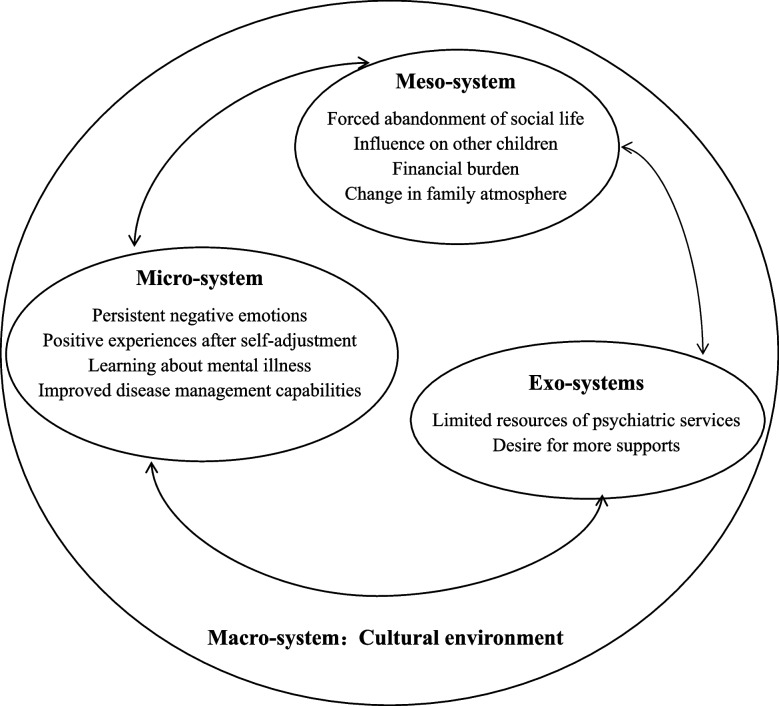
Eighteen parents were interviewed. The following four main themes emerged from the interview data: micro-system-coexistence of caregiver distress and growth (persistent negative emotions, positive experiences after self-adjustment, learning about mental illness, and improved disease management capabilities); meso-system-lifestyle changes (forced abandonment of social life, influence on other children, financial burden, and change in family atmosphere); exo-system-weak support system (limited resources of psychiatric services and desire for more supports); and macro-system-cultural environment.
The social ecosystem of parents of adolescents with NSSI is undesirable. Psychological intervention, online and offline extension services, and the dissemination of professional knowledge may help improve the mental health level and care ability of parents of adolescents with NSSI, thereby reducing adolescent self-injurious behaviors.
非自杀性自伤行为(NSSI)——青少年中日益严重的心理健康问题——与多种精神疾病密切相关。尽管取得了一些进展,但中国对有NSSI行为青少年的父母进行的定性研究,由于个体与环境的相互作用,忽略了对其进行探索。本定性研究旨在基于布朗芬布伦纳的生态系统理论,调查有NSSI行为青少年患者父母的心理体验,从而将青少年的NSSI行为置于相应的社会背景中。
本定性研究于2024年4月至9月采用面对面半结构化访谈进行。访谈前根据布朗芬布伦纳的生态系统理论设置问题。从中国北方一家三级医院的精神科招募有NSSI行为的青少年住院患者的父母。采用科莱齐七步法对数据进行组织、分析和提取主题。
对18位父母进行了访谈。访谈数据中出现了以下四个主要主题:微观系统——照顾者痛苦与成长并存(持续的负面情绪、自我调整后的积极体验、对精神疾病的了解以及疾病管理能力的提高);中观系统——生活方式改变(被迫放弃社交生活、对其他孩子的影响、经济负担以及家庭氛围的变化);外部系统——支持系统薄弱(精神科服务资源有限以及对更多支持的渴望);以及宏观系统——文化环境。
有NSSI行为青少年的父母所处的社会生态系统不理想。心理干预、线上线下延伸服务以及专业知识的传播,可能有助于提高有NSSI行为青少年父母的心理健康水平和照护能力,从而减少青少年的自伤行为。