• 文献检索
  • 文档翻译
  • 深度研究
  • 学术资讯
  • Suppr Zotero 插件Zotero 插件
  • 邀请有礼
  • 套餐&价格
  • 历史记录
应用&插件
Suppr Zotero 插件Zotero 插件浏览器插件Mac 客户端Windows 客户端微信小程序
定价
高级版会员购买积分包购买API积分包
服务
文献检索文档翻译深度研究API 文档MCP 服务
关于我们
关于 Suppr公司介绍联系我们用户协议隐私条款
关注我们

Suppr 超能文献

核心技术专利:CN118964589B侵权必究
粤ICP备2023148730 号-1Suppr @ 2026

文献检索

告别复杂PubMed语法,用中文像聊天一样搜索,搜遍4000万医学文献。AI智能推荐,让科研检索更轻松。

立即免费搜索

文件翻译

保留排版,准确专业,支持PDF/Word/PPT等文件格式,支持 12+语言互译。

免费翻译文档

深度研究

AI帮你快速写综述,25分钟生成高质量综述,智能提取关键信息,辅助科研写作。

立即免费体验

新冠疫情后期对适应不良饮食、心理困扰和体重的恐惧影响:一项全球横断面研究。

The impact of COVID-19 fear during the later stages of the pandemic on maladaptive eating, psychological distress and body weight: a global cross-sectional study.

作者信息

Willig Meeah, Cabeza de Baca Tomás, J Stinson Emma, M Treviño-Alvarez Andrés, Rodzevik Theresa, B Votruba Susanne, C Lameman Coley, Krakoff Jonathan, Gluck Marci E

机构信息

Phoenix Epidemiology and Clinical Research Branch, National Institute of Diabetes and Digestive and Kidney Diseases, National Institutes of Health, Phoenix, AZ, USA.

Department of Neurology, School of Medicine, Universidad Autonoma de Nuevo Leon, Monterrey, Mexico.

出版信息

BMC Public Health. 2025 Apr 11;25(1):1365. doi: 10.1186/s12889-025-22444-6.

DOI:10.1186/s12889-025-22444-6
PMID:40217216
原文链接:https://pmc.ncbi.nlm.nih.gov/articles/PMC11987404/
Abstract

BACKGROUND

The COVID-19 pandemic significantly impacted global mental health, leading to increased levels of fear, stress, and anxiety [1]. Previous research has suggested associations between functional fear of detrimental mental health outcomes and psychological stressors which may drive maladaptive eating behaviors. This study explored the associations between COVID-19 fear during later stages of the pandemic, psychological distress (anxiety, depression, and stress), maladaptive eating behaviors (emotional, uncontrolled, binge, and nighttime eating), and self-reported body weight.

METHODS

This was a global cross-sectional survey conducted from February 2022 to February 2024, involving 4390 adults (70% female) from 25 countries. The survey collected information on demographics, psychosocial impact, eating behaviors, and COVID-19 related behaviors. General linear models, multinomial logistic regression modes, and structural equation modeling were used to analyze the data.

RESULTS

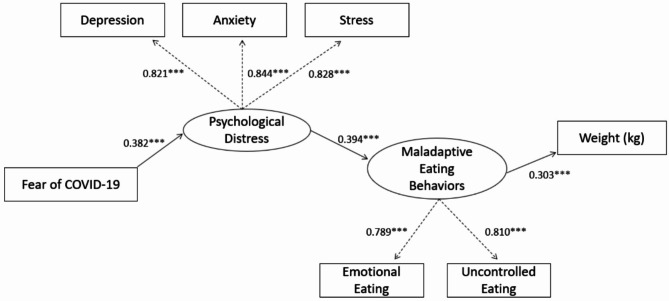
Higher fear of COVID-19 was significantly associated with increased emotional and uncontrolled eating, even after adjusting for psychological distress and other covariates. Specifically, each unit increase in fear of COVID-19 scores was associated with a corresponding increase in emotional eating (β = 0.018) and uncontrolled eating (β = 0.029) behaviors (p-values < 0.0001). Furthermore, fear of COVID-19 was linked to higher odds of engaging in binge eating (OR = 1.05, 95% CI: 1.03, 1.07, p-value < 0.0001) and nighttime eating behaviors (OR = 1.04, 95% CI: 1.03, 1.06, p-value < 0.0001) in models adjusted for covariates; however, these associations were no longer significant when psychological distress variables were included. Fear of COVID-19 was also associated with body weight (β = 0.18) and BMI (β = 0.08) even with adjustments of covariates and psychological distress variables (p-values < 0.01). Structural equation modeling showed that fear of COVID-19 was related to current body weight through its impact on psychological distress and maladaptive eating behaviors.

CONCLUSIONS

Maladaptive eating behaviors influenced by the psychological distress experienced during the COVID-19 pandemic have persisted into the later stages of the pandemic. These results underscore an interconnectedness between functional fear and its influence on maladaptive eating behaviors and body weight. Understanding this link is crucial and has the potential to inform the development of public health policies.

TRIAL REGISTRATION

Clinical Trials.gov NCT04896060 Date of Registration: May 21, 2021.

摘要

背景

新冠疫情对全球心理健康产生了重大影响,导致恐惧、压力和焦虑水平上升[1]。先前的研究表明,对有害心理健康结果的功能性恐惧与可能导致适应不良饮食行为的心理压力源之间存在关联。本研究探讨了疫情后期对新冠的恐惧、心理困扰(焦虑、抑郁和压力)、适应不良饮食行为(情绪化、无节制、暴饮暴食和夜间进食)以及自我报告的体重之间的关联。

方法

这是一项于2022年2月至2024年2月进行的全球横断面调查,涉及来自25个国家的4390名成年人(70%为女性)。该调查收集了有关人口统计学、心理社会影响、饮食行为和与新冠相关行为的信息。使用一般线性模型、多项逻辑回归模型和结构方程模型对数据进行分析。

结果

即使在调整了心理困扰和其他协变量后,对新冠的更高恐惧与情绪化和无节制饮食的增加显著相关。具体而言,新冠恐惧得分每增加一个单位,与情绪化饮食(β = 0.018)和无节制饮食(β = 0.029)行为的相应增加相关(p值<0.0001)。此外,在调整协变量的模型中,对新冠的恐惧与暴饮暴食(OR = 1.05,95% CI:1.03,1.07,p值<0.0001)和夜间进食行为(OR = 1.04,95% CI:1.03,1.06,p值<0.0001)的更高几率相关;然而,当纳入心理困扰变量时,这些关联不再显著。即使调整了协变量和心理困扰变量,对新冠的恐惧也与体重(β = 0.18)和BMI(β = 0.08)相关(p值<0.01)。结构方程模型表明,对新冠的恐惧通过其对心理困扰和适应不良饮食行为的影响与当前体重相关。

结论

受新冠疫情期间经历的心理困扰影响的适应不良饮食行为一直持续到疫情后期。这些结果强调了功能性恐惧与其对适应不良饮食行为和体重的影响之间的相互联系。理解这种联系至关重要,并且有可能为公共卫生政策的制定提供信息。

试验注册

ClinicalTrials.gov NCT04896060 注册日期:2021年5月21日。
https://cdn.ncbi.nlm.nih.gov/pmc/blobs/aa6b/11987404/3f8389e970d4/12889_2025_22444_Fig3_HTML.jpg
https://cdn.ncbi.nlm.nih.gov/pmc/blobs/aa6b/11987404/7a706ecb8ec3/12889_2025_22444_Fig1_HTML.jpg
https://cdn.ncbi.nlm.nih.gov/pmc/blobs/aa6b/11987404/b4c0bd6b39f7/12889_2025_22444_Fig2_HTML.jpg
https://cdn.ncbi.nlm.nih.gov/pmc/blobs/aa6b/11987404/3f8389e970d4/12889_2025_22444_Fig3_HTML.jpg
https://cdn.ncbi.nlm.nih.gov/pmc/blobs/aa6b/11987404/7a706ecb8ec3/12889_2025_22444_Fig1_HTML.jpg
https://cdn.ncbi.nlm.nih.gov/pmc/blobs/aa6b/11987404/b4c0bd6b39f7/12889_2025_22444_Fig2_HTML.jpg
https://cdn.ncbi.nlm.nih.gov/pmc/blobs/aa6b/11987404/3f8389e970d4/12889_2025_22444_Fig3_HTML.jpg

相似文献

1
The impact of COVID-19 fear during the later stages of the pandemic on maladaptive eating, psychological distress and body weight: a global cross-sectional study.新冠疫情后期对适应不良饮食、心理困扰和体重的恐惧影响:一项全球横断面研究。
BMC Public Health. 2025 Apr 11;25(1):1365. doi: 10.1186/s12889-025-22444-6.
2
A model of occupational stress to assess impact of COVID-19 on critical care and redeployed nurses: a mixed-methods study.一种评估 COVID-19 对重症护理和重新调配护士影响的职业压力模型:一项混合方法研究。
Health Soc Care Deliv Res. 2024 Dec 18:1-32. doi: 10.3310/PWRT8714.
3
Physical interventions to interrupt or reduce the spread of respiratory viruses.物理干预措施以阻断或减少呼吸道病毒的传播。
Cochrane Database Syst Rev. 2023 Jan 30;1(1):CD006207. doi: 10.1002/14651858.CD006207.pub6.
4
Economic Deterioration and Social Factors Affecting Mental Health During the COVID-19 Pandemic in Japan: Web-Based Cross-Sectional Survey.日本新冠疫情期间影响心理健康的经济恶化与社会因素:基于网络的横断面调查
JMIR Form Res. 2025 Jun 10;9:e65204. doi: 10.2196/65204.
5
COVID-19-Related Increases in Depressive and Anxious Symptoms Are Associated with Maladaptive Eating Among Patients up to 4 years Post-bariatric Surgery.新冠肺炎相关的抑郁和焦虑症状增加与患者在减重手术后 4 年内的不良进食行为有关。
Obes Surg. 2024 Jul;34(7):2580-2586. doi: 10.1007/s11695-024-07326-x. Epub 2024 Jun 6.
6
Psychological distress during the COVID-19 pandemic in Canada.加拿大 COVID-19 大流行期间的心理困扰。
PLoS One. 2022 Nov 17;17(11):e0277238. doi: 10.1371/journal.pone.0277238. eCollection 2022.
7
Antibody tests for identification of current and past infection with SARS-CoV-2.抗体检测用于鉴定 SARS-CoV-2 的现症感染和既往感染。
Cochrane Database Syst Rev. 2022 Nov 17;11(11):CD013652. doi: 10.1002/14651858.CD013652.pub2.
8
The cumulative impact of trauma, chronic illness, and COVID-19 stress on mental health in a case-control study of adults with psychotic disorders in Ethiopia.在一项针对埃塞俄比亚有精神病障碍的成年人的病例对照研究中,创伤、慢性疾病和 COVID-19 压力对心理健康的累积影响。
Compr Psychiatry. 2024 Oct;134:152508. doi: 10.1016/j.comppsych.2024.152508. Epub 2024 Jun 12.
9
The impact of the COVID-19 pandemic on eating disorders: A systematic review.新冠疫情对进食障碍的影响:一项系统综述。
Int J Eat Disord. 2023 Jan;56(1):5-25. doi: 10.1002/eat.23704. Epub 2022 Apr 5.
10
Exploring the Impact of the COVID-19 Pandemic on Student Mental Health: A Repeated Cross-Sectional Study.探索新冠疫情对学生心理健康的影响:一项重复横断面研究。
Int J Environ Res Public Health. 2025 Jun 8;22(6):913. doi: 10.3390/ijerph22060913.

本文引用的文献

1
The state of mental health among Ebola virus disease survivors through a cross-sectional study in Sierra Leone.塞拉利昂一项横断面研究显示埃博拉病毒病幸存者的心理健康状况。
BMJ Glob Health. 2024 May 23;9(5):e015098. doi: 10.1136/bmjgh-2024-015098.
2
Fear of COVID-19, insomnia, and eating disorder symptoms among Iranian college students.伊朗大学生对新冠病毒的恐惧、失眠及饮食失调症状
J Affect Disord Rep. 2023 Jul;13:100601. doi: 10.1016/j.jadr.2023.100601. Epub 2023 May 20.
3
Exploring the impact of the COVID-19 pandemic on perceptual disturbances and dysfunctional eating attitudes and behaviors: A review of the literature.
探索新冠疫情对知觉障碍以及功能失调的饮食态度和行为的影响:文献综述
Front Psychol. 2023 Mar 15;14:1139261. doi: 10.3389/fpsyg.2023.1139261. eCollection 2023.
4
Relationship between Mental Health and Emotional Eating during the COVID-19 Pandemic: A Systematic Review.新冠疫情期间心理健康与情绪性进食的关系:系统综述。
Nutrients. 2022 Sep 26;14(19):3989. doi: 10.3390/nu14193989.
5
The impacts of COVID-19 on eating disorders and disordered eating: A mixed studies systematic review and implications.2019年冠状病毒病对饮食失调和紊乱饮食的影响:一项混合研究的系统评价及启示
Front Psychol. 2022 Sep 6;13:926709. doi: 10.3389/fpsyg.2022.926709. eCollection 2022.
6
A systematic review of fear, stigma, and mental health outcomes of pandemics.关于大流行病引发的恐惧、污名化和精神健康后果的系统综述。
J Ment Health. 2023 Oct;32(5):920-934. doi: 10.1080/09638237.2022.2091754. Epub 2022 Jul 6.
7
Everyday discrimination as a predictor of maladaptive and adaptive eating: Findings from EAT 2018.日常歧视预测不良和适应性进食:来自 EAT 2018 的发现。
Appetite. 2022 Mar 1;170:105878. doi: 10.1016/j.appet.2021.105878. Epub 2021 Dec 22.
8
The COVID-19 Fear Scale (FCV-19S): Psychometric properties and invariance of the measure in the Spanish version.新型冠状病毒肺炎恐惧量表(FCV-19S):西班牙语版的心理测量学特性和不变性。
Actas Esp Psiquiatr. 2021 May;49(3):96-105. Epub 2021 May 1.
9
The impact of COVID-19 lockdown on disordered eating behaviors: the mediation role of psychological distress.COVID-19 封锁对饮食失调行为的影响:心理困扰的中介作用。
Eat Weight Disord. 2022 Feb;27(1):179-188. doi: 10.1007/s40519-021-01128-1. Epub 2021 Mar 13.
10
The Psychological Consequences of COVID-19 Fear and the Moderator Effects of Individuals' Underlying Illness and Witnessing Infected Friends and Family.COVID-19 恐惧的心理后果,以及个体潜在疾病和目睹感染朋友和家人的调节作用。
Int J Environ Res Public Health. 2021 Feb 13;18(4):1836. doi: 10.3390/ijerph18041836.