Zhou Jiawei, Cheng Anqi, Guo Jianqiang, Liu Yafeng, Li Xuan, Chen Maoqian, Hu Dong, Wu Jing
School of Medicine, Anhui University of Science and Technology, Huainan, Anhui, 232000, China.
School of Medicine, The First Affiliated Hospital of Anhui University of Science and Technology Huainan First People's Hospital, Huainan, Anhui, 232000, China.
J Transl Med. 2025 Apr 11;23(1):434. doi: 10.1186/s12967-025-06441-2.
Triple-negative breast cancer (TNBC) is characterized by high invasiveness, high potential for metastasis, easy recurrence, and poor prognosis. There is an urgent need to develop new clinical treatments.
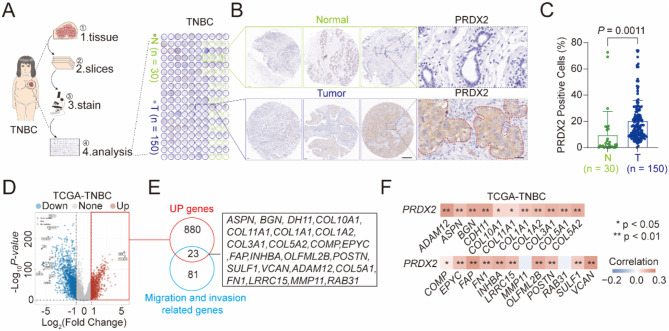
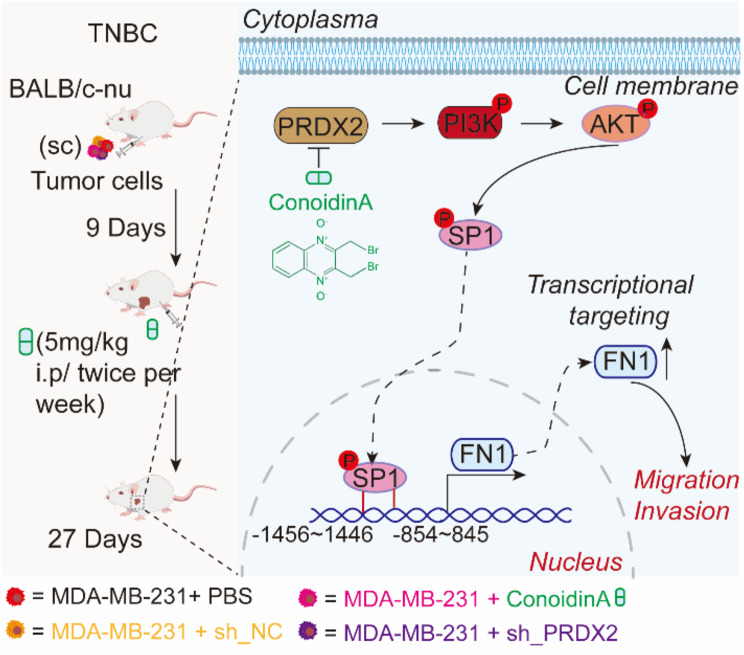
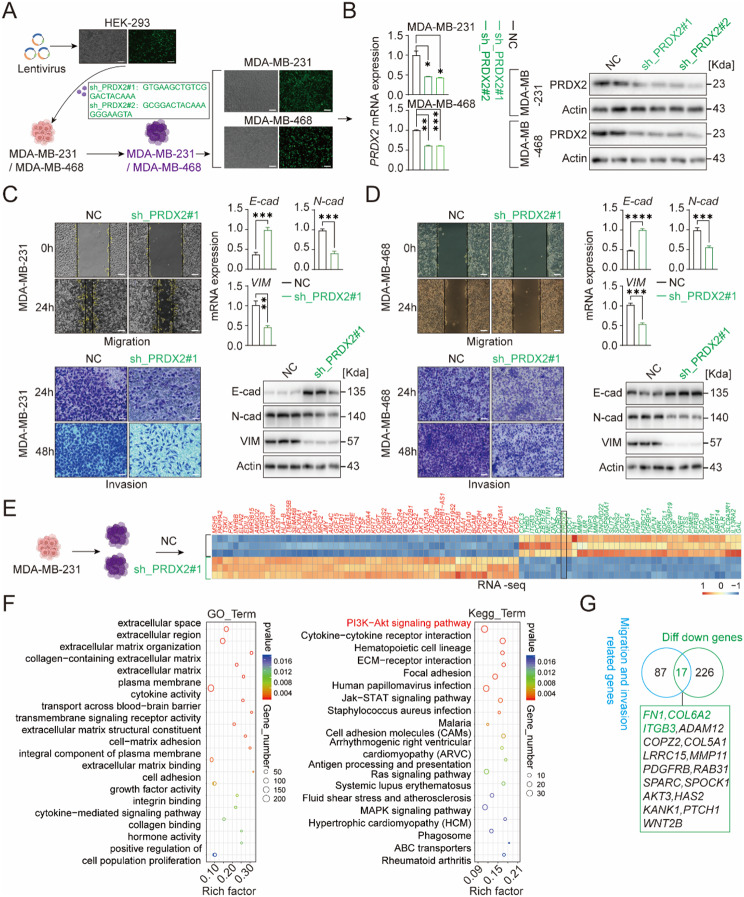
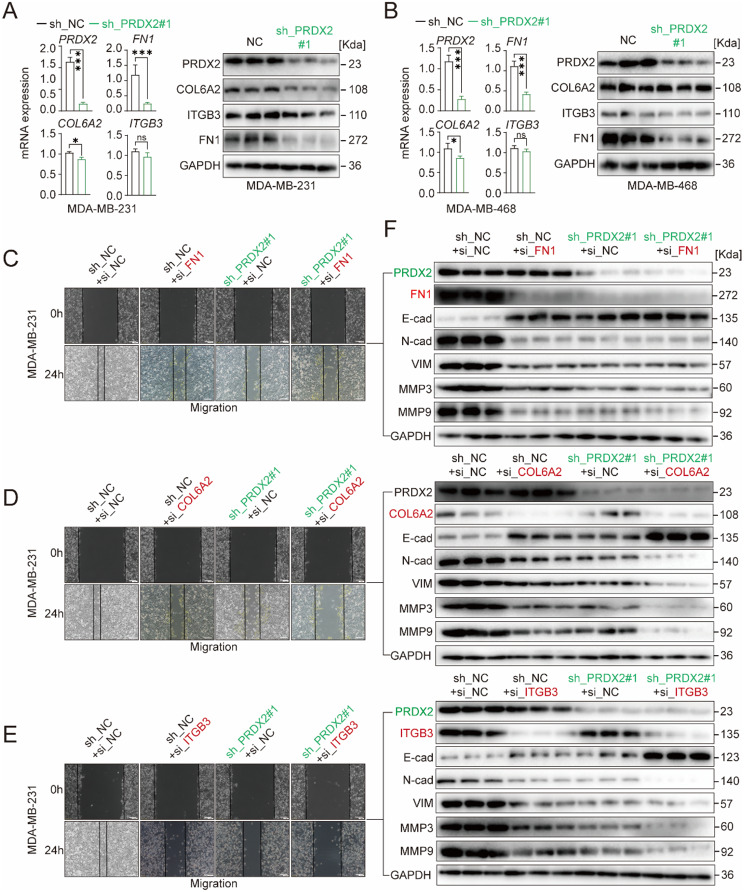
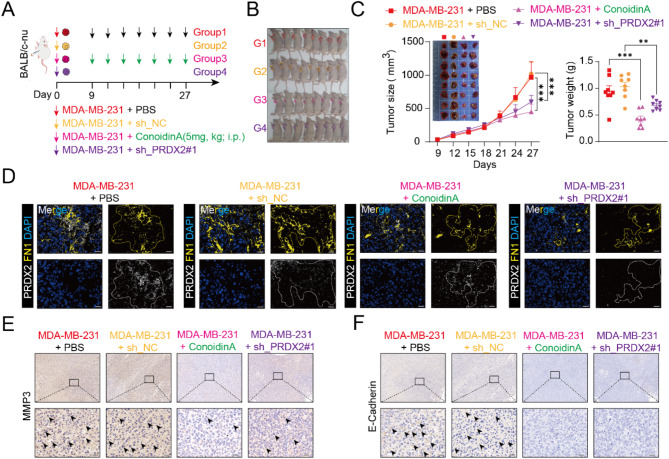
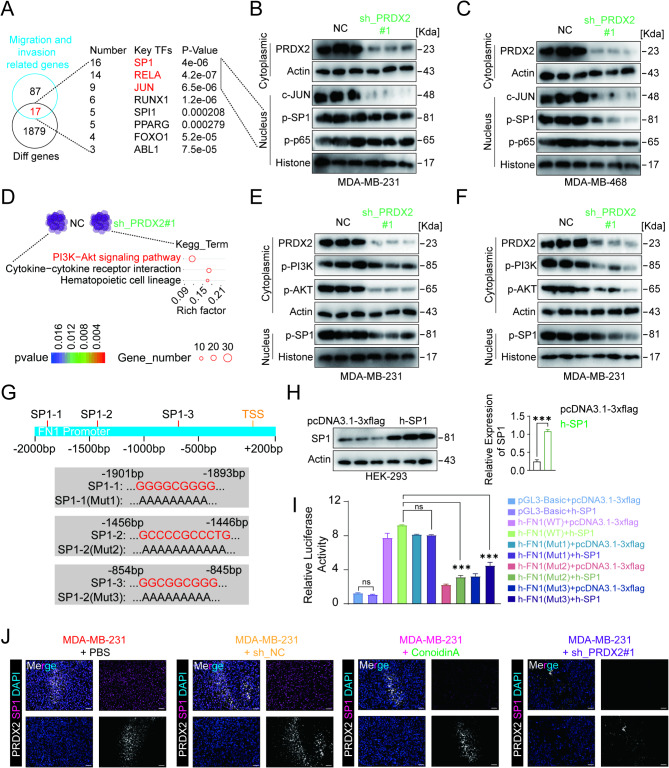
This study utilized TNBC tissue microarrays to detect Peroxiredoxin 2 (PRDX2) expression levels and analyzed the correlation between PRDX2 and tumor invasion as well as invasion-related gene expression through the TCGA database. A stable PRDX2-knockdown triple-negative breast cancer cell line was established using lentiviral technology. The effects of PRDX2 on triple-negative breast cancer cell migration, invasion, and epithelial-mesenchymal transition (EMT) were investigated via wound healing assays, Transwell assays, qPCR, and Western blotting. RNA sequencing (RNA-seq), Western blotting, and dual luciferase reporter assays were performed to confirm that PRDX2 regulates FN1 expression through SP1. Furthermore, subcutaneous tumor xenograft models in nude mice were constructed to assess the effects of PRDX2 knockdown and the PRDX2 inhibitor Conoidin A on tumor growth in vivo.
Tissue microarray detection and correlative analysis revealed that PRDX2 is significantly upregulated in triple-negative breast cancer (TNBC) tumor tissues and positively correlated with genes associated with cell migration and invasion. Functional experiments demonstrated that in vitro knockdown of PRDX2 suppresses migration, invasion, and epithelial-mesenchymal transition (EMT) in TNBC cells. Furthermore, in vivo knockdown of PRDX2 or treatment with the PRDX2 inhibitor Conoidin A effectively reduced tumor burden. Mechanistic investigations utilizing RNA sequencing (RNA-seq) identified FN1 as a critical gene promoting TNBC cell migration and invasion. PRDX2 facilitates TNBC progression by activating the PI3K/AKT signaling pathway, which enhances SP1 binding to the FN1 gene promoter. This regulatory cascade ultimately drives tumor advancement in TNBC.
This study elucidates the role of the PRDX2/SP1/FN1 axis in TNBC migration and invasion, and highlights PRDX2 as a promising therapeutic target for triple-negative breast cancer.
三阴性乳腺癌(TNBC)具有高侵袭性、高转移潜能、易复发及预后差的特点。迫切需要开发新的临床治疗方法。
本研究利用三阴性乳腺癌组织芯片检测过氧化物还原酶2(PRDX2)的表达水平,并通过TCGA数据库分析PRDX2与肿瘤侵袭以及侵袭相关基因表达之间的相关性。利用慢病毒技术建立稳定敲低PRDX2的三阴性乳腺癌细胞系。通过伤口愈合实验、Transwell实验、qPCR和蛋白质免疫印迹法研究PRDX2对三阴性乳腺癌细胞迁移、侵袭及上皮-间质转化(EMT)的影响。进行RNA测序(RNA-seq)、蛋白质免疫印迹法和双荧光素酶报告基因实验以证实PRDX2通过SP1调节纤连蛋白1(FN1)的表达。此外,构建裸鼠皮下肿瘤异种移植模型,以评估敲低PRDX2及PRDX2抑制剂锥虫蓝素A对体内肿瘤生长的影响。
组织芯片检测及相关性分析显示,PRDX2在三阴性乳腺癌(TNBC)肿瘤组织中显著上调,且与细胞迁移和侵袭相关基因呈正相关。功能实验表明,体外敲低PRDX2可抑制TNBC细胞的迁移、侵袭及上皮-间质转化(EMT)。此外,体内敲低PRDX2或用PRDX2抑制剂锥虫蓝素A治疗可有效减轻肿瘤负担。利用RNA测序(RNA-seq)进行的机制研究确定FN1是促进TNBC细胞迁移和侵袭的关键基因。PRDX2通过激活PI3K/AKT信号通路促进TNBC进展,该信号通路增强了SP1与FN1基因启动子的结合。这一调节级联最终推动TNBC肿瘤进展。
本研究阐明了PRDX2/SP1/FN1轴在TNBC迁移和侵袭中的作用,并突出了PRDX2作为三阴性乳腺癌有前景的治疗靶点。