Tian Qingyan, Guo Haiyue, Zhang Mengyao, Jiang Kunmao, Hu Fan, Xu Yan, Wan Li, Zhou Xiaokai, Pan Yinbing, Liu Wentao, Jiang Chun-Yi
Jiangsu Key Laboratory of Neurodegeneration, Department of Pharmacology, Nanjing Medical University, Nanjing, Jiangsu, 211166, China.
Department of Pain, The First People's Hospital of Changzhou, Soochow University, Changzhou, Jiangsu, China.
Cell Commun Signal. 2025 Apr 11;23(1):181. doi: 10.1186/s12964-025-02181-4.
The development of morphine tolerance presents a major clinical challenge in the effective management of severe pain. This study aims to explore the mechanisms underlying morphine tolerance from a novel perspective, with the ultimate goal of uncovering new insights and identifying promising therapeutic targets for its treatment.
C57BL/6J mice were used in the tail-flick test to evaluate morphine tolerance. Neutrophils derived from mouse bone marrow were employed to investigate the mechanisms underlying morphine-induced NETs formation. Bone marrow-derived macrophages (BMDMs) were harvested from the femur and tibia to study the role of NETs-induced inflammation in analgesic tolerance. Proinflammatory cytokines were measured using Western blotting and real-time PCR. The levels of NETs and the TLR7/9-NLRP3-related signaling pathway were assessed through Western blotting, real-time PCR, and ELISA. Confocal laser scanning microscopy was utilized to visualize NETs in the dorsal root ganglion (DRG) and in cells.
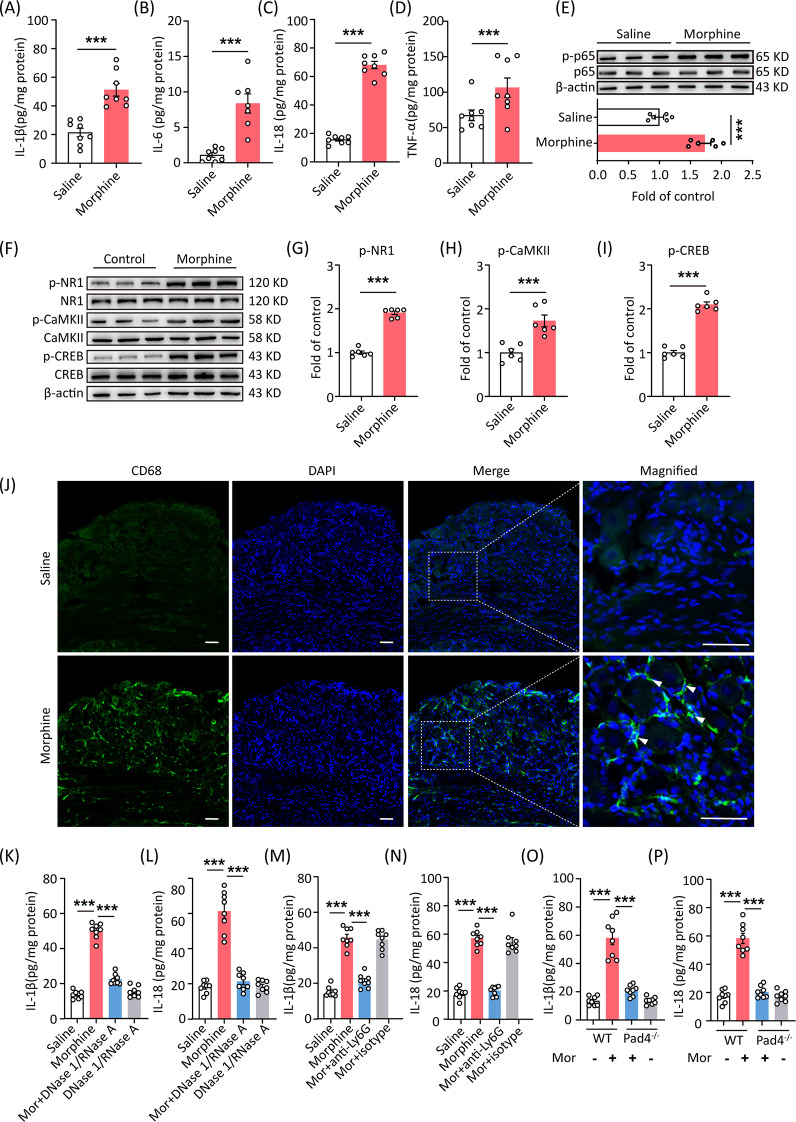
Our experiments demonstrated that the levels of NETs in the plasma of patients using morphine for analgesia, as well as in morphine-tolerant animals, were significantly elevated. Genetic elimination of Pad4, neutrophil depletion, and treatment with DNase 1 and RNase A to disrupt NETs formation all effectively alleviated morphine tolerance. These findings indicate that NETs play a critical role in the development of morphine tolerance. Mechanistically, we discovered that morphine-induced NETs can be engulfed by macrophages through the GAS6-AXL axis, which subsequently triggers the activation of the TLR7/TLR9-mediated NLRP3 inflammasome, leading to significantly increased levels of IL-1β and IL-18, and ultimately contributing to tolerance. Deletion of Axl, Gas6, or Nlrp3 each significantly improved morphine tolerance. Furthermore, in the murine model, treatment with the IL-1 receptor antagonist anakinra and the IL-18 decoy receptor IL-18BP prevented the development of morphine tolerance.
This study identifies morphine-induced NETs as a key contributor to morphine tolerance, with the GAS6-AXL-TLR7/9 axis emerging as a potential therapeutic target. Strategies focused on disrupting NETs and modulating this axis may offer a promising approach to combat morphine tolerance.
吗啡耐受性的发展是严重疼痛有效管理中的一项重大临床挑战。本研究旨在从一个新的角度探索吗啡耐受性的潜在机制,最终目标是揭示新的见解并确定有前景的治疗靶点。
使用C57BL/6J小鼠进行甩尾试验以评估吗啡耐受性。利用从小鼠骨髓中分离出的中性粒细胞来研究吗啡诱导的中性粒细胞胞外陷阱(NETs)形成的机制。从股骨和胫骨中获取骨髓来源的巨噬细胞(BMDMs),以研究NETs诱导的炎症在镇痛耐受性中的作用。使用蛋白质免疫印迹法和实时聚合酶链反应(PCR)检测促炎细胞因子。通过蛋白质免疫印迹法、实时PCR和酶联免疫吸附测定(ELISA)评估NETs水平以及Toll样受体7/9(TLR7/9)-NOD样受体蛋白3(NLRP3)相关信号通路。利用共聚焦激光扫描显微镜观察背根神经节(DRG)和细胞中的NETs。
我们的实验表明,使用吗啡镇痛的患者以及吗啡耐受动物血浆中的NETs水平显著升高。Pad4基因敲除、中性粒细胞清除以及用脱氧核糖核酸酶1(DNase 1)和核糖核酸酶A(RNase A)处理以破坏NETs形成均有效减轻了吗啡耐受性。这些发现表明NETs在吗啡耐受性的发展中起关键作用。从机制上讲,我们发现吗啡诱导的NETs可通过生长停滞特异性蛋白6(GAS6)-AXL轴被巨噬细胞吞噬,随后触发TLR7/TLR9介导的NLRP3炎性小体的激活,导致白细胞介素-1β(IL-1β)和白细胞介素-18(IL-18)水平显著升高,最终导致耐受性。敲除Axl、Gas6或Nlrp3均可显著改善吗啡耐受性。此外,在小鼠模型中,用IL-1受体拮抗剂阿那白滞素和IL-18诱饵受体IL-18BP进行治疗可预防吗啡耐受性的发展。
本研究确定吗啡诱导的NETs是吗啡耐受性的关键促成因素,GAS6-AXL-TLR7/9轴成为一个潜在的治疗靶点。专注于破坏NETs和调节该轴的策略可能为对抗吗啡耐受性提供一种有前景的方法。