Berclaz Luc M, Di Gioia Dorit, Völkl Michael, Jurinovic Vindi, Klein Alexander, Dürr Hans Roland, Knösel Thomas, Teodorescu Bianca, Enßle Stefan, Rippl Michaela, von Bergwelt-Baildon Michael, Kunz Wolfgang G, Lindner Lars H, Burkhard-Meier Anton
Department of Internal Medicine III, University Hospital, LMU Munich, Munich, Germany.
German Cancer Consortium (DKTK), Partner Site Munich, Munich, Germany.
BMC Cancer. 2025 Apr 11;25(1):671. doi: 10.1186/s12885-025-14050-x.
The prognostic and predictive value of obesity and sarcopenia remains poorly defined in patients with high-risk soft tissue sarcoma (HR-STS). We sought to correlate clinical outcomes with CT-based body composition parameters in patients with HR-STS undergoing a multimodal preoperative therapy. The impact of radiologic and histopathologic response to preoperative treatment was correlated with individual fat and muscle distribution.
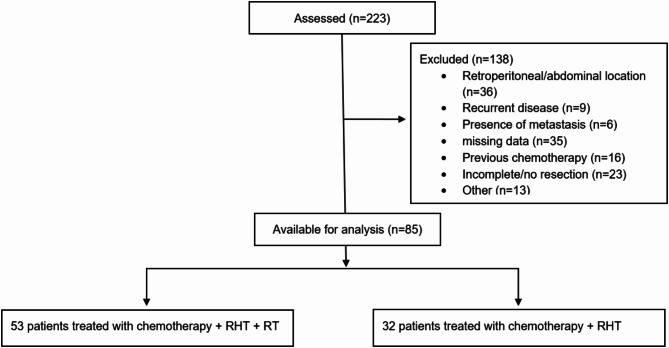
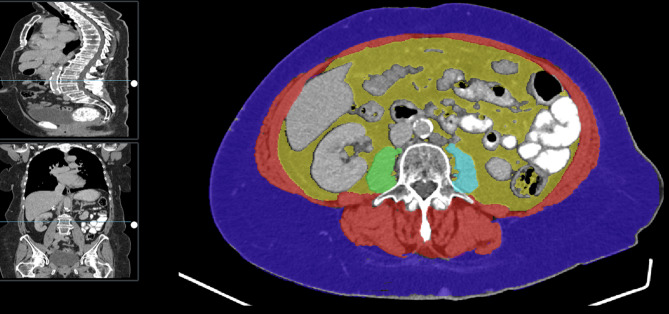
Patients with locally advanced non-abdominal HR-STS and treatment with preoperative chemotherapy + regional hyperthermia (RHT) +/- radiotherapy (RT) followed by surgery between 2015 and 2022 were retrospectively evaluated. Body composition parameters measured on baseline CT scans were correlated with clinical outcomes including event-free survival (EFS) and overall survival (OS) as well as radiologic and histopathologic treatment response.
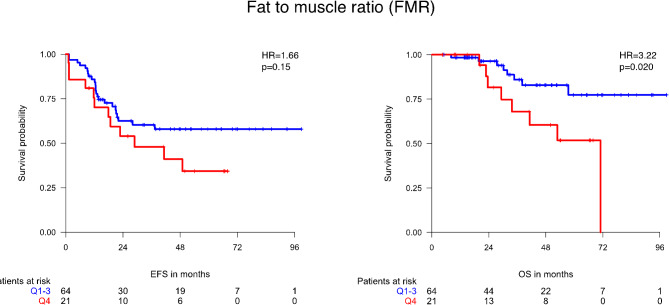
A total of 85 patients were included. Body composition parameters showed no significant correlation with radiologic or histopathologic treatment response. High total fat indices such as the total fat index (TFI, HR 3.56, p = 0.005) and high total fat to muscle ratio (FMR, HR 3.22, p = 0.020) were strongly associated with poor OS. Parameters for sarcopenia including skeletal muscle index (SMI) were not significantly linked to survival outcomes.
High fat indices and a high FMR are strong predictors of poor OS in patients with HR-STS. Larger studies are warranted to further clarify the prognostic impact of sarcopenia and the predictive value of body composition parameters on preoperative treatment response.
肥胖和肌肉减少症在高危软组织肉瘤(HR-STS)患者中的预后和预测价值仍不明确。我们试图将接受多模式术前治疗的HR-STS患者的临床结局与基于CT的身体成分参数相关联。术前治疗的放射学和组织病理学反应的影响与个体脂肪和肌肉分布相关。
回顾性评估2015年至2022年间局部晚期非腹部HR-STS患者,这些患者接受术前化疗+区域热疗(RHT)+/-放疗(RT),随后进行手术。在基线CT扫描上测量的身体成分参数与包括无事件生存期(EFS)和总生存期(OS)以及放射学和组织病理学治疗反应在内的临床结局相关联。
共纳入85例患者。身体成分参数与放射学或组织病理学治疗反应无显著相关性。高总脂肪指数,如总脂肪指数(TFI,风险比3.56,p = 0.005)和高总脂肪与肌肉比率(FMR,风险比3.22,p = 0.020)与较差的OS密切相关。包括骨骼肌指数(SMI)在内的肌肉减少症参数与生存结局无显著关联。
高脂肪指数和高FMR是HR-STS患者OS较差的强预测指标。需要进行更大规模的研究以进一步阐明肌肉减少症的预后影响以及身体成分参数对术前治疗反应的预测价值。