Balan Gheorghe G, Toader Elena, Zenovia Sebastian, Juncu Simona, Iacob Andreea, Nastasa Robert, Sfarti Catalin Victor, Trifan Anca, Knieling Anton
Institute of Gastroenterology and Hepatology, St. Spiridon Iasi County Emergency Clinical Hospital, 700111 Iasi, Romania.
General Medicine Department, Grigore T. Popa University of Medicine and Pharmacy of Iasi, 700115 Iasi, Romania.
J Clin Med. 2025 Mar 22;14(7):2181. doi: 10.3390/jcm14072181.
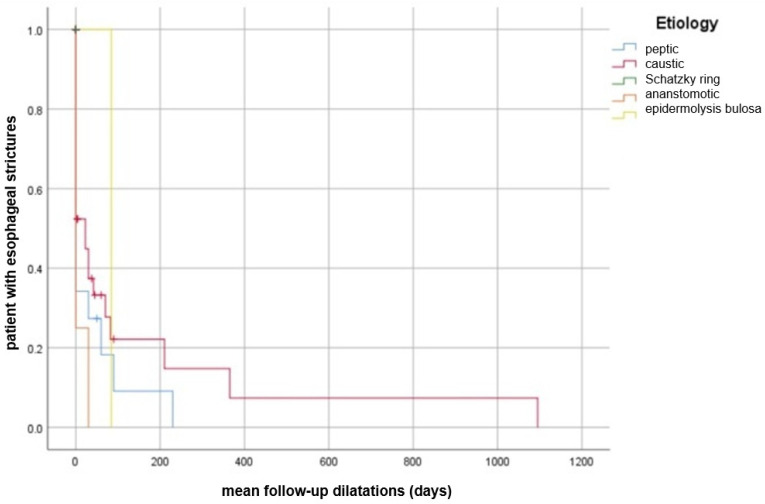
: Over the last two decades, therapy for benign esophageal strictures has shifted from empirical dilatations and surgery to evidence-based and complex endoscopic and surgical procedures, aiming to achieve long-term esophageal patency. Aim: The purpose of our study is to provide descriptive evidence regarding the appropriate tailored medical, endoscopic, and surgical management of benign esophageal strictures. : This retrospective study includes patients with benign esophageal strictures; the data collected encompass the complete patient profiles, detailed etiologic and anatomic workups of the strictures, comprehensive imaging, as well as management and follow-up details. Technical and clinical success rates, adverse events, stricture patency, and the need for additional therapy have been evaluated. : Most of the strictures (80.2%) were complex, requiring advanced techniques for management. The primary treatment involved endoscopic dilation, performed with Savary-Gillard bougie dilators in 76.7% of cases and pneumatic balloon dilators in 23.3% of cases. Clinical success was achieved in 95.3% of patients, with a significant improvement in the Ogilvie dysphagia score. Patients with caustic strictures required repeated dilations over the years, compared to shorter intervals for peptic strictures. Adverse events were minimal (e.g., perforation 2.3% and bleeding 4.7%) and managed predominantly endoscopically. Refractory strictures (16.3%) required advanced interventions, including fully covered self-expandable metallic stents (fc-SEMS) and corticosteroid injections. : Both our data and the current literature support the use of tailored endoscopic strategies as the first-choice options for managing benign esophageal strictures. Our results strongly suggest against one-size-fits-all therapeutic alternatives.
在过去二十年中,良性食管狭窄的治疗已从经验性扩张和手术转向基于证据的复杂内镜和外科手术,旨在实现食管长期通畅。目的:我们研究的目的是提供关于良性食管狭窄适当的个性化医学、内镜和外科治疗的描述性证据。 这项回顾性研究纳入了良性食管狭窄患者;收集的数据包括完整的患者资料、狭窄的详细病因和解剖学检查、全面的影像学检查以及治疗和随访细节。评估了技术成功率和临床成功率、不良事件、狭窄通畅情况以及额外治疗的需求。 大多数狭窄(80.2%)较为复杂,需要先进技术进行治疗。主要治疗方法为内镜扩张,76.7%的病例使用Savary-Gillard探条扩张器,23.3%的病例使用气囊扩张器。95.3%的患者取得了临床成功,奥吉尔维吞咽评分有显著改善。与消化性狭窄相比,腐蚀性狭窄患者多年来需要反复扩张。不良事件极少(如穿孔2.3%,出血4.7%)且主要通过内镜处理。难治性狭窄(16.3%)需要先进的干预措施,包括全覆膜自膨式金属支架(fc-SEMS)和皮质类固醇注射。 我们的数据和当前文献均支持使用个性化内镜策略作为管理良性食管狭窄的首选方案。我们的结果强烈反对一刀切的治疗选择。